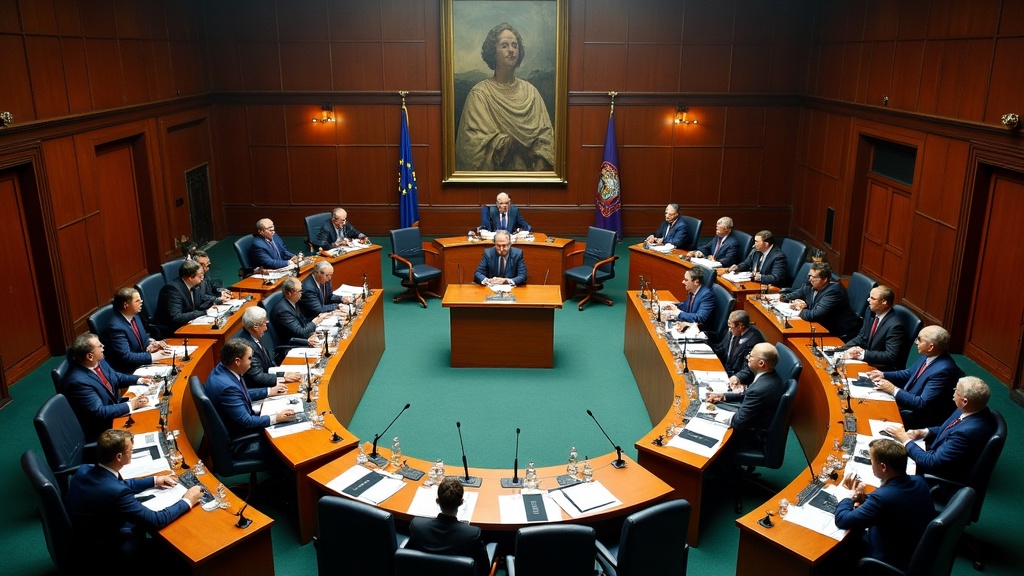
At 5:21 p.m. Eastern Time on Friday, June 13, Commerce Secretary Howard Lutnick's letter arrived at Anthropic's offices. By 9 p.m., Fable 5 and Mythos 5 were offline for every user outside the United States. By Saturday morning, European parliaments were holding emergency discussions about what "sovereignty" means when the most powerful AI tool on the planet can be switched off by a foreign government with a single letter.
What Actually Happened
The Trump administration ordered Anthropic to disable its Fable 5 and Mythos 5 models for all foreign nationals, effective immediately, citing national security concerns. Business Standard confirmed the Commerce Department's order specified "all foreign nationals, whether inside or outside the United States," which meant that a German researcher at MIT using Fable 5 for a dissertation lost access at the same moment a software engineer in Seoul did. Anthropic CEO Dario Amodei received the letter from Lutnick personally and announced compliance within hours, releasing a statement that read: "The net effect of this order is that we must abruptly disable Fable 5 and Mythos 5 for all our customers to ensure compliance." The company gave no advance warning. Enterprise clients, research institutions, and government contractors in allied countries found their workflows severed overnight. Anthropic's enterprise support queues reportedly received thousands of tickets before dawn.
The specific models targeted represent Anthropic's most advanced publicly accessible frontier systems. Fable 5, released earlier this year, had scored at the top of nearly every major benchmark across reasoning, coding, and scientific analysis. Mythos 5, its companion model optimized for long-document processing and research synthesis, was the backbone of dozens of institutional workflows across Europe, Japan, South Korea, and Australia. These were not experimental models: they were production-grade systems embedded in legal research platforms, pharmaceutical discovery pipelines, and government-facing document analysis tools in countries that are formal American treaty allies. The cutoff applied regardless of the client's relationship with the US government, regardless of whether the user was a NATO member, and regardless of whether the use case had any conceivable national security relevance. As RedState reported, the Trump administration framed the action as a consequence of Fable 5's unprecedented capability level, citing concerns about foreign adversaries accessing reasoning capabilities that approach or exceed expert human performance on sensitive technical tasks.
The timing was commercially damaging. Anthropic had filed its confidential S-1 on June 1 and was preparing for a Q4 2026 IPO targeting a valuation of $60 billion or higher. An IPO prospectus naturally requires disclosure of material risks, and an active government export restriction on your flagship product constitutes precisely the kind of material risk that institutional investors scrutinize carefully. Within hours of the cutoff announcement, financial analysts began revising their Anthropic revenue models, noting that international enterprise accounts represent a growing share of Anthropic's customer base. The restriction arrived at the worst possible moment commercially, even if the administration's national security rationale was genuine. Meanwhile, the world's most important geopolitical conversation about AI dependency had just been forced into the open by a single Friday afternoon letter.
Why This Matters More Than People Think
The immediate impact, inconvenient as it is, is not the real story. The real story is structural. Europe currently controls roughly 5% of global AI compute capacity compared to the United States' approximately 80%, according to analysis published by the European Commission. Those numbers have been known for years. Politicians and academics have been writing reports about AI sovereignty for the better part of three years. But reports about compute asymmetry produce a different emotional response than suddenly discovering that your company's core research tool was turned off overnight by a government you have no influence over. The Fable 5 cutoff is not primarily a story about Anthropic. It is a demonstration, at scale, of what a digitally dependent infrastructure looks like when the dependency becomes hostile or even merely unilateral.
Consider the business implications beyond the immediate API outage. European companies that built internal tools using Fable 5's API, that trained product managers on its capabilities, that signed multi-year enterprise contracts based on its performance characteristics now face a choice: migrate to less capable alternatives and absorb the productivity loss, or lobby their governments urgently for action that may take years to materialize. The middleware dependency problem is distinct from the compute dependency problem. Even if Europe built out its data centers tomorrow, the model capabilities that matter most require billions of dollars in training runs and years of alignment research. A compute facility is a building. A frontier AI model is an intellectual product that took hundreds of the world's top researchers and $500 million or more in compute costs to produce. Europe cannot build that faster than it can build a data center, and it cannot build either fast enough to address the current moment.
The deeper economic concern is the services layered on top. Euronews captured the scale of this concern in its coverage of European officials' immediate reactions: multiple heads of state and ministry-level officials were quoted within hours. Benjamin Haddad, the French minister responsible for European affairs, stated: "Europe cannot settle for being an open market dependent on technologies designed, funded, and controlled elsewhere." Tom Tugendhat, the British former security minister, framed it in terms that will resonate with defense circles: "sovereignty is more about code than cannons" in the current era of AI-enabled warfare. These are not marginal voices. They are senior officials of G7 governments, and their language on June 13 was dramatically more urgent than anything that had been said about AI sovereignty in any European forum before this week.
The Competitive Landscape
Europe's most credible domestic response to US AI dominance remains Mistral, the French startup that has raised over 3 billion euros since its founding. Mistral's latest models are genuinely competitive with second-tier US models, and the company has been careful to maintain EU data residency options and open-weight releases that satisfy European regulatory preferences. But Mistral is not Anthropic. Its most capable closed model is measurably behind Fable 5 on frontier benchmarks. That gap matters enormously for the specific use cases, such as complex scientific reasoning, multi-step legal analysis, and advanced coding, where Fable 5 had become the tool of choice for European enterprise clients. France's Bruno Retailleau, a presidential candidate, acknowledged this directly by calling for France to "rearm our technological power" and specifically naming Mistral as a strategic asset to be leveraged. However, even the most optimistic Mistral roadmap does not suggest frontier parity within the next 18 months.
The broader European competitive picture is worse. Beyond Mistral, the EU's primary frontier AI champions are at pre-commercial research stage. The EU's Tech Sovereignty Package, unveiled this week with notable urgency, proposes to triple EU data center capacity within five to seven years and establish a Cloud and AI Development Act designed to reduce reliance on American infrastructure. The EU's InvestAI pledge of 200 billion euros is real money, but it is dwarfed by what a single year of American hyperscaler capital expenditure represents. Google, Microsoft, Meta, and Amazon collectively plan to spend more than $300 billion on AI infrastructure in 2026 alone. The entire EU InvestAI pledge spread across five to seven years amounts to roughly 10% of that annual American run rate. The EU can build more data centers. It cannot, on current timelines, build the models that fill them with frontier capabilities.
The historical parallel that looms over this moment is the semiconductor supply chain crisis of 2020 to 2022. European automakers and electronics manufacturers learned painfully that a supply chain running through Taiwan and South Korea and controlled by American export rules could be disrupted at any moment for any reason. The European Chips Act that followed was a direct response to that lesson. But chips are physical goods with defined trade rules and WTO frameworks. AI models are software, delivered via APIs, and the legal framework governing their export is being written in real time by the Commerce Department. Former French Prime Minister Edouard Philippe put it precisely: "An infrastructure whose models and computing power we do not control is an infrastructure that others can unplug." He was describing the current reality of European AI dependency, and on June 13, the theoretical became concrete.
Hidden Insight: The Model Access Precedent Is Permanent
The critics are right that the Fable 5 and Mythos 5 restrictions are Anthropic-specific, linked to those models' specific capability profiles and an apparent jailbreak incident that gave the administration its national security pretext. The US government has already signaled it does not intend to apply the same restrictions to OpenAI's GPT models or Google's Gemini. But the relevant question is not whether this specific restriction will spread immediately. The question is what has changed about the fundamental nature of AI model access after June 13, 2026. The answer is: everything. For the first time, a US government has directly ordered an AI company to terminate foreign access to a specific model. The precedent exists. The mechanism is established. The next administration, or this one, can invoke it for any model, for any reason, with a letter and a 4-hour compliance window.
This matters for every company and government that has bet its AI strategy on US model providers. The calculation that European enterprises have been making, that US AI tools are effectively neutral commercial services like email or cloud storage, is now permanently wrong. Email providers do not receive letters from the Commerce Secretary instructing them to cut off specific categories of foreign users. Cloud storage services do not get shut off in NATO allies overnight. AI models, it turns out, occupy a different legal and strategic category: they are treated by the US government as the equivalent of advanced weapons systems, subject to export control rules that can be invoked unilaterally, without treaty obligation, and without prior notice to affected parties. Edouard Philippe's framing is not metaphorical. It is a legal description of what happened on Friday.
The second hidden dimension is the IPO market signal. Anthropic's S-1 was filed confidentially on June 1. The company is targeting a Q4 2026 listing. Every institutional investor analyzing the S-1 must now include a section on export restriction risk that did not exist two weeks ago. If the government can pull this lever once, it can pull it again. If Anthropic's next generation model achieves a higher frontier capability level, is there a mechanism to prevent a repeat? The honest answer is no: there is no contractual protection, no treaty framework, no bilateral agreement that prevents the Commerce Department from issuing another letter. This regulatory risk will appear in every AI company's S-1 going forward, not just Anthropic's. That represents a structural change in how investors price US AI companies with growing international revenue, now estimated at over 40% of enterprise accounts.
The third dimension is the most counterintuitive. The week after Fable 5 went dark for European users may actually accelerate EU AI development funding more than three years of policy papers and funding pledges had done. MEPs and ministers who had previously treated AI sovereignty as an important medium-term priority have been handed the most vivid possible demonstration of what dependency looks like. Jordan Bardella, the MEP from France's National Rally, stressed that nations must "quickly develop their own models" to avoid dependency. That framing, from a politician not historically associated with technology investment priorities, suggests the political coalition for serious EU AI investment has grown dramatically overnight. The bear case for EU AI sovereignty is that the regulatory posture of the EU AI Act, which imposes compliance costs that Mistral CEO Arthur Mensch has called "prohibitive for frontier research", simultaneously creates the urgency for sovereignty and the conditions that make achieving it harder. Critics argue that Europe cannot simultaneously demand frontier AI capabilities and impose the world's most restrictive AI regulations. That tension will define EU tech policy for the next decade.
What to Watch Next
The most important immediate indicator is whether the European Commission convenes emergency sessions specifically around AI model access rights within the next 30 days. If it does, expect a proposed framework for "strategic AI access agreements" with US model providers, similar to how the EU has historically negotiated data transfer frameworks like the EU-US Privacy Shield. The deadline pressure from France and Germany is real: both France and Germany have national elections approaching and AI sovereignty has become electoral material overnight. Watch specifically for any mention of a "European AI Models Registry" or mandatory open-weight requirements for models sold into EU markets.
At 90 days, watch Mistral's next fundraising round and whether the EU InvestAI fund makes its first major disbursement to a French or German AI lab. If the InvestAI fund moves capital within 90 days of the Fable 5 incident, that is strong evidence the political shock has translated into budgetary action. Watch also for the EU AI Act's implementation timeline: the High-Risk AI Systems provisions are scheduled to apply from August 2026, and the Fable 5 incident gives enforcement bodies political cover to apply those provisions aggressively to US model providers operating in the EU market.
Over the 180-day horizon, the key question is whether any European frontier model, Mistral or otherwise, passes the benchmark threshold where EU institutions can plausibly mandate its use for sensitive government workloads. If a European model can match or approach Fable 5's benchmark performance on the GPQA Diamond and similar reasoning benchmarks, the sovereignty argument becomes economically viable rather than merely politically necessary. At that point, the regulatory and fiscal tools available to EU member states, procurement requirements, data localization rules, and strategic subsidy programs, align with a genuine technical alternative. Until then, Europe's AI sovereignty push is more accurately described as a strategy in search of a product.
The first time a government switches off an AI model, it is a crisis. The second time, it is policy. Europe's urgency is not about Friday's outage. It is about preventing the third time from being routine.
Key Takeaways
- June 13 cutoff at 5:21 p.m. ET : Commerce Secretary Lutnick's letter forced Anthropic to disable Fable 5 and Mythos 5 for all foreign nationals within hours, affecting enterprise clients across 50+ countries
- Europe holds 5% of global AI compute : compared to the United States' roughly 80%, creating the dependency that made Friday's cutoff possible and Friday's reaction inevitable
- Multiple G7 European officials reacted within hours : France's Benjamin Haddad, Britain's Tom Tugendhat, and former French PM Edouard Philippe each issued statements calling for immediate AI sovereignty investment
- EU Tech Sovereignty Package unveiled this week : proposes tripling EU data center capacity within five to seven years and a Cloud and AI Development Act to reduce US dependency
- The export control precedent is permanent : regardless of whether this specific restriction spreads, the US government has established both the legal mechanism and the political willingness to terminate foreign AI model access unilaterally
Questions Worth Asking
- If the EU AI Act's compliance costs continue to deter domestic frontier AI investment, how does Europe plan to achieve the capability level required for genuine sovereignty, and is "sovereignty" achievable without frontier capability?
- Which European enterprise sectors have built the deepest dependencies on US frontier AI models, and what is the realistic cost of migrating those workflows to EU-based alternatives at current capability parity gaps?
- If the US government is willing to restrict its allies' access to frontier AI on national security grounds, what does that signal about how Washington views the AI capabilities gap between the US and its treaty partners?