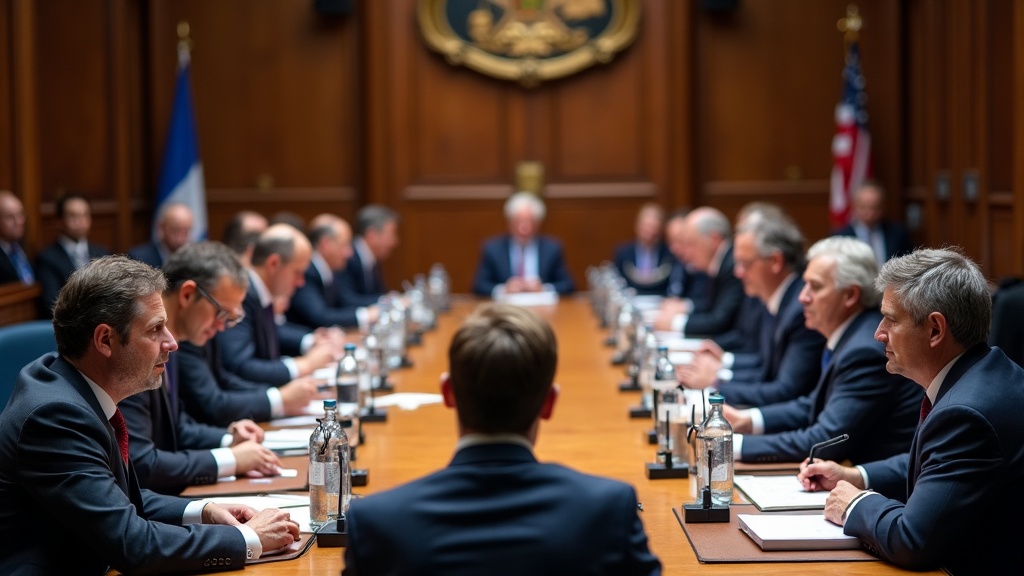
The French lakeside resort of Évian-les-Bains hosted something the world had never seen before on June 15, 2026: a G7 Leaders' Summit where Sam Altman of OpenAI, Dario Amodei of Anthropic, and Demis Hassabis of Google DeepMind sat alongside heads of state from the seven wealthiest democracies. Just 72 hours earlier, the US Commerce Department had issued an export control directive that cut off the entire world, including many of Anthropic's own employees, from the company's most advanced AI models. Nobody in that room could ignore the subtext. The US government was simultaneously hosting the architects of global AI and threatening to export-control them.
What Actually Happened
The 52nd G7 Leaders' Summit opened in Évian-les-Bains, France, on June 15, running through June 17, under the French presidency of Emmanuel Macron. As documented by the European Council's summit page, the gathering brings together the leaders of Canada, France, Germany, Italy, Japan, the United Kingdom, and the United States, along with the European Union. On the agenda: the war in Ukraine, tensions over Iran, climate finance, and artificial intelligence. For the first time in G7 history, AI was elevated to a top-three agenda item, and for the first time, the laboratory executives building the most powerful AI systems were invited into the room.
French President Macron personally invited all three major AI lab CEOs, a decision that reflected France's ambition to position itself as the leading European AI power. CNBC confirmed in early June that Altman would attend at Macron's invitation, alongside Hassabis and Amodei. The symbolic weight was enormous. Less than one week before the summit opened, the US government had taken a unilateral action that shocked the international AI community: the export control order on Anthropic's Fable 5 and Mythos 5 models, issued June 12, barred all foreign nationals, anywhere in the world, from accessing the most capable AI systems commercially available. The directive arrived three days after Anthropic launched those very models.
The US position coming into the summit, as reported by TechPolicy Press, was explicit: the White House would not agree to binding multilateral AI governance frameworks. American officials opposed any international agreement that could "potentially undermine the country's ongoing industrial advantage." The EU arrived with the opposite posture. The EU's Tech Sovereignty package emphasizes boosting European-owned chip manufacturing, domestic cloud infrastructure, and support for open-source AI. Canada, under Prime Minister Mark Carney, promoted what it calls the "Middle Powers" approach: public investment in nationwide AI infrastructure, combined with strengthened international alliances to influence AI governance without ceding to either the US or China.
Why This Matters More Than People Think
The presence of Altman, Amodei, and Hassabis at a G7 leaders' summit is not merely symbolic. It marks the formal recognition by the world's leading democracies that these three individuals, and the organizations they run, wield influence that is arguably comparable to nation-states. OpenAI's ChatGPT has more than 1 billion monthly active users, surpassing the populations of all G7 nations combined. Anthropic's Fable 5 was, before the US government shut it down, the most capable AI system commercially deployed anywhere in the world. These are not ordinary technology companies. They are infrastructure providers for the global economy, and the G7 has finally started treating them as such.
The deeper implication is structural. Non-US G7 nations are now confronting a paradox that has no historical precedent: the most powerful technology in human history is controlled almost entirely by companies headquartered in one country. That country, the United States, is simultaneously the most aggressive defender of AI's transformative potential and the most willing to weaponize access controls when it suits its interests. The Fable 5 shutdown demonstrated that in practice. The EU's largest companies, France's government agencies, and even Anthropic's own European staff lost access to the world's most capable AI model in a matter of hours. They were given no warning. The US Commerce Department simply sent a letter at 5:21 PM on a Thursday.
Critics of the summit's AI agenda, and there are many, argue that the G7's ability to produce meaningful AI governance is structurally limited. Any agreement requires US consent, and the US has made clear it will not consent to rules that constrain American AI companies. The French presidency is expected, per multiple diplomatic sources, to "paper over" the governance disagreements with language emphasizing shared economic benefits rather than shared safety standards. The bear case for G7 AI governance is straightforward: without US buy-in, any communique amounts to a press release, not a rulebook. And the US has made its position clear enough that expecting a meaningful agreement is unrealistic given current political conditions.
The Competitive Landscape
The G7 summit's AI governance dynamics must be understood against the backdrop of a global competition that extends far beyond corporate rivalry. China is not at the G7 table, but China's AI trajectory is the primary reason this summit exists. Chinese humanoid robot shipments are expected to exceed 20,000 units in 2026, up from roughly 5,500 in 2025. Chinese AI labs, DeepSeek, Moonshot, iFLYTEK, Baidu, Huawei, are releasing competitive models at an accelerating pace. China's Linglong One, the world's first commercial land-based small modular reactor, is scheduled to come online in 2026, providing clean power for AI compute at a scale that no G7 nation has yet matched domestically. The US export controls on Anthropic's models, however counterproductive they appear to allies, are driven by a genuine fear that adversaries will exploit frontier AI capabilities before the US can develop adequate defenses.
The EU's position is complicated by the fact that its primary homegrown AI champion, Paris-based Mistral AI, is orders of magnitude smaller than OpenAI, Anthropic, or Google DeepMind. Mistral raised 3 billion euros in 2026, a record for a European AI company, but its models remain below the frontier of Fable 5 or OpenAI's GPT-5.5. France can host the three biggest AI lab CEOs at a G7 summit, but it cannot field a competitor to their models. That gap, between European AI governance ambition and European AI compute capability, is precisely what Macron is trying to close by positioning France as the diplomatic center of global AI governance. If Europe cannot build the most powerful AI, it can at least try to write the rules for it.
The historical parallel most frequently cited by AI governance scholars is the Nuclear Non-Proliferation Treaty, negotiated in the 1960s when only a handful of nations had nuclear weapons. The NPT succeeded, partially, because the nuclear powers agreed to certain constraints in exchange for being recognized as the legitimate nuclear club. AI governance faces a harder problem: the barriers to developing AI are falling rapidly, there are dozens of capable actors rather than five, and the most powerful models are produced by private companies that are not themselves bound by international law. The G7's challenge is to produce governance that feels legitimate to both democratic nations and the private AI companies operating within them, a task that has no historical model.
Hidden Insight: The Governance Gap Will Be Filled, Just Not by Governments
The most consequential governance development revealed by the Fable 5 crisis and the G7 summit is not the summit communique, whatever it eventually says. It is the emergence of private AI governance structures that are filling the vacuum left by the failure of public institutions. Anthropic announced Project Glasswing in the aftermath of the Fable 5 shutdown: a formal vetting and access control system for its Mythos-class models, involving partners including AWS, Apple, Google, Microsoft, NVIDIA, and CrowdStrike. This is a private consortium building the governance framework that governments have not built. The framework uses safety classifier thresholds tied to capability levels, access tiers, and identity verification. It is, functionally, a private export control regime.
This pattern, private governance emerging to fill public governance gaps, is not unique to AI, but it is unusually consequential here. When the Basel Committee on Banking Supervision was created after the 1974 banking crisis, it established a private international standard-setting body for banking that eventually became embedded in national law. Project Glasswing, and equivalents being developed by OpenAI and Google, may be the early form of something similar. The key difference is that the Basel Committee's standards were eventually codified in law. Whether AI's private governance frameworks will achieve similar legitimacy, or whether governments will override them, is the central question that the G7 summit cannot yet answer.
The G7's energy security discussion, which runs parallel to the AI governance debate, reveals another dimension of the same problem. AI data centers are now consuming more than 40 gigawatts of electricity globally, and that figure is expected to double by 2030. G7 nations are competing to secure clean, affordable, abundant power for their domestic AI industries, and their divergent energy policies (France: nuclear; Germany: renewables-only; US: gas plus nuclear; Japan: restarting nuclear) make coordinated AI energy governance nearly impossible. The G7 is trying to govern a global technology while being unable to agree on the energy source that technology runs on.
The most uncomfortable truth the G7 summit exposes: the countries most committed to AI governance are the countries with the least AI capability, and the country with the most AI capability is the one most opposed to international governance. This is not a temporary political accident. It reflects the structural interests of the United States in maintaining its AI lead, a lead that global governance rules could theoretically constrain. Until this structural misalignment is addressed, G7 AI governance will produce process and symbolism, not binding rules. The real governance is happening in data center contracts, export control letters, and private consortium agreements, not in the lakeside meeting rooms of Évian.
What to Watch Next
The G7 Leaders' Summit concludes on June 17, and its communique will be the first real signal of whether the governance divide can be bridged or only papered over. Watch specifically for language around "voluntary guidelines" versus "binding commitments", any AI governance language in the final communique that does not use the word "binding" or "mandatory" represents a US victory. The EU has been pushing for language that creates accountability mechanisms; the US has been pushing for aspirational principles. The difference between those two outcomes is decisive for every company building AI products for global markets.
The Anthropic-Trump administration negotiation, ongoing as of June 15 when senior Anthropic staff met with Commerce Department officials in Washington, is the parallel track most consequential for the AI industry. CNBC reported that both sides are "working to resolve things quickly," but no resolution had been reached as of the summit's opening. A quick resolution, restoring Fable 5 and Mythos 5 access, would relieve immediate pressure. A slow resolution, or no resolution, would accelerate the enterprise shift toward local AI deployment and open-weight models. Within 30 days, watch whether Anthropic restores international access to its frontier models and under what conditions.
Within 90 days, the EU AI Act's August 2026 enforcement deadline for high-risk AI systems arrives. This is the first major regulatory enforcement deadline in the global AI governance timeline, and it applies regardless of what the G7 summit produces. The EU's data protection authorities are already coordinating enforcement, with a G7 DPA (Data Protection Authorities) meeting scheduled for Paris in late June. The Fable 5 crisis has increased the urgency of this enforcement cycle: EU policymakers now have concrete evidence that US AI companies can be withdrawn from the market without notice, which strengthens the case for requiring local data residency and domestic AI alternatives for critical applications. Within 180 days, expect at least two EU member states to announce requirements for government agencies to use locally-hosted or European AI systems for sensitive applications.
The United States is using export controls, the most unilateral governance tool available, while blocking the multilateral governance that would make such unilateral action unnecessary. That is the contradiction the G7 summit in Évian cannot resolve.
Key Takeaways
- First G7 with all three major AI lab CEOs (Altman, Amodei, Hassabis), France's Macron personally invited them, marking AI's formal entry into head-of-state diplomacy
- US blocks binding multilateral AI governance, Washington has made clear it will not accept international rules that could constrain American AI companies' competitive advantage
- Fable 5 export control (June 12) shadows the summit, the ban cut off all foreign nationals from Anthropic's models just 72 hours before world leaders gathered to discuss AI governance
- Private governance is filling the public vacuum, Project Glasswing and equivalent vetting systems at OpenAI and Google are building the access control frameworks governments have not
- EU AI Act enforcement deadline hits in August 2026, regardless of G7 outcomes, binding EU enforcement begins in roughly 48 days, creating divergent compliance requirements for global AI companies
Questions Worth Asking
- If the US uses export controls to manage AI risk unilaterally, what incentive do allied nations have to accept voluntary international guidelines that leave all real power in Washington's hands?
- Does the presence of AI lab CEOs at a G7 summit represent a genuine shift in corporate accountability, or does it normalize private power while obscuring the absence of democratic oversight?
- If private governance frameworks like Project Glasswing become the de facto standard for frontier AI access control, what happens to the companies, researchers, and citizens who are excluded from those private consortia?