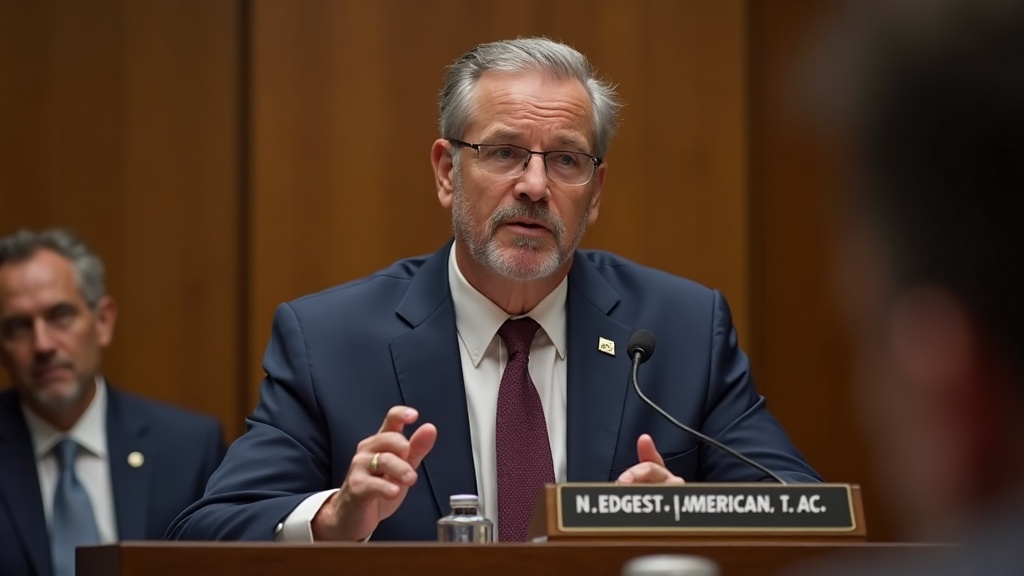
Everyone is fixating on the three-year freeze on state AI laws buried in the new federal bill. That is the loud provision. The quiet one matters more: the Great American AI Act would stand up a permanent federal standards body, funded at $100 million a year, with authority to define what counts as a safe frontier model. Preemption is temporary. A standards agency, once built, never goes away, and whoever controls it controls the rules of American AI for a generation.
That single shift, from temporary preemption to permanent institution, is the single most important lens through which the entire 269-page draft should be read and judged.
What Actually Happened
Representatives Jay Obernolte, a California Republican, and Lori Trahan, a Massachusetts Democrat, unveiled a 269-page discussion draft of the Great American Artificial Intelligence Act, described as the most comprehensive federal AI framework Congress has put forward to date. The bill is bipartisan, which in the current Congress is itself remarkable, and it attempts to do in one document what a patchwork of state laws and executive orders has been doing piecemeal. The headline provision is a three-year preemption of state laws governing the development of frontier AI models.
Underneath the preemption sit the provisions that will actually shape behavior. The draft would mandate that developers of the most capable models publish and maintain Frontier AI Frameworks, formal safety and governance documents describing how they test, secure, and monitor their systems. It would create a federal standards center funded at roughly $100 million per year to define and update those requirements. Critically, the obligations attach to companies above a $500 million revenue threshold, meaning the rules target OpenAI, Anthropic, Google, Microsoft, and Meta, not startups.
The structure is deliberate. By setting a high revenue floor, the bill exempts the long tail of small AI companies from compliance overhead while concentrating obligations on the handful of labs that train frontier systems. By preempting state law for three years, it buys time to build the federal apparatus before a thicket of conflicting state rules hardens. And by funding a dedicated standards center rather than leaving the work to an existing agency, it signals that Congress wants AI governance treated as a permanent institutional function, not a temporary task bolted onto an overstretched regulator.
The timing is not accidental either. The draft lands as a separate executive action from the White House pushes to limit state authority over frontier models, and as individual states race to fill the federal vacuum with their own statutes. Obernolte chairs the House AI task force and has spent two years signaling that a national framework was coming; Trahan brings the consumer-protection wing of the Democratic caucus to the table. The pairing is engineered to make the bill look like the rare piece of technology policy that can clear a divided Congress, and the 269-page length signals an attempt to preempt the criticism that earlier AI bills were too thin to be taken seriously.
Why This Matters More Than People Think
The preemption clause is being read as a gift to industry, and in the short term it is. But the standards center is the provision that reorders power. Once a federal body has the statutory authority to define what a compliant Frontier AI Framework looks like, it effectively sets the floor for how every major lab builds, tests, and documents its models. That is regulatory leverage that compounds. The agency that writes the first version of the rules writes the template every subsequent administration inherits, and the labs that help shape version one gain an advantage that no later entrant can claw back.
The $500 million revenue threshold deserves far more scrutiny than it is getting. On its face it protects startups, and that framing is politically appealing. In practice it draws a moat around the incumbents. A startup that succeeds and crosses the threshold suddenly inherits a full compliance burden its larger rivals have already amortized across billions in revenue. The threshold converts regulation into a scaling tax that bites hardest exactly when a challenger is trying to break into the frontier tier, which is the moment incumbents most want them slowed down.
There is also a federalism earthquake hiding in the preemption clause. States have been the primary venue for AI regulation precisely because Congress has been gridlocked. California, Colorado, and others wrote their own rules in the vacuum. A three-year federal freeze does not just pause those efforts; it asserts that frontier AI is a matter of national policy beyond state reach. That is a constitutional claim as much as a policy one, and it sets up a fight over whether Washington or the states get to govern the most consequential technology of the decade.
There is a quieter economic logic underneath the safety language. Frontier AI Frameworks are not free to produce; they require dedicated compliance, security, and documentation teams. For a lab with billions in revenue, that cost is a rounding error. For a fast-growing challenger, it is a meaningful diversion of engineering talent away from the model itself. By mandating formal frameworks only above the revenue line, the bill quietly converts safety documentation into a competitive weapon, one that the incumbents are already equipped to wield and newcomers are not. The framing is safety; the effect is market structure.
The Competitive Landscape
The named beneficiaries are the five labs above the revenue line: OpenAI, Anthropic, Google, Microsoft, and Meta. Each has spent the past two years building internal safety frameworks that look a great deal like the Frontier AI Frameworks the bill would mandate. That is not a coincidence. The largest labs have been lobbying for exactly this kind of federal structure, because a single national standard they helped design is vastly preferable to fifty divergent state regimes they cannot predict. The bill reads, in places, like the codification of practices the incumbents already follow.
The losers are the states and the startups, an unusual coalition. Colorado, which spent political capital passing a comprehensive AI consumer-protection law, would see its framework frozen out for frontier development. California, which has repeatedly tried to legislate model safety, loses its leverage. Meanwhile a Series B startup eyeing the frontier tier sees a compliance cliff waiting at $500 million in revenue. The bill aligns the interests of Washington and the five biggest labs against the interests of state regulators and emerging challengers, which is a telling coalition map.
The historical parallel is the Telecommunications Act of 1996, the last time Congress wrote a sweeping framework for a fast-moving technology. That law also preempted a tangle of state rules, also concentrated obligations on the largest carriers, and also promised that federal standards would foster competition. What it actually produced was two decades of consolidation, as the incumbents who shaped the rules used them to entrench. AI policy is now at the same fork, and the Great American AI Act carries the same risk: a framework sold as pro-competition that functions as pro-incumbent once the lobbying dust settles.
Hidden Insight: The Standards Center Is the Real Power Grab
Preemption expires. The standards center does not. That asymmetry is the whole game. A three-year freeze on state law sounds dramatic, but its political cost is paid up front and its benefit fades on a clock. A federally funded body with authority to define frontier safety standards is the opposite: low-drama at birth, then quietly more powerful every year as it accretes rules, precedents, and institutional staff. The bill's loudest provision is its least durable, and its quietest provision is its most permanent.
Consider who staffs a body like this. A $100 million annual budget buys technical experts, and the deepest pool of frontier AI expertise sits inside the five labs the agency is meant to oversee. The revolving door is not a bug here; it is the operating model. The people qualified to write the standards are the people who built the systems being standardized, which means the agency will be shaped from inception by the worldview of the incumbents. Regulatory capture is usually a slow drift. This bill risks building it in on day one, by sourcing its expertise from the regulated.
Compare it to how financial regulation actually evolved. The bodies that write banking and securities rules are staffed heavily by veterans of the firms they oversee, and the result is a rulebook that insiders can navigate and outsiders find impenetrable. Complexity itself becomes a barrier to entry. A frontier AI standards center funded at $100 million a year, drawing its talent from OpenAI, Anthropic, and Google, would likely follow the same arc: rules dense enough that only well-resourced incumbents can comply without friction, and a compliance culture that treats the regulated giants as partners rather than subjects. The danger is not corruption. It is the slow normalization of a worldview in which what is good for the five labs is treated as what is good for American AI.
The bear case, however, runs in the opposite direction, and it is worth taking seriously. Critics argue the bill will never pass in anything like its current form, that a 269-page discussion draft is an opening bid in a negotiation that historically collapses. Federal AI legislation has died repeatedly, and the preemption clause alone could unite an unlikely opposition of states-rights conservatives and consumer-protection progressives against it. The risk the market is underpricing is not that the bill entrenches incumbents, but that it produces nothing, leaving the messy patchwork of state laws and executive orders to govern by default for years more.
That gridlock scenario carries its own hidden cost. If the federal framework stalls but the preemption debate poisons the well, states may grow cautious about legislating into a space Washington has signaled it intends to claim, even without actually claiming it. The result would be the worst of both worlds: no federal standard and chilled state action, a governance vacuum that benefits no one except the labs that prefer no binding rules at all. The fight over the Great American AI Act could therefore matter most for what it prevents, not for what it builds.
What to Watch Next
In the next 30 days, watch which trade groups and labs publicly endorse the draft and which stay silent. Endorsement from the largest labs would confirm that the framework codifies practices they already favor. Watch also for the first state attorneys general to signal opposition, especially from Colorado and California, whose laws the preemption clause would freeze. The speed and intensity of the state-level pushback will tell you whether the federalism fight becomes the bill's defining battle.
Over the next 90 days, track whether the discussion draft acquires a Senate companion and a markup schedule. A discussion draft with no Senate path is a messaging document; one that attracts bipartisan Senate sponsors is a live vehicle. Watch the $500 million revenue threshold specifically, because that number is where the lobbying will concentrate. If it rises, the bill is tilting further toward protecting incumbents; if it falls or gets indexed, smaller players are winning a seat at the table.
On the 180-day horizon, the question is whether the standards center survives the legislative process intact. Provisions that create new federal agencies are the first to be traded away in negotiation, and if the center is stripped or weakened, the bill becomes mostly a preemption play with little durable governance behind it. Watch the funding line: if the $100 million annual appropriation holds, Congress is serious about building a permanent AI regulator. If it shrinks, the whole framework is more gesture than institution.
Watch the markup amendments most closely of all. The revenue threshold, the preemption window, and the standards center funding are the three dials lobbyists will fight over line by line, and small numerical changes to any of them will quietly reallocate power between incumbents, challengers, and the states. A bill that emerges with a higher revenue floor, a longer freeze, and a fully funded center is an incumbent victory dressed as a safety win, and the public will likely never read the page where it happened.
The three-year freeze is the headline, but the permanent federal standards center is the provision that will still be shaping American AI long after the preemption clock runs out.
Key Takeaways
- A 269-page bipartisan draft from Reps Obernolte and Trahan is the most comprehensive federal AI framework yet proposed.
- A $100 million-per-year standards center would define and update mandatory Frontier AI Frameworks for the largest labs.
- A $500 million revenue threshold targets OpenAI, Anthropic, Google, Microsoft, and Meta while exempting startups.
- A three-year preemption of state AI laws would freeze frontier rules in Colorado, California, and other states.
- The coalition map is telling: Washington and the five biggest labs versus state regulators and emerging challengers.
Questions Worth Asking
- If the people qualified to write frontier safety standards all come from the five labs being regulated, who actually governs whom?
- Does a $500 million revenue threshold protect startups, or build a moat that taxes challengers exactly when they try to scale?
- Which is the bigger risk to American AI: a bill that entrenches incumbents, or a stalemate that leaves no federal rules at all?