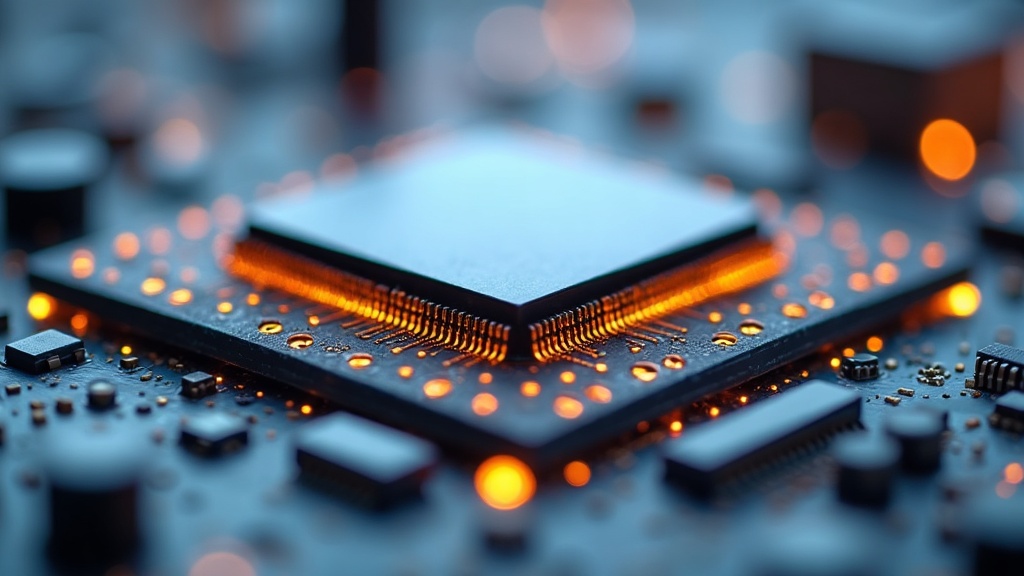
Intel walked into Computex with the most advanced chip it has ever built and watched its own stock fall anyway. On June 1 in Taipei, CEO Lip-Bu Tan unveiled Xeon 6+, codenamed Clearwater Forest, a server processor packing up to 288 cores on Intel's homegrown 18A process, the first high-volume product off the fabrication node the entire company has bet its survival on. The silicon is genuinely impressive. The market reaction was a reminder that impressive is no longer enough.
What Actually Happened
The centerpiece is Xeon 6+, built on the 18A process, Intel's 1.8nm-class node and its most cutting-edge manufacturing technology to date. Clearwater Forest fits up to 288 Darkmont cores in a single socket, a density Intel says leads the market and pairs with what it claims is the best performance per thread available. The pitch is aimed squarely at the AI data center, where racks are power-limited and the number of cores a single socket can deliver determines how much compute fits inside a fixed energy budget.
Tan did not stop at the CPU. Intel rounded out a full-stack reveal with new E835 Ethernet adapters delivering up to 200 GbE, an expansion of the Xeon 6300 family for entry-level servers, and fresh detail on Crescent Island, its next data center GPU. Crescent Island is built on the Xe3P architecture, supports datatypes from FP4 to FP64, and carries up to 480GB of LPDDR5X memory, though Intel's own add-in cards ship with 160GB. It runs at a 350W TDP in a PCIe form factor and is aimed at inference and agentic workloads rather than frontier training.
The strategy on display was end-to-end rather than chip-by-chip. Intel framed the announcements as a single infrastructure platform spanning compute, networking, memory, and AI acceleration, a deliberate echo of how Nvidia sells full systems instead of parts. Yet despite the breadth of the reveal, INTC shares slipped during and after the keynote, an unusual response for a company unveiling its most advanced product in years. The disconnect between the engineering and the share price is the real story of Intel's Computex.
Why This Matters More Than People Think
Clearwater Forest is the first time 18A shows up in a product people can actually buy at scale, and that makes it a referendum on Intel's foundry ambitions more than on any single CPU. Intel has spent years and tens of billions insisting it could leapfrog back to process leadership with 18A after the 10nm debacle that handed AMD half a decade of advantage. A 288-core part shipping in volume on 18A is the proof point. If yields hold and the chip performs, Intel Foundry suddenly has a credible story to tell external customers. If they do not, the entire turnaround thesis wobbles.
The choice to lead with core density rather than raw AI throughput is also a tell about where Intel thinks the money is moving. The frontier training market belongs to Nvidia and Intel knows it cannot win there. But inference, the day-to-day running of models in production, is a different economic game governed by tokens per watt and cores per rack, not peak FLOPS. By building the densest general-purpose socket on the market and a cheap-memory inference GPU beside it, Intel is positioning for the phase of AI where cost discipline beats benchmark glory, betting that 2026 is the year enterprises start counting the bill.
Crescent Island deserves more attention than it got. A GPU with 480GB of LPDDR5X trades the blistering bandwidth of HBM for sheer capacity at a fraction of the cost, which is exactly the tradeoff that long-context and agentic inference rewards. Agents keep large amounts of state in memory and tolerate slightly slower access far better than they tolerate running out of room. Intel is quietly arguing that the inference era does not need the most expensive memory on earth, and if that argument lands, it undercuts the HBM scarcity that has defined accelerator pricing for two years.
The networking piece, easy to overlook, completes the argument. A 200 GbE E835 adapter exists because dense compute is useless if data cannot reach the cores fast enough, and the bottleneck in modern AI clusters has migrated from the chip to the interconnect between chips. By shipping its own high-speed Ethernet alongside the CPU and GPU, Intel is refusing to let Nvidia's NVLink and InfiniBand own the fabric uncontested. Whether enterprises adopt open Ethernet over proprietary interconnect for AI is one of the quieter but more consequential standards fights of the decade, and Intel just planted a flag on the open side of it.
The Competitive Landscape
Intel's most immediate rival is not Nvidia but AMD, and the comparison is unforgiving. AMD's EPYC Venice, built on a 2nm process, reaches 256 cores and has spent years eating Intel's data center share with chiplet designs while Intel struggled with its nodes. Clearwater Forest's 288 cores on 18A is Intel's attempt to retake the density crown outright, the first time in years it can claim a clear specification lead over EPYC rather than playing catch-up. Whether customers believe the 18A numbers after a decade of Intel roadmap slips is a separate question from whether the chip is good.
On the accelerator side, Intel faces Nvidia's Vera Rubin platform and AMD's Instinct line, both of which lean on HBM and target training as well as inference. Crescent Island sidesteps that fight entirely by competing on capacity and cost rather than bandwidth, a flanking move rather than a frontal assault. The closest analog is Nvidia's own quieter inference parts and the wave of LPDDR-based accelerators, all chasing the same insight that not every workload needs HBM. Intel is betting it can own the value tier of inference silicon while the giants fight over the top.
The historical parallel that should worry and encourage Intel in equal measure is AMD's own comeback. A decade ago AMD was a distant second in servers, written off by most of the market, until Zen and a disciplined chiplet roadmap clawed back share point by point over multiple generations. The lesson is that data center comebacks are possible but slow, measured in years of consistent execution, not single keynotes. Intel has the product to start that climb with Clearwater Forest. What it has not yet shown is the multi-generation consistency that turned AMD from afterthought to leader.
Arm-based server chips add a third front Intel cannot ignore. Nvidia's Vera CPU, Amazon's Graviton, Microsoft's Cobalt, and Ampere's parts have spent years arguing that the x86 instruction set itself is a liability in power-constrained racks. Clearwater Forest is Intel's rebuttal that a modern x86 design can match Arm on cores per watt while keeping the vast x86 software base intact. The danger is that hyperscalers, who buy the most servers on earth, increasingly design their own Arm silicon and have every incentive to keep doing so. Intel is defending x86 in the data center against both AMD and an entire architectural movement at the same time.
Hidden Insight: The Chip Is a Trojan Horse for the Foundry
The deepest read of Clearwater Forest is that the CPU almost does not matter on its own terms. What matters is that it is the first heavyweight product manufactured on 18A, and 18A is the asset Intel actually needs to monetize. The company's entire IDM 2.0 strategy hinges on convincing outside chip designers to manufacture at Intel Foundry instead of TSMC. No customer commits a flagship design to an unproven node. A 288-core Xeon shipping in volume is the demonstration reel that says the node is real, the yields are there, and the risk is acceptable.
That reframes how to read the stock drop. Investors did not punish Intel for a bad chip, they punished it for a credibility gap that one keynote cannot close. The market has been told 18A would arrive, would yield, and would matter so many times that a single impressive demo no longer moves the needle. What would move it is a named external foundry customer committing volume to 18A, and that did not come at Computex. Until it does, every product reveal reads as a promise rather than a result, and the share price reflects accumulated skepticism rather than the merits of Clearwater Forest itself.
This is why the keynote framing as a full platform matters more than any single spec. Intel has watched Nvidia turn hardware into a system business, where the moat is the combination of chips, networking, and software rather than any one die. By presenting Xeon, Crescent Island, and E835 as one stack, Intel is signaling it understands the game has changed, that selling discrete components into a market that now buys integrated systems is a losing position. The open question is execution: announcing a platform is trivial, while delivering one that interoperates as cleanly as a vertically controlled Nvidia rack is the work of years, not quarters.
There is a second-order insight in the inference positioning. By aiming Crescent Island and the dense Xeon at inference economics rather than training, Intel is implicitly conceding the glamorous half of AI to Nvidia while claiming the larger, less visible half. Training is a capital event that happens occasionally; inference is an operating cost that runs forever and grows with every deployed agent. If the inference bill becomes the dominant line item in enterprise AI spending, as the shift to production agents in 2026 suggests, then owning the cost-efficient tier of inference hardware is a bigger prize than winning training, even if it generates fewer headlines.
The bear case, however, is brutal and well rehearsed. Intel has promised process leadership and missed before, and 18A yields at high core counts remain unproven outside Intel's own statements. Critics argue that a 288-core part is easy to announce and hard to ship in volume at acceptable yield, and that even a flawless launch leaves Intel years behind in the AI accelerator software ecosystem that makes Nvidia sticky. The risk is that Clearwater Forest is technically excellent and commercially insufficient, a great chip arriving into a market that buys platforms and developer ecosystems, not transistors. Skeptics point out that Intel has had great chips before and still lost share.
What to Watch Next
In the next 30 days, the figure that matters is any independent confirmation of 18A yield and the real-world performance of Clearwater Forest against EPYC Venice in third-party benchmarks. Intel's own numbers are a starting point, not a verdict, and the company's history means the market will wait for outside validation before repricing the stock. Watch also for pricing, because a dense Xeon that costs too much per core simply hands the rack-density argument back to AMD on a value basis.
Over the next 90 days, the single most important signal is whether Intel Foundry lands a named external customer willing to manufacture a flagship product on 18A. That announcement, far more than any Xeon benchmark, is what converts the turnaround story from hope to evidence. A marquee foundry win would do more for INTC than a generation of CPU leadership, because it proves the node can sell to people who are not named Intel. Its absence through the summer would confirm the market's current skepticism.
On the 180-day horizon, watch Crescent Island's actual availability and early inference deployments, plus whether the cheap-capacity GPU thesis attracts real workloads away from HBM-based parts. If enterprises start running long-context agents on 480GB LPDDR5X cards because the economics work, Intel will have found a defensible niche in the AI buildout. If Crescent Island slips or fails to win inference benchmarks, Intel will have a dense CPU, an unproven foundry, and a GPU strategy that ceded both training and the high end of inference. The next two quarters decide which story is true.
The wildcard above all of this is geopolitics. Intel Foundry is the centerpiece of the US push to manufacture leading-edge chips on home soil, and 18A is the node that has to work for that policy to mean anything. That gives Clearwater Forest a strategic weight no AMD or Nvidia part carries, and it means Washington has a stake in Intel's execution that pure market logic would not assign. Watch whether federal support, anchor orders, or subsidies materialize if commercial demand alone proves too slow to validate the node, because the US cannot afford for 18A to fail.
Intel built its most advanced chip in years and the market shrugged, because the question was never whether Intel could design 18A silicon, but whether anyone besides Intel will ever trust it to manufacture theirs.
Key Takeaways
- 288 Darkmont cores in a single socket make Xeon 6+ Clearwater Forest the first high-volume product on Intel's 18A process
- Crescent Island GPU carries up to 480GB of LPDDR5X at a 350W TDP, betting that inference rewards memory capacity over costly HBM bandwidth
- INTC shares fell during the keynote despite the reveal, signaling a credibility gap that engineering alone cannot close
- AMD EPYC Venice at 256 cores on 2nm is the direct rival Clearwater Forest aims to outrun on density
- 18A is the real asset: the chip is a proof point for Intel Foundry, which still lacks a named external customer on the node
Questions Worth Asking
- If inference becomes the dominant cost in enterprise AI, does winning cost-efficient inference silicon matter more than winning training, even with fewer headlines?
- What single announcement would actually move Intel's stock, and why is it a foundry customer rather than a faster chip?
- After a decade of missed nodes, how many flawless launches does Intel need before the market prices 18A as a result instead of a promise?