The factory floor has run on human judgment and pattern recognition for 250 years. NVIDIA just handed that judgment to a network of AI agents, and the first factory to run the full stack cut its root-cause analysis time by 80 percent. That is not a benchmark on a slide deck; it is a production result from Foxconn's operating plants, delivered on hardware that fits inside a desk drawer.
What Actually Happened
NVIDIA unveiled FOX, the Factory Operations Blueprint, at GTC Taipei on June 4, 2026. FOX is a reference architecture for building autonomous factory manager agents, assembled from NemoClaw, the AI-Q Blueprint, and Nemotron open models. The stack runs a central orchestrator agent that coordinates specialized sub-agents for quality control, logistics, and safety in natural language. It runs on the DGX Station, NVIDIA's deskside AI supercomputer powered by the GB300 Grace Blackwell Ultra superchip, a machine that delivers data-center-class inference without the latency of a cloud round-trip. Manufacturers download the reference stack, adapt it to their equipment profiles, and deploy it on-site within weeks rather than the months that a custom industrial AI integration historically required.
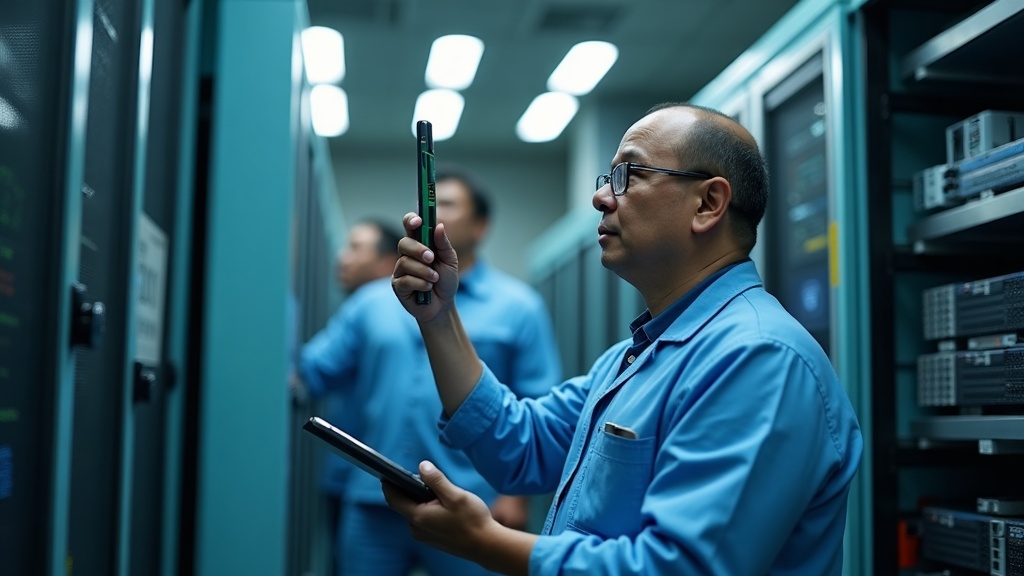
Foxconn is the first manufacturer to deploy the full stack in production. Its system, called MoMClaw, connects hundreds of specialized AI agents directly to production equipment, machine sensors, and enterprise resource planning data through a single agentic layer. Plant managers and floor operators query MoMClaw in plain language, asking why a machine slowed, which batch is at risk, or what the fastest path to a restart is, and the system returns real-time answers and action plans. NVIDIA OpenShell privacy controls and safety guardrails prevent agents from issuing commands that bypass human approval, keeping a human in the decision loop for any action that could affect product quality or worker safety. The architecture is designed so that each query and response is logged, auditable, and reviewable by the plant team.
The measurable outcomes from Foxconn's live deployment are striking by any industrial benchmark: 80 percent faster root-cause analysis, a 15 percent increase in labor productivity, and a 10 percent reduction in machine failure rates. Foxconn operates over 200 factories globally and manufactures components and finished goods for Apple, Google, Sony, Amazon, and virtually every major consumer electronics brand. A 10 percent drop in machine failure rates across that network translates to hundreds of millions of dollars in avoided downtime annually. The 80 percent root-cause acceleration means that an investigation that once required eight hours of technician time and cross-department coordination now closes in under 90 minutes, often before the production shift that experienced the fault has ended.
Why This Matters More Than People Think
The factory has been the last major domain to resist software-driven transformation. While financial services, healthcare, and media were reshaped by data analytics and machine learning in the 2010s, manufacturing held onto its tribal knowledge model: experienced technicians carrying years of pattern recognition in their heads, making judgment calls at machines that cost 50 million dollars each. FOX is the first architecture purpose-built to encode, distribute, and scale that judgment across an AI agent network. The comparison that matters is not to previous factory software. It is to what happened when spreadsheets replaced ledger books: not just the same work done faster, but entirely new categories of decision that became possible once the constraint of manual calculation was removed.
The implications for manufacturing economics are material. McKinsey estimates that unplanned downtime costs industrial manufacturers $50 billion annually in the United States alone. A 10 percent reduction in failure rates, combined with an 80 percent improvement in diagnostic speed, means that plants recover from incidents in a fraction of their previous time and prevent more of them outright. The labor productivity gains are additive: if 15 percent more output comes from the same headcount, the economics of reshoring Western manufacturing start to look different in a way that a decade of policy incentives could not produce. A system that makes existing workers materially more effective is far easier to adopt politically and operationally than one that requires headcount reduction.
There is also a compounding effect that initial benchmarks do not capture. Unlike traditional automation, which executes fixed programs, a multi-agent system accumulates knowledge from every incident it resolves. Each root-cause analysis that MoMClaw completes becomes training signal for the next failure prediction. Foxconn is not just solving individual incidents faster; it is building a continuously improving model of what goes wrong in a semiconductor-grade production environment. That proprietary model is a competitive moat that grows with every machine cycle and every shift, independent of any competitor's software roadmap.
The Competitive Landscape
The industrial AI space has been active for years, but no competitor has yet deployed a comparable full-stack multi-agent reference architecture at scale. Siemens has been building its Industrial Copilot on Azure OpenAI, embedding GPT-4 into its factory management software and marketing natural language access to production data. ABB launched its Genix industrial AI platform in early 2026, combining process optimization models with predictive maintenance agents. Rockwell Automation and PTC have embedded AI assistants in their digital twin offerings. Each of these approaches treats AI as a feature layer on top of existing industrial software; NVIDIA is positioning FOX as the base operating system below that layer, which means every ISV building on top eventually runs on NVIDIA silicon.
The more direct competition comes from the cloud hyperscalers. Microsoft Azure's manufacturing AI suite and AWS's industrial AI toolkit both offer agent orchestration frameworks that manufacturers can build on. But neither ships with the purpose-built hardware integration that DGX Station provides. Running a multi-agent factory system on general-purpose cloud compute introduces latency that industrial environments cannot always absorb: a machine safety recommendation made 200 milliseconds too late can mean a 2-million-dollar piece of equipment hits a fault condition that an on-premises agent would have caught in time. The DGX Station's on-premises architecture eliminates that latency entirely while keeping production data behind the plant's own firewall. AWS and Azure can offer breadth; NVIDIA is offering depth and determinism.
The historical parallel is the introduction of the programmable logic controller in the 1970s. When PLCs replaced hardwired relay panels, they did not just automate existing processes; they changed what manufacturers could design. A process requiring 40 hardwired relays could be reprogrammed in software in an afternoon, enabling product variation that physical switching could never support. FOX is the same kind of architectural shift: once factory logic lives in an AI agent that can be retrained and re-instructed through natural language, the pace at which manufacturers can adapt their processes changes fundamentally. The companies that adopt the PLC-equivalent architecture first do not just get efficiency gains; they get a design flexibility advantage that compounds over time.
Hidden Insight: The Real Competition Is for Factory Intelligence, Not Factory Hardware
The most important sentence in NVIDIA's GTC Taipei announcement was not about Foxconn's production numbers. It was the decision to open-source the Nemotron models and publish the NemoClaw stack as a public reference architecture. NVIDIA is not trying to keep FOX proprietary; it is trying to make FOX the standard, in exactly the same way that CUDA became the standard for GPU programming. If every factory AI system in the world runs on Nemotron and NemoClaw, NVIDIA captures the hardware market whether or not it controls the software. The platform is free; the silicon is not. Developers who build expertise on NemoClaw will buy DGX Stations to run it, and their factories will stay on NVIDIA hardware for the lifetime of the trained models they deploy.
This strategy explains why Pegatron and Advantech are already building on the FOX stack despite being direct supply-chain competitors to Foxconn in electronics manufacturing. NVIDIA offered them the reference design at no charge, knowing that each deployment drives demand for DGX Station hardware and Blackwell Ultra chips. The business model is a direct replication of the CUDA playbook from 2007: give away the development platform, sell the silicon that runs it. By the time a competitor builds a credible competing stack to rival NemoClaw, the industrial AI ecosystem will have accumulated years of NVIDIA-native tooling, training data, and developer expertise. Switching costs compound faster in manufacturing than in consumer software because the certified integrations with specific machine types cannot be quickly reproduced.
The data moat deserves specific attention. Every Foxconn plant running MoMClaw generates structured agent-to-machine interaction logs describing exactly what fails, when, and why in a GB300-class compute environment. That data does not leave the plant; NVIDIA OpenShell ensures it. But the aggregate behavioral patterns feed into Nemotron model improvements that NVIDIA ships back to every customer as updates. The company is effectively building an industrial AI foundation model trained on production data from the world's largest contract manufacturer, without owning or transferring that data. It is the most defensible competitive position in industrial AI available today, and it costs NVIDIA nothing in data acquisition expense because the customers are building the training set themselves.
The bear case, however, is real and underpriced by the market's enthusiasm. Multi-agent systems fail in ways that traditional automation does not. When a PLC faults, it fails deterministically: the fault code appears, the technician replaces the module, and the line restarts within a defined procedure. When an AI agent makes a wrong inference at the intersection of sensor data, ERP records, and production schedules, the failure mode can be subtle: a recommendation that seems statistically valid routes a production batch through an underperforming station, compounding quality issues over hours before any human notices. Foxconn's 10 percent reduction in machine failures is impressive, but critics in the process engineering community point out that the safety guardrails NVIDIA describes have not yet been independently certified under IEC 61508 or ISO 13849, the functional safety standards that governs industrial automation worldwide. Certification cycles run two to five years. The production results are real; the safety validation is incomplete.
What to Watch Next
The 30-day indicator to watch is Foxconn's investor disclosures. The company is publicly traded in Taiwan and files detailed production performance reports quarterly. If the MoMClaw numbers hold in the 10 to 15 percent range across a full production quarter, rather than a controlled pilot window, it will be the first independently verifiable proof point for multi-agent factory AI at scale. Watch for the Foxconn Q2 2026 operational release, expected in late July 2026. Any divergence between the GTC Taipei pilot numbers and the quarterly average will be the most honest signal of whether FOX performs under full production load or only under favorable test conditions.
In the 90-day window, the critical question is whether Pegatron and Advantech publish their own deployment results. GTC Taipei confirmed both companies are building on FOX, but neither stated a production rollout timeline. If both announce live deployments by September 2026, the FOX stack will have three of the world's five largest contract electronics manufacturers running on it simultaneously. That is the threshold at which Siemens, ABB, and Rockwell will need to either partner with NVIDIA or accelerate their own agentic stack development from scratch. The ISV response to three concurrent FOX deployments will define whether this becomes a standard or a dominant-but-fragmented platform.
In the 180-day window, watch for NVIDIA to announce a Nemotron variant trained specifically on factory deployment data. The company has historically shipped model updates every six to nine months, and a version purpose-trained on industrial agent interactions would differentiate FOX from anything the cloud providers can replicate without comparable production install base. If Jensen Huang announces that model at GTC Paris in late 2026 or CES 2027, it will confirm that NVIDIA's long-term strategy is to build a proprietary industrial AI foundation model on the back of its hardware install base, effectively turning every Foxconn, Pegatron, and Advantech plant into training infrastructure for its next-generation system.
NVIDIA is not automating factory decisions; it is building the platform on which every future factory decision will run, and it is using Foxconn's 200 plants as the training data.
Key Takeaways
- 80% faster root-cause analysis: Foxconn's MoMClaw cuts the average diagnostic cycle from roughly 8 hours to under 90 minutes across live production floors, with the NVIDIA FOX stack coordinating hundreds of specialized agents.
- 15% labor productivity gain: The same headcount produces measurably more output when AI agents coordinate quality, logistics, and safety decisions in real time, surfacing bottlenecks before they compound.
- 10% reduction in machine failures: Applied across Foxconn's 200+ global factories manufacturing for Apple, Google, and Sony, this figure translates to hundreds of millions in avoided annual downtime costs.
- Open-source NemoClaw replicates the CUDA strategy: NVIDIA is publishing the full reference stack freely to maximize DGX Station hardware adoption, betting that factory AI ecosystem lock-in flows through silicon, not software licenses.
- Pegatron and Advantech already building on FOX: Three of the five largest contract electronics manufacturers are now on a common NVIDIA-native stack, creating the conditions for a de facto industry standard within 90 days.
Questions Worth Asking
- If AI agents absorb the tacit knowledge that experienced plant technicians carry, what happens to institutional expertise at manufacturers who adopt FOX first, and what do they lose if NVIDIA's architecture changes in a future version?
- NVIDIA publishes Nemotron as open-source but sells DGX Station as proprietary hardware. At what point does the free model become a lock-in mechanism rather than a genuine open resource?
- Industrial safety certification under IEC 61508 and ISO 13849 runs two to five years. If MoMClaw is already live in Foxconn plants, which regulatory frameworks govern it today, and who is liable when an agent recommendation causes a quality failure at scale?