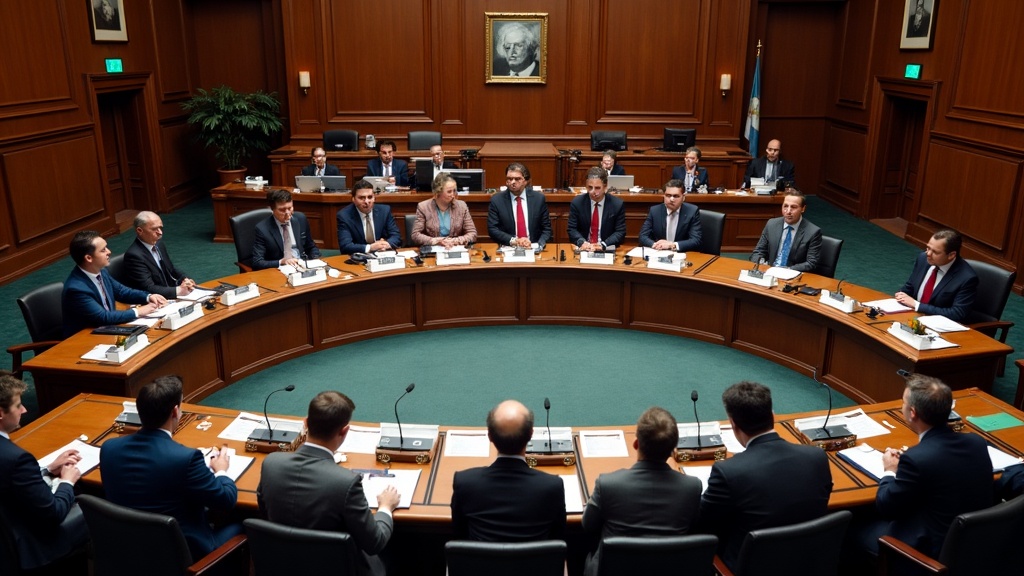
OpenAI launched the Economic Research Exchange on June 8, 2026, a platform that invites external economists to propose structured, privacy-protected research collaborations on how AI affects workers, wages, firms, and institutions. The framing is about building evidence. The mechanics reveal something more strategic: a company facing its first serious wave of labor-market regulation is funding the research infrastructure that will define what Congress reads when it legislates.
What Actually Happened
OpenAI announced the Economic Research Exchange through a post on its website dated June 8, 2026, with applications open immediately and a closing deadline of July 5, 2026. Selected researchers will be notified by July 31, 2026. The program invites academics and policy researchers with expertise in applied causal inference, labor economics, productivity measurement, firm behavior, education, entrepreneurship, public finance, regional economics, development, and inequality to propose structured research collaborations. Selected participants receive access to OpenAI's data under privacy-protection agreements and work on questions that build what OpenAI calls "credible external evidence on AI's economic impacts." The program is framed as building the evidence base that researchers, policymakers, businesses, and the public need as AI transforms work and the economy.
The timing places the announcement in a specific regulatory context. The EU AI Act's enforcement deadline for general-purpose AI models lands in August 2026, 55 days from the date of the Exchange announcement. The US Senate has been deliberating the Great American AI Act, which proposes a three-year freeze on new state AI regulations while establishing a federal framework, a bill that depends heavily on the economic impact evidence base that does not yet exist in rigorous, causally identified form. Congress has been asking AI companies for data on job displacement for over a year, and AI companies have generally provided anecdotal evidence, user surveys, and productivity case studies rather than peer-reviewed economic research with clean causal identification strategies. The Economic Research Exchange is OpenAI's answer to that gap, on OpenAI's terms and under OpenAI's data governance.
OpenAI has published prior economic analyses of its own, including a workforce complement study from 2023 that found most occupations would be augmented rather than replaced, and a more recent update suggesting that 38,579 jobs cited AI as the primary reason for layoffs in the first quarter of 2026 across the US labor market. The Exchange represents a shift in strategy. Rather than publishing first-party analysis that critics immediately label as self-serving, OpenAI is funding external researchers to produce findings that carry academic credibility and independent institutional affiliations. The program explicitly prioritizes methodological rigor and feasibility, using causal inference methodology and clear milestones, which means the research will be harder to dismiss as marketing even if OpenAI controls the data access that makes the research possible.
Why This Matters More Than People Think
The power in the Economic Research Exchange is not in what it produces. It is in what questions it makes answerable. A researcher without access to OpenAI's user data can observe AI's economic effects only indirectly: through employment surveys, wage records, firm-level productivity filings, and job posting data. Those sources carry measurement lags of six to twelve months, attribution problems, and measurement error when trying to isolate AI's causal contribution. A researcher with access to OpenAI's usage data can ask questions like: how do workers at firms that adopted ChatGPT in month X differ in productivity and wages from comparable workers at firms that adopted in month X plus six? Which task categories see substitution versus augmentation at different levels of AI usage intensity? Those questions require OpenAI's cooperation to be answerable at all. By choosing which researchers get that access, OpenAI shapes which questions become part of the academic literature that policymakers cite.
The regulatory stakes are direct and well-documented. Labor economists broadly agree that AI will reduce the value of certain categories of cognitive work, but the distribution of that effect across income levels, firm sizes, geographic regions, and occupational categories is genuinely contested. The range of plausible outcomes spans from a modest productivity redistribution that raises median wages over a decade to an acute displacement of lower-income workers that widens inequality faster than the social safety net can absorb. Congressional staffers writing AI labor legislation are going to cite whatever credible peer-reviewed evidence is available. If the only causally identified studies of AI and wages with clean natural experiments were funded through OpenAI's Exchange, those studies will be the literature, regardless of whether they lean positive or neutral on AI's distributional effects. That is a durable influence on policy that no number of company lobbyists can replicate.
There is also a first-mover advantage in academic relationships that is easy to undervalue. The researchers who conduct the Exchange's inaugural studies will become the recognized experts on AI and labor economics. They will be invited to testify before Congress, advise regulatory agencies, and peer-review legislation. OpenAI will have established relationships with those researchers before Anthropic, Google, or Microsoft built comparable research access programs. Academic influence compounds the same way developer mindshare compounds: the people who know the field, know the data, and know the company are the people regulators call when they need expert guidance.
The Competitive Landscape
Anthropic has invested heavily in safety research and published frameworks for AI model evaluation, including its Responsible Scaling Policy and model welfare work, but it has not built a comparable external economics research program. Google has long-standing academic partnership programs through Google Research and has funded economic research through think tanks, but those programs were designed for a different era of regulatory pressure and do not offer the kind of structured, privacy-protected data access that would enable causally identified labor market studies. Microsoft has similar academic collaboration infrastructure through its research division, but its AI economic impact research has largely relied on GitHub Copilot productivity studies that show developer efficiency gains rather than addressing the displacement question that policymakers care most about. OpenAI is the first major AI lab to build a purpose-designed research program specifically targeting the empirical gaps in the AI and labor economics literature at the moment when that literature will be most consequential.
The historical parallel that best captures this dynamic is pharmaceutical industry funding of clinical research. When the FDA requires clinical evidence for drug approval, drug companies fund much of the clinical trial infrastructure that produces that evidence. The trials use independent researchers, pre-registered protocols, and peer-reviewed publication, yet the companies that funded the trials shaped which questions were asked, which endpoints were measured, and which results were published versus left in file drawers. Academic economists who study research publication bias in pharma have documented systematic differences between industry-funded and independently funded trials. AI economics research funded through the Exchange faces the same structural dynamic, with OpenAI as funder and the academic researchers as credentialed intermediaries whose institutional affiliations provide cover that OpenAI's own publications lack.
The bear case, however, is not subtle: critics argue that any research program where the studied company controls data access is structurally compromised regardless of how rigorous the methodology is. A researcher who cannot access the comparison case, a world where OpenAI did not deploy these models, cannot run the counterfactual that a true natural experiment would require. The Exchange will produce correlation studies with sophisticated controls and plausible instruments, which is the best empirical economics can do with observational data, but skeptics point out that correlation studies with the most favorable data cuts will systematically overstate the benefits and understate the costs compared to a truly independent research program with adversarial access rights. The question is whether policymakers will distinguish between rigorous correlation and rigorous causation when citations are being collected for a bill's economic impact assessment.
Hidden Insight: OpenAI Is Colonizing the Evidence Base Before Congress Mandates Its Own
There is a bill moving through the Senate that would create a federal AI economic impact monitoring office, funded at $100 million, to study AI's effects on the labor market independent of any company's cooperation. The Great American AI Act's regulatory provisions, which passed committee in May 2026, include a mandate for the Bureau of Labor Statistics to develop new AI-exposure measures for its occupational employment surveys. If that mandate becomes law, there will be a federally funded, adversarially independent research program producing AI labor market data alongside OpenAI's Exchange program. The research that reaches policymakers first, and that has the most academic citations by the time the federal program produces its first reports, will carry greater weight in legislative deliberations simply by virtue of temporal priority.
The application deadline of July 5, 2026 is not arbitrary. Selected researchers will be notified July 31 and will begin accessing data in August or September 2026. If the Exchange moves at normal academic speed, the first working papers will circulate in late 2026 or early 2027. Congressional hearings on AI labor policy are expected in Q1 2027 based on current legislative calendars. OpenAI is explicitly timing the Exchange to produce academic working papers that exist and can be cited before the federal monitoring office produces anything. A working paper from a Princeton or MIT economist with access to OpenAI's actual user data will carry far more weight in a hearing than a federal agency's preliminary survey instrument design. OpenAI's timing is not coincidental; it is infrastructure for a regulatory environment that does not yet exist but will.
It is worth examining who is not in the Exchange. The program targets researchers with "strong empirical skills" and expertise in the listed subfields, which is standard academic language for quantitative economists with causal identification skills. It notably does not include labor historians, sociologists, ethnographers, or researchers who study technology's qualitative effects on job quality, worker autonomy, and labor power dynamics. Those disciplines tend to document AI's costs to workers, including monitoring, deskilling, algorithmic management, and the erosion of task discretion, with methodologies that do not map easily onto productivity and wage outcomes. By defining the Exchange's scope through the vocabulary of empirical labor economics, OpenAI has implicitly excluded the research traditions most likely to document distributional harms that productivity-focused studies would miss entirely.
The broader question the Exchange raises is whether a research program can be simultaneously rigorous and strategic. The answer from the history of corporate-funded academic research is: yes, often, and the rigor is precisely what makes the strategic benefit durable. Sloppy corporate research gets dismissed. Methodologically rigorous corporate-funded research gets cited, taught in graduate seminars, and embedded in the literature that the next generation of policy researchers builds on. OpenAI is not trying to produce fraudulent research. It is trying to produce research that is accurate on the questions it asks and silent on the questions it does not ask, which is exactly how the most effective regulatory preemption through the academy has always worked.
What to Watch Next
The 30-day marker is the July 5 application deadline and the composition of the applicant pool. Pay attention to which institutions and researchers apply versus which prominent labor economists publicly decline to participate. If researchers at major policy-oriented institutions like the National Bureau of Economic Research, the Brookings Institution, or the Economic Policy Institute either enthusiastically apply or publicly criticize the program's data access structure, that split will reveal the academic community's assessment of whether the Exchange can produce independent research. A strong applicant pool from elite institutions validates the program's design. Prominent abstentions are the signal that the research community has concluded the structural incentives compromise the independence too much to be worth the data access.
At 90 days, the question shifts to Congress. The Senate AI subcommittee has scheduled hearings on AI and labor for Q3 2026. Watch whether Exchange-affiliated researchers are invited to testify, and whether their early findings are cited in members' opening statements or bill amendments. Congressional staff who are building the evidence record for AI labor legislation will be aware of the Exchange's existence and will need to decide whether to treat it as credible independent evidence or as industry-funded advocacy. How quickly the academic community peer-reviews the first Exchange working papers, and whether those papers survive the referee process at top economics journals, will shape how Congress uses them.
At 180 days, the critical indicator is whether Anthropic, Google, or Microsoft builds a comparable program. If the Exchange produces findings that receive serious academic attention and congressional citation, the competitive incentive for other major AI companies to establish similar research access programs becomes pressing. An industry in which only OpenAI has data-sharing relationships with the economists who study it has given OpenAI a durable advantage in the regulatory conversations that will determine the rules all AI companies operate under. The companies that wait for the regulatory environment to crystallize before investing in this kind of academic infrastructure will be playing defense in hearings they did not help shape. The Exchange is not a research project. It is an investment in the architecture of future regulation.
OpenAI is not studying AI's economic impact. It is deciding who gets to study it, which is a different and more consequential act.
Key Takeaways
- OpenAI launched the Economic Research Exchange on June 8, 2026, inviting external economists to propose structured research on AI's effects on workers, wages, firms, and institutions, with applications closing July 5
- Selected researchers gain access to OpenAI's user data under privacy protections, enabling causally identified studies that independent researchers without data access cannot conduct, giving OpenAI structural influence over which questions get answered
- The Exchange timeline is explicitly calibrated to produce academic working papers before a federally mandated AI labor market monitoring program, authorized under the Great American AI Act, produces its first reports
- No comparable external research access program exists at Anthropic, Google, or Microsoft, giving OpenAI a first-mover advantage in academic relationships with the economists Congress will cite when writing AI labor legislation
- The program's scope is limited to quantitative labor economics, implicitly excluding research traditions in sociology and labor studies that tend to document qualitative harms like algorithmic management, deskilling, and erosion of worker autonomy
Questions Worth Asking
- If a company controls both the AI system being studied and the data access that makes rigorous study possible, is any research conducted under those conditions truly independent, regardless of the researchers' institutional affiliations?
- What would the research landscape look like if the Bureau of Labor Statistics received adversarial subpoena power over AI company usage data instead of relying on voluntary disclosure programs like the Exchange?
- Does the Exchange's exclusion of qualitative research methodologies reveal an implicit assumption about which kinds of evidence count in AI policy, and what does that assumption cost workers whose harms do not show up in wage data?