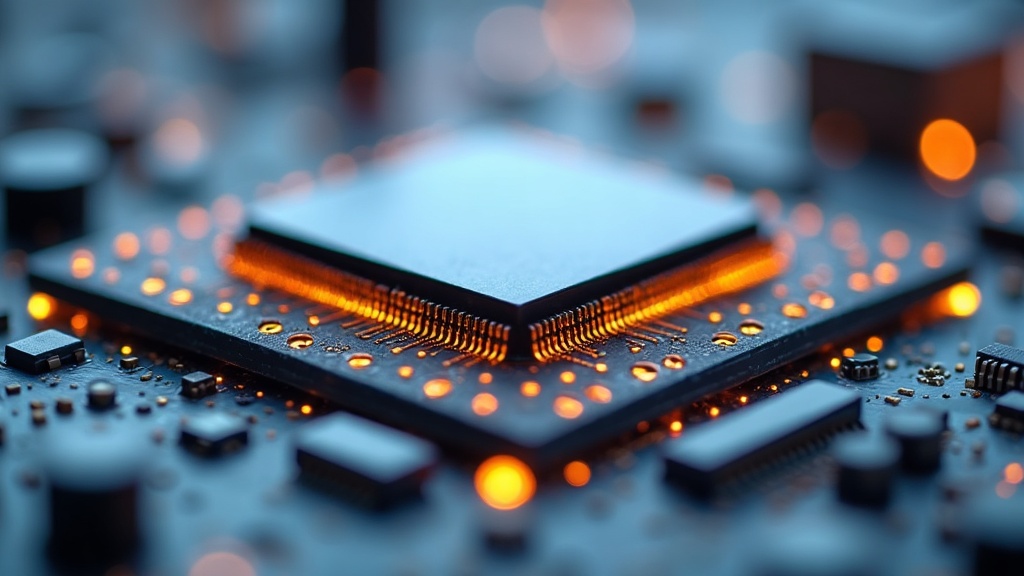
The undisputed king of the smartphone chip market has entered the war for the robot brain. The Dragonwing IQ10 series that Qualcomm unveiled at CES in January 2026 is not just another product launch. It is a frontal challenge to the robotics computing market that NVIDIA has monopolized for years. Qualcomm's partner roster includes Figure AI and Kuka Robotics, spanning everything from humanoid robots to industrial robot arms. This is an encirclement strategy aimed at the entire robotics market.
What Actually Happened: The Quietest Declaration of War at CES 2026
Qualcomm introduced its Dragonwing Robotics Development Platform at CES 2026. At its core sits the Dragonwing IQ10 processor, built with an 18-core CPU and an integrated NPU. The chip is designed to cover everything from home service robots to industrial autonomous mobile robots (AMRs) and full-size humanoid robots, all under a single architecture. More important is that Qualcomm showed off not just hardware but a full-stack architecture that integrates software and compound AI. NVIDIA's Jetson platform is powerful, but its GPU-based approach carries the weakness of heavy power consumption. Qualcomm's approach, by contrast, brings the power efficiency proven in smartphones to robots. The launch partners include Figure AI, Kuka Robotics, Advantech, APLUX, AutoCore, Booster, Robotec.ai, and VinMotion.
The choice to anchor the announcement around a development platform rather than a single chip is telling. Qualcomm is not simply selling silicon. It is trying to seed an ecosystem, offering robot makers a reference design, a software layer, and AI model support in one package. The breadth of the partner list, ranging from a humanoid pioneer like Figure AI to a century-old industrial automation leader like Kuka, signals that Qualcomm wants to be the default compute layer across every robot form factor rather than winning a single niche.
Why This Matters More Than People Think: The Second Semiconductor War in Robotics
As the robot revolution moves into full swing, the question of who supplies the robot's brain has become the central battle for dominance in the robot economy. Until now, NVIDIA has effectively monopolized this market with its Isaac platform and Jetson modules. The GR00T foundation model, the Cosmos simulation engine, and the Jetson Orin hardware: at every layer, NVIDIA has set the standard. Qualcomm's entry into the fight could change that picture. In the smartphone chip market, Qualcomm has spent decades competing to push power efficiency to its absolute limit. For a battery-powered robot, that edge in efficiency is critically important.
NVIDIA GPUs are powerful, but they run hot and consume a great deal of electricity. The Qualcomm IQ10, by contrast, claims to handle the same AI inference at far lower power. If that claim holds, Qualcomm could become a more attractive choice than NVIDIA in the humanoid robot market, where eight or more hours of autonomous operation is a requirement. The bear case, however, is straightforward: raw silicon efficiency rarely decides these contests on its own. NVIDIA's lead is not just in chips but in the developer ecosystem wrapped around them, and critics argue that Qualcomm is entering a fight where the hardware is the easy part and the software moat is the hard part. The risk Qualcomm underprices is that robot makers may not want to abandon tooling they already know, no matter how efficient the new chip is.
Hidden Insight: Not NVIDIA vs. Qualcomm, but GPU vs. NPU
Most coverage frames this simply as a rivalry between two semiconductor companies. But the real fight is more fundamental. This is a war over AI inference architecture. NVIDIA ported the approach of running LLMs on GPUs over to robots, processing heavy computation in the cloud or on high-performance edge servers while the robot receives the result and acts on it. Qualcomm holds the opposite philosophy: process the AI directly on the NPU inside the robot and make decisions in real time, with no communication latency.
This is not a simple performance contest. It is a fight over two different robot futures, the cloud-dependent robot and the fully autonomous robot. Figure AI's decision to join hands with Qualcomm is significant. Figure is the company building humanoid robots that have been deployed in a BMW factory, and in a real factory environment Wi-Fi is unreliable and cloud latency can be fatal. The field's demand for an on-device chip capable of fully autonomous inference is what connected Qualcomm and Figure.
Read over a longer horizon, this signals where the industry is likely to head over the next 12 to 24 months. If the most demanding deployments, factories, warehouses, and homes, all punish latency and connectivity gaps, then the architecture that pushes intelligence onto the device gains structural advantage. The uncomfortable truth this story challenges is the widely held assumption that robotics will simply inherit the cloud-first playbook of the LLM era. Robots move through the physical world in real time, and the physical world does not wait for a round trip to a data center.
What to Watch Next
Over the next 30 to 90 days, watch whether any of the launch partners move from announcement to shipping hardware built on the IQ10, and watch the published power and inference benchmarks against Jetson Orin. Specific numbers matter here: performance per watt, sustained inference latency on-device, and the price of the development kit will tell you whether Qualcomm's efficiency claim survives contact with real workloads. Track Figure AI's deployment cadence in particular, since a humanoid running fully on-device inference in a production BMW line would be the strongest possible proof point.
Over the next 180 days, the question becomes ecosystem traction. If NVIDIA responds by opening GR00T, Cosmos, and Isaac more aggressively, that tells you the developer-stack moat is where the war will be decided. If Qualcomm announces a credible software and model story to sit alongside the silicon, the contest tightens. The mental model for evaluating future developments is simple: if power efficiency wins, Qualcomm gains; if developer ecosystem lock-in wins, NVIDIA holds. Whichever metric the next wave of partner announcements emphasizes is the one the market has decided will matter most.
If a robot is to move like a person, it needs to decide like a person, with no time to wait for an answer descending from the cloud.
Key Takeaways
- Dragonwing IQ10, 18-core CPU plus integrated NPU, the robot-specific processor Qualcomm unveiled at CES 2026, covers everything from home robots to full-size humanoids on a single platform
- Figure AI plus Kuka Robotics partnership, a launch-partner lineup spanning humanoid robots and industrial robot arms, an encirclement strategy aimed at the entire robotics market
- A frontal challenge to NVIDIA Jetson's monopoly, swapping the GPU-based high-power-consumption approach for an NPU-based power-efficiency approach to win the battery-powered robot market
- An integrated hardware, software, and AI full stack, not a simple chip sale but a strategy to build a whole platform ecosystem, including support for VLA and VLM models
- On-device AI inference is the core differentiator, processing real-time AI decisions inside the robot without cloud dependence, solving the connectivity instability of factory and logistics environments
Questions Worth Asking
- With NVIDIA dominating the robot AI software ecosystem (GR00T, Cosmos, Isaac), can Qualcomm win this contest on hardware alone? Is the real battleground the developer ecosystem rather than chip performance?
- If on-device AI robots become the norm, how will the business models of companies offering cloud-based robot services change? What future awaits services like AWS Robotics and Azure Robot Framework?
- If your company or investment portfolio is weighing robot adoption, which architecture would you choose between cloud-dependent and on-device AI robots? How can you predict which direction will dominate five years from now?