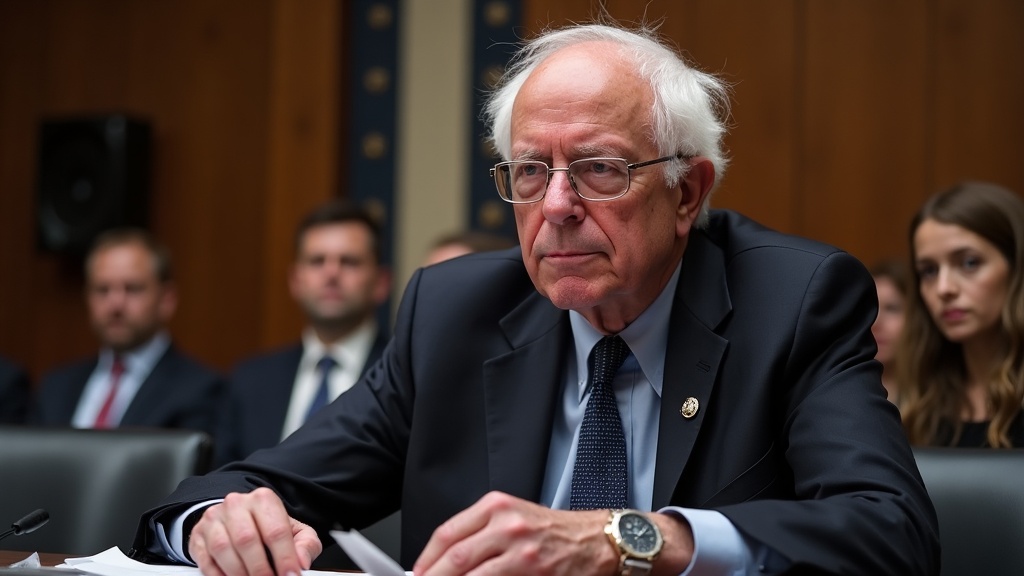
Frontier AI companies just discovered a new line item for their IPO risk disclosures. Senator Bernie Sanders announced legislation in June 2026 that would seize 50% of the stock in OpenAI, Anthropic, xAI, and other leading AI companies through a one-time stock tax, depositing the shares into a government-owned sovereign wealth fund with full voting rights and board representation. The bill is unlikely to pass the current Congress. That is almost beside the point.
What Actually Happened
Sanders unveiled the American AI Sovereign Wealth Fund Act in the first week of June 2026, proposing a mechanism by which the federal government would receive equity stakes in the country's largest artificial intelligence companies. The legislation would impose a one-time tax, paid not in cash but in stock, equal to 50% of each qualifying company's outstanding shares. The resulting government portfolio would be housed in a newly created sovereign wealth fund, with investment returns distributed directly to American citizens as cash payments, comparable in structure to Alaska's Permanent Fund Dividend, which has paid every Alaskan resident a share of the state's oil revenue every year since 1982.
The legislation would give the federal government more than a passive investment position. Under the proposed terms, the government's 50% stake would come with full voting rights and equal board representation, allowing the government to veto or block corporate decisions it determines are harmful to the public interest. Sanders's office was explicit about which decisions the government would prioritize: AI safety standards, data privacy practices, wage policies for workers displaced by automation, and decisions about which foreign governments or militaries gain access to US AI capabilities. The timing, just days after OpenAI's confidential S-1 filing and a week before Anthropic's own S-1, was not coincidental. Both companies are at their most politically visible and most structurally vulnerable to ownership-structure intervention precisely when they are seeking public capital markets access.
President Trump added an unexpected dimension to the story on June 6, when he told reporters that the US government "may take direct equity stakes" in OpenAI, Anthropic, and xAI, framing it as the public becoming "a partner in this revolution." Trump's framing was voluntary rather than coercive, and his proposed mechanism was the donation of equity by companies rather than Sanders's forced stock tax. But the convergence of the populist left and the populist right on the same basic premise, that AI's gains should be publicly shared through equity ownership, marks a politically unprecedented moment in American technology policy. Two sides of the political spectrum have independently arrived at the same structural conclusion about frontier AI, and that consensus, however the mechanics differ, will appear in risk disclosures before it appears in signed legislation.
Why This Matters More Than People Think
The surface-level read is that a Sanders bill has no realistic path through a Republican-controlled Congress and therefore doesn't matter. That read misses how major legislative proposals work in practice. Sanders's 50% stock seizure is a negotiating anchor. OpenAI has already proposed donating equity to a public wealth fund on its own terms. Anthropic has similarly included sovereign wealth fund language in its policy documents. Both companies proposed voluntary, modest equity contributions as a way to demonstrate public benefit without regulatory compulsion. Sanders has now established what the maximum regulatory ask looks like. The eventual outcome, whatever form it takes, will be negotiated between OpenAI's voluntary model and Sanders's 50% seizure. That is a fundamentally different negotiating table than if Sanders had never introduced the bill, and the AI companies' lawyers understand this dynamic precisely.
For companies preparing IPO prospectuses, the bill immediately becomes a material risk disclosure. Every investment bank advising OpenAI or Anthropic on their offerings must now include the possibility of government equity intervention as a tail risk factor. That risk doesn't need a 10% probability of passage to affect valuation. If the market assigns even a 5% probability of a 50% equity transfer at a $1 trillion company, the expected value reduction is $25 billion dollars of market cap. That number will appear in the fine print of S-1 risk factors, and institutional investors running expected value models will build it into their bid prices. The bill has already changed the economics of AI IPOs simply by existing as a named legislative proposal with a Senate sponsor.
The broader political economy argument Sanders is making is one that will not disappear regardless of this particular bill's fate. AI systems are primarily trained on data generated by the public: text written by humans, images created by humans, code written by software engineers who were themselves educated in public institutions. The argument that the public should receive a share of the economic value created from that data has a coherent logic that neither OpenAI's PR department nor Wall Street's underwriting mechanics can fully neutralize. The critics' counterargument, advanced by economists at the Reason Foundation and other free-market institutions, is that government board seats in private AI companies would politicize safety research, create regulatory capture, and introduce decision-making processes that move at the speed of Congressional committees into an industry where competitive dynamics change in months. That critique is also coherent. But it does not make the underlying demand for public benefit-sharing disappear, and the political coalition behind that demand is growing across party lines.
The Competitive Landscape
OpenAI faces the greatest exposure from Sanders's proposal, not because it's most likely to pass but because OpenAI is the most publicly visible target in the AI industry. With a private valuation exceeding $850 billion and a CEO who appears regularly on mainstream television and in White House policy meetings, OpenAI is the symbol that politicians reach for when they want to make a point about AI wealth concentration. Sam Altman's own proposed "Public Wealth Fund," which would receive donated OpenAI equity as a seed before the IPO, represents his attempt to preempt exactly the kind of mandatory seizure Sanders is proposing. Whether the market views Altman's voluntary model as genuinely protective or as a token gesture insufficient to forestall mandatory intervention is a question that roadshow investors will force him to answer directly, under oath-level scrutiny, before a single share prices.
Anthropic's position is more nuanced. The company has explicitly supported sovereign wealth fund concepts in its own policy proposals, which gives it a credible argument that it has been ahead of this issue. However, Anthropic's core strategic funding comes from Google and Amazon, both public companies with their own shareholders and fiduciary duties. A 50% stock transfer in Anthropic would affect Google's and Amazon's stakes in ways that create second-order effects extending well beyond the AI startup sector into the governance of two of the world's most valuable public companies. Google Deputy General Counsel has reportedly flagged this downstream complexity in internal communications circulating since the bill's announcement, and the legal question of whether a stock seizure of Anthropic would trigger change-of-control provisions in Google's and Amazon's investment agreements has not been publicly answered.
Elon Musk's xAI is the wild card in this equation. Musk has not offered a substantive public response to the Sanders bill beyond dismissal. However, xAI is valued at approximately $120 billion in secondary market transactions, and a 50% stake transfer would be among the largest involuntary transfers of private company equity in US commercial history. Musk's relationship with the Trump administration, which is simultaneously pursuing voluntary equity stakes, creates an asymmetric dynamic: xAI might be exempted from a Sanders-style mandatory approach while being included in a Trump-structured government partnership framework. The two equity paths, mandatory and voluntary, may ultimately converge on different terms for different companies depending on their political relationships with the executive branch, a dynamic that itself raises competition law questions about selective government ownership in an oligopolistic industry.
Hidden Insight: The Board Seats Matter More Than the Stock Certificate
The headline number in Sanders's bill is the 50% stock transfer, but the paragraph that matters most to AI industry lawyers is the one about board representation and voting rights. A passive 50% stake in OpenAI that simply received dividends and appreciated in value would be a financial curiosity and a policy symbolic gesture. A 50% stake with equal board representation and explicit veto rights over "decisions harmful to citizens" is a fundamental restructuring of how AI companies govern themselves, with consequences that extend into every product decision, every hiring decision, and every contract signed with foreign entities. Every major AI safety decision, every capability release determination, every acquisition proposal, and every contract with foreign military organizations would require government board approval or acquiescence. That's not an investment vehicle. It's nationalization with market-rate equity pricing attached.
The reason this distinction matters practically is that AI safety debates are already deeply contested within the companies themselves. Anthropic's Constitutional AI approach, OpenAI's safety team's technical recommendations, and xAI's more permissive release posture all reflect different internal judgments about acceptable risk at the frontier of capability development. Introducing a government board member with explicit veto power over safety decisions doesn't resolve those internal debates. It politicizes them. Government officials operating on two-year or four-year election cycles make decisions on fundamentally different time horizons than AI researchers thinking about decade-scale alignment problems. The risk is that board representation produces safety theater: public statements and visible process improvements designed to satisfy political constituencies, rather than genuine safety improvements that reduce actual risk.
However, critics of the current governance model have a substantive point that the self-policing approach has produced mixed results in practice. OpenAI's board famously fired and then rehired CEO Sam Altman in November 2023 in a governance crisis that revealed how fragile the nonprofit mission structure was under pressure from commercial investors. Anthropic's long-term benefit trust structure has been more stable but still fundamentally concentrates decision-making in the hands of a small group of founders with limited external accountability mechanisms. The bear case for the current governance model is that AI companies are making decisions with civilizational consequences while accountable primarily to the investors whose capital they need to continue operating, not to the broader public whose social infrastructure they're reshaping through automation, media influence, and scientific research acceleration.
The historical parallel that AI executives privately reference is the 1984 AT&T breakup. The US government spent more than a decade building a regulatory case against AT&T's monopoly over telecommunications infrastructure before forcing a structural remedy that the company's legal team had dismissed as legally and technically impossible until the judge signed the consent decree. The Sanders bill is not today's AT&T breakup. But it is the first detailed legislative proposal for structural intervention in the AI industry, backed by a senator who has been politically correct about the direction of American public opinion on wealth concentration before the mainstream political establishment caught up. The AI industry's pattern of dismissing regulatory threats as legally unserious is a pattern that has ended badly for industries that held it before.
What to Watch Next
In the next 30 days, the critical signals are whether Sanders attracts Senate co-sponsors and whether any House members introduce a companion bill. Even two or three Senate co-sponsors would force every major AI company's legal team to include the legislation as a named risk factor in their IPO prospectuses rather than a vague reference to general regulatory uncertainty. The other critical signal is whether the Trump administration's "voluntary equity stake" discussions produce a specific published framework, because a formal White House framework would define the terms against which Sanders's mandatory seizure bill is compared in the public conversation, and would likely foreclose Sanders's approach politically if the voluntary version moves forward with executive backing.
By 90 days, the OpenAI and Anthropic IPO roadshows will be underway or imminent, scheduled to begin around August or September 2026. Institutional investors, particularly the large pension funds and sovereign wealth funds that have both the largest AI-sector investment mandates and the longest investment horizons, will ask explicit questions about the Sanders bill's risk to the IPO structure. How Sam Altman and Dario Amodei answer those questions under the scrutiny of a roadshow, where statements can be quoted in lawsuits and regulatory proceedings, will set the industry's official public position on government equity in AI. A dismissive answer will strengthen critics. A substantive engagement will signal that the companies see the legislative risk as material. Either response tells investors something important about how AI company leadership actually assesses the political risk to their ownership structures.
The 180-day window extends into the 2026 midterm election campaign season, and AI ownership and the public distribution of AI gains are now active political issues that poll well with working-class voters across partisan lines. Candidates in competitive congressional races will be asked where they stand on AI sovereignty, and the answers will shape the legislative environment for AI regulation in 2027 and beyond. The bills most likely to eventually advance are not Sanders's 50% seizure nor Trump's voluntary donation framework but something between them: a mandatory equity contribution at IPO, or an AI-specific tax earmarked for a public benefit fund, that both parties can claim as a political victory. That outcome is 18 months away at minimum. But the Sanders bill has made it analytically certain that some form of mandatory public benefit obligation will be attached to frontier AI companies before the end of the decade.
The most dangerous idea in AI policy is not Sanders's 50% seizure. It's the assumption that trillion-dollar AI companies can self-regulate their way through a democracy that built the internet they trained on.
Key Takeaways
- 50% stock tax on AI companies: Sanders's bill would transfer half of OpenAI, Anthropic, and xAI's equity to a government sovereign wealth fund via a one-time stock seizure, with full voting rights and board representation attached to the transferred shares
- Board veto over safety decisions: The government's stake would include equal board representation and the explicit right to block decisions "harmful to citizens," effectively giving Congress a governance seat in AI safety determinations
- Trump-Sanders ownership convergence: Both ends of the political spectrum converged on public AI ownership in the same week, with Trump endorsing voluntary equity stakes and Sanders mandating them, creating bipartisan pressure that will show up in IPO risk disclosures
- Material IPO risk even at low passage probability: A 5% probability of passage on a $1 trillion company creates a $25 billion expected value impact, forcing S-1 risk disclosures that will affect institutional investor bid prices
- OpenAI's preemptive Public Wealth Fund: OpenAI's own voluntary equity donation proposal was designed to preempt exactly this kind of mandatory seizure legislation, a strategic choice that the Sanders bill has now made visible as a defensive maneuver
Questions Worth Asking
- If the government holds 50% voting shares in OpenAI and Anthropic, which specific government agency exercises those votes, and what prevents them from being used to advantage one lab over its competitors for reasons unrelated to public safety?
- Does Sanders's bill actually protect the public from AI risk, or does it create a perverse incentive for AI companies to stay private longer to avoid the equity seizure, further concentrating AI power in the hands of private investors rather than distributing it to the public it claims to serve?
- Is there a version of mandatory public AI ownership that preserves the incentive for safety research, which is expensive and commercially unrewarding in the short term, rather than shifting governance decisions to political cycles that reward short-term visibility over long-term technical judgment?