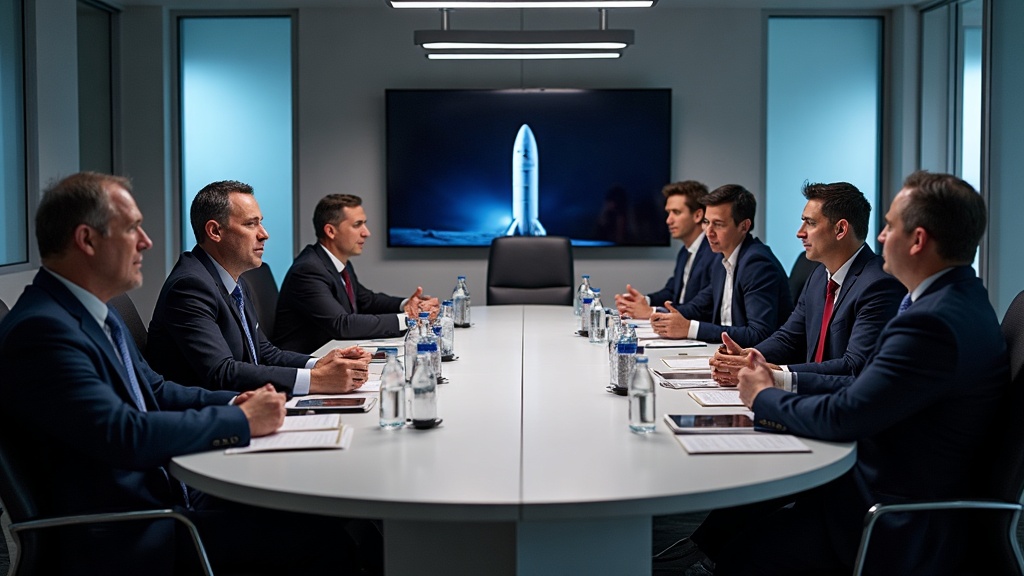
Anthropic spends its days warning the world about the risks of unaligned artificial intelligence. It will spend the next three years paying Elon Musk roughly $1.25 billion every month to train its models inside the same data centers that power xAI, the lab Musk built to compete with it. SpaceX disclosed the arrangement in its IPO filing, and the numbers reframe how the entire AI industry now thinks about who actually owns the compute.
What Actually Happened
SpaceX, in the S-1 registration statement filed ahead of its public offering, revealed that Anthropic has committed to pay approximately $1.25 billion per month for data center capacity running through May 2029. Over the full term the contract could deliver up to $45 billion in revenue to SpaceX, at a run rate near $15 billion per year. The disclosure landed as a footnote to an IPO but reads as one of the largest compute supply agreements ever signed between two AI-era companies.
The capacity itself is concrete. The deal gives Anthropic access to 300 megawatts of compute located across xAI's flagship Colossus 1 facility and the still-expanding Colossus 2 site near Memphis, Tennessee, with command-line access to an estimated 220,000 state-of-the-art Nvidia GPUs. The filing notes a discounted rate for the initial May and June ramp period, after which the full monthly figure applies. Either party can walk away with 90 days notice, a clause that looks routine until you consider what 90 days of lost capacity would do to a frontier training run.
Put the GPU figure in context. Roughly 220,000 advanced Nvidia accelerators is a cluster large enough to rank among the biggest training environments on the planet, the kind of scale only a handful of organizations can assemble. At current market prices that hardware alone represents tens of billions of dollars in silicon, before counting the power and cooling to run it. Anthropic is not renting a server rack. It is renting a large fraction of the world's available frontier-training capacity, which is precisely why the monthly price carries a comma followed by nine zeros.
The strangest line in the filing points upward, not at Tennessee. SpaceX and Anthropic have opened joint research talks to develop gigawatt-scale orbital AI compute using the Starlink satellite network, with a target of beginning as early as 2028. A model lab that publicly frames itself as the safety-first counterweight to Musk is now contemplating training runs that happen in low Earth orbit on infrastructure he controls. The compute crunch has rewritten the rules of who works with whom.
Why This Matters More Than People Think
The headline most outlets ran was the size of the check. The more telling fact is the direction of the money. Anthropic positions itself as the responsible alternative to Musk-aligned AI, and Musk has repeatedly attacked Anthropic and its backers in public. Yet when Anthropic needed 300 megawatts of immediate capacity, the only seller with the GPUs powered, cooled, and online was the company attached to its loudest critic. Compute scarcity has become so acute that ideological and competitive lines simply dissolve when the alternative is not training at all.
This exposes the real bottleneck of the 2026 AI economy. It is not talent, not algorithms, not even chips in the abstract. It is energized, operational data center capacity, the rare combination of power hookups, cooling, land, and installed silicon that takes years to assemble and cannot be conjured with a funding round. Anthropic has raised tens of billions and is valued near a trillion dollars, and it still had to rent from a rival because money does not equal megawatts. The firms that pre-built capacity now hold pricing power over the firms that only have capital.
For Anthropic, the deal also reveals a strategic vulnerability it would rather not advertise. Paying $15 billion a year to a third party, one that hosts a direct competitor, means a slice of every Claude training run effectively subsidizes the broader Musk compute empire. It also means Anthropic carries enormous fixed obligations that must be serviced whether or not its revenue keeps growing at its current pace. A 90-day termination clause cuts both ways: it gives flexibility, but it also signals that neither side wanted to be locked in if the relationship sours or capacity gets more valuable elsewhere.
The deal also recalibrates how to read Anthropic's much-discussed IPO filing. A company about to face public-market scrutiny just disclosed, indirectly through its supplier's S-1, that it owes a counterparty roughly $15 billion a year in compute payments. Public investors will price that fixed obligation against Anthropic's revenue run rate, and the ratio matters enormously. If Claude revenue keeps compounding, the lease looks like leverage on a winning bet. If growth stalls even for two quarters, a $1.25 billion monthly outflow becomes the kind of liability that turns a hot IPO into a cautionary tale about over-committing to compute at the top of the cycle.
The vendor relationship carries a reputational cost too. Every public attack Musk launches at Anthropic now coexists with an invoice Anthropic pays him each month, a contradiction that journalists and rivals will happily exploit. For a lab whose brand is built on trust and restraint, depending on its most vocal critic for survival-grade infrastructure is a narrative liability that no amount of capital erases. The deal works on a spreadsheet, but it complicates the story Anthropic tells about why it deserves to be trusted with powerful AI.
The Competitive Landscape
SpaceX has quietly become an AI infrastructure landlord, and the IPO filing is where that transformation became visible. The company most associated with rockets is monetizing the data center footprint built for xAI by renting spare capacity to xAI's competitors. That is the same playbook Amazon ran two decades ago, when it turned the excess server capacity built for its retail business into Amazon Web Services and accidentally created the most profitable arm of the company. SpaceX may have just discovered its own AWS moment hiding inside Colossus.
The competitive irony deepens when you map the dependencies. Anthropic is backed by Google and Amazon, both of which operate their own massive cloud and AI ambitions, yet it is renting from SpaceX. OpenAI leans on Microsoft, Oracle, and a sprawling Stargate buildout. xAI owns Colossus outright and now sublets it. Every major lab is simultaneously a competitor, a customer, and a supplier to the others, a tangle of circular dependencies where the same megawatt can serve two rivals in the same week. Untangling who truly controls the compute supply chain has become nearly impossible.
History offers a cautionary parallel in the telecom buildout of the late 1990s. Carriers leased capacity from one another at premium rates during the bandwidth shortage, signing long-term contracts at peak prices, only to watch a glut arrive as new fiber lit up and rates collapsed. Anthropic is signing a four-year compute lease at what may be peak GPU scarcity. If next-generation chips and new data centers flood the market by 2028, the firm could be locked into paying yesterday's premium while competitors buy tomorrow's compute at a discount. Long contracts are insurance against scarcity and a trap against abundance.
There is also a concentration and national-security angle that regulators have barely begun to examine. When the compute that trains the most capable AI systems in the world sits in a few private campuses near Memphis and is controlled by companies like SpaceX, the question of who can be denied access becomes a lever of real power. A supplier that hosts two rival labs in the same building holds information and leverage over both. Antitrust authorities spent years worrying about cloud concentration among Amazon, Microsoft, and Google. The compute-rental web emerging among the AI labs themselves may prove harder to map and more consequential to police.
Hidden Insight: The Lab That Fears Power Just Handed Power to a Rival
The deepest irony is philosophical, not financial. Anthropic was founded on the premise that concentrated, unaccountable control of advanced AI is dangerous, and that safety requires careful governance over who can build and run the most capable systems. By committing $45 billion to train inside infrastructure owned by SpaceX, Anthropic has made itself structurally dependent on the goodwill, pricing, and operational decisions of a company run by the person whose AI approach it most explicitly rejects. The safety lab outsourced its most critical dependency to the actor it trusts least.
This is the compute paradox no lab has solved. To build AI you believe is safe, you must first secure enormous physical capacity, and that capacity is controlled by a handful of players who may not share your values or your timeline. Owning your own data centers costs tens of billions and takes years, so the fast path is to rent, and renting means dependence. Anthropic chose speed over sovereignty, which is a rational business decision and a quiet admission that its mission is now hostage to the same infrastructure economics that constrain everyone else.
The orbital research talks make the paradox almost surreal. If Anthropic and SpaceX genuinely pursue gigawatt-scale compute in low Earth orbit by 2028, the most safety-conscious AI lab in the world would be running training inside satellites operated by a private space company answerable to one founder. The governance questions are staggering: who has physical access, who controls the kill switch, what jurisdiction even applies to a model trained in orbit. The deal that started as a capacity rental could end as the most consequential test of who really governs frontier AI.
There is a darker reading for the broader market. If the only way to access frontier-scale compute is to sign multibillion-dollar contracts with the three or four entities that physically control it, then the AI industry is not the open, competitive landscape its boosters describe. It is an oligopoly of landlords renting to tenants, and the tenants, no matter how well funded, serve at the pleasure of the people who own the buildings. Anthropic just demonstrated that even a trillion-dollar valuation does not buy you out of being a tenant.
The most practical lesson for founders watching this unfold is brutal in its simplicity. In the current AI economy, the binding constraint is not how clever your model is or how much you raised, but whether you can secure power and silicon before competitors lock it up. Anthropic, with every advantage capital can buy, still ended up a tenant. Any startup imagining it will out-innovate the incumbents should study this deal closely, because it shows the frontier is gated not by ideas but by infrastructure, and that infrastructure is owned by a shrinking club that sets the price of admission.
What to Watch Next
In the next 30 days, watch whether SpaceX's IPO roadshow leans on the Anthropic contract as proof of a recurring, high-margin revenue stream. If investors reward the data center rental line as heavily as the launch business, expect SpaceX to accelerate Colossus expansion and chase more lab tenants. That would confirm the AWS-style pivot and put SpaceX in direct competition with the hyperscalers it currently supplies. The framing SpaceX chooses on the roadshow will tell you how central compute rental is to its future.
Over 90 days, track whether Anthropic announces its own owned data center capacity to reduce this dependence. A trillion-dollar-valuation lab paying $15 billion a year in rent has every incentive to build, and any move toward self-owned compute would signal that the SpaceX deal was a stopgap, not a strategy. Watch capital-expenditure disclosures, land acquisitions near power sources, and any partnership with chipmakers for guaranteed supply. The tell is whether Anthropic treats this lease as a bridge or as a permanent arrangement.
Over 180 days, the orbital talks are the indicator that matters. The bear case, however, is that the Starlink compute concept is investor theater, a futuristic line in an S-1 designed to justify a sky-high valuation, and that physics, latency, and cooling in orbit make it impractical for years. Skeptics point out that radiating heat in a vacuum and beaming training data to satellites are unsolved at scale. If concrete engineering milestones appear by late 2026, take it seriously. If the orbital language quietly disappears from future filings, it was always a story, not a plan.
Anthropic raised tens of billions to stay independent, then discovered the one thing money cannot buy fast enough: a powered, cooled, online data center. So it rented from the rival it fears most.
Key Takeaways
- Anthropic will pay SpaceX about $1.25 billion per month for compute through May 2029, up to $45 billion total
- The deal provides 300 megawatts across xAI's Colossus 1 and Colossus 2 near Memphis, with access to roughly 220,000 Nvidia GPUs
- SpaceX disclosed the contract in its IPO S-1, revealing a recurring near $15 billion per year data center rental business
- Either party can terminate with 90 days notice, and an initial discounted rate applied for the May and June ramp
- SpaceX and Anthropic are in joint research talks on gigawatt-scale orbital AI compute via Starlink, targeted as early as 2028
Questions Worth Asking
- If a trillion-dollar-valuation lab still has to rent compute from a rival, what does that tell you about where real power in AI actually sits?
- What happens to Anthropic's training roadmap if SpaceX exercises its 90-day termination right at an inconvenient moment?
- Is signing a four-year compute lease at peak GPU scarcity a hedge against shortage or a trap waiting for the next glut?