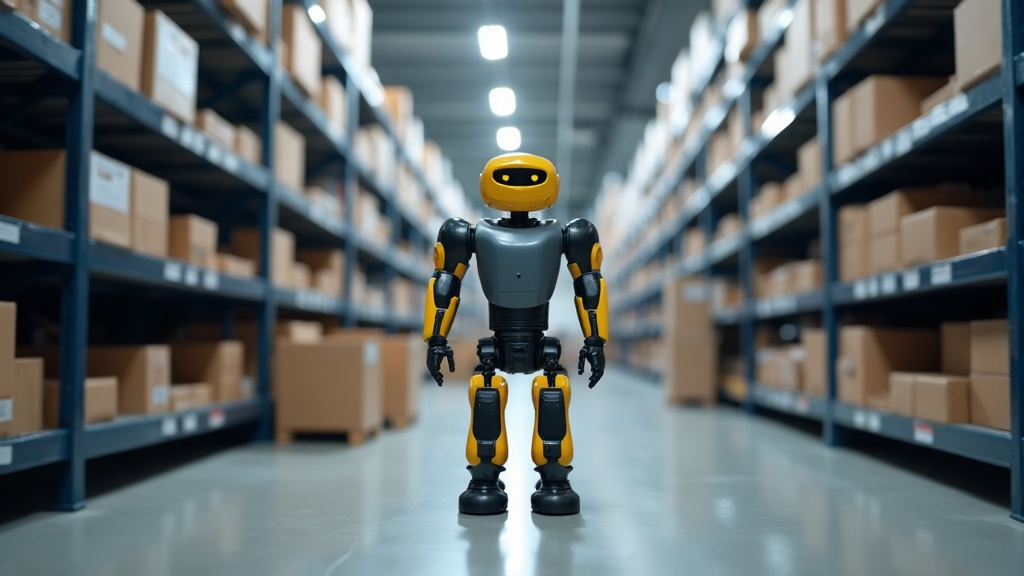
A warehouse outside Atlanta has quietly become the most important address in robotics. Inside a GXO Logistics building in Flowery Branch, Georgia, a bipedal robot named Digit has moved more than 100,000 totes, and unlike almost every other humanoid on Earth, it got paid by the hour to do it. While Tesla, Figure, and a dozen Chinese rivals trade viral demo clips, Agility Robotics has done the one thing that actually pays a robotics company's bills: it turned a humanoid into a line item on a customer's invoice.
What Actually Happened
Agility Robotics builds Digit, a roughly five-foot bipedal robot purpose-built for warehouse work like moving totes between conveyors and storage. Over the past two years Digit has logged hundreds of thousands of operating hours across deployments with Amazon, GXO Logistics, and shapewear brand Spanx. The Spanx work runs inside a GXO-operated facility in Flowery Branch, Georgia, where Digit has now shifted past 100,000 totes in live production rather than a staged pilot.
The detail that separates Agility from the field is the contract structure. GXO signed a multi-year Robots-as-a-Service agreement, the first publicly disclosed humanoid RaaS deal in the industry. GXO does not buy Digits outright. It pays Agility for the work the robots perform, billed on a per-robot, per-hour basis that industry observers peg in the $10 to $30 per hour range, though the exact GXO rate is not public. The robot is sold as labor, not as hardware.
Agility is not a newcomer riding the current hype. The company spun out of Oregon State University research, and in 2023 it opened RoboFab in Salem, Oregon, billed as the world's first factory purpose-built to mass-produce humanoid robots, with capacity to build up to 10,000 Digits a year. Amazon, which backed an earlier investment, trialed Digit inside its own facilities before the GXO and Spanx work moved the robot from experimental testing into a paid, contracted role with measurable output.
Digit's design reflects that pragmatism. It stands about five feet tall, weighs roughly 140 pounds, and uses a bird-like leg geometry tuned for walking on flat warehouse floors and reaching shelves built for people. Crucially, it was engineered to operate inside spaces designed for humans without costly facility retrofits, which is what lets a customer like GXO slot it into an existing operation rather than rebuilding the warehouse around it. That human-compatible footprint is the practical reason a humanoid, rather than a fixed arm or a wheeled cart, earned the job here.
That framing matters because it converts a capital-expense gamble into an operating expense a logistics manager can approve without betting the budget on unproven machines. Agility handles uptime, maintenance, and software updates; the customer simply pays for totes moved. The Spanx and GXO deployments marked the transition from pilot to recurring revenue, a milestone no other humanoid company has credibly claimed at commercial scale.
Why This Matters More Than People Think
The humanoid industry currently runs on capital, not customers. Figure raised more than $1 billion in its latest round at a reported $39 billion valuation, Apptronik pulled in $520 million, and NEURA Robotics took roughly $1.2 billion. Almost all of that money funds research, demos, and factory build-outs rather than paid work. Agility's revenue is small in absolute terms, but it is real, and it changes the question every investor should be asking from "can it walk" to "will anyone pay it to."
Consider the contrast in how the market keeps score. A demo video buys a company a news cycle; a signed RaaS contract buys it a renewal. Logistics is a brutal, low-margin business where labor is the single largest controllable cost, and turnover in warehouse roles routinely exceeds 100 percent a year. A machine that shows up every shift, never quits, and bills predictably attacks the exact pain point that keeps operations executives awake. That is why a robot moving totes in Georgia is a more important data point than most laboratory breakthroughs.
RaaS also quietly solves the adoption problem that has stalled industrial robots for decades. Buying a fleet of experimental humanoids is a board-level decision with brutal downside if the machines underperform. Renting their output by the hour is a procurement decision a plant manager can reverse next quarter. By absorbing the risk onto its own balance sheet, Agility lowers the barrier to the first yes, and the first yes is the hardest one in enterprise robotics.
There is a flywheel hidden in those 100,000 totes. Every hour Digit works generates proprietary data on grasping, navigation, and failure modes inside messy real warehouses, the exact data competitors are paying gig workers to teleoperate and fabricate. Revenue funds deployments, deployments generate data, data improves the robot, and a better robot wins more contracts. That loop is far more defensible than any single hardware spec.
The Competitive Landscape
Agility's closest revenue rival is Figure, which deployed 40 Figure 03 units at BMW's Spartanburg plant and reportedly bills around $25 per robot-operating-hour, with its BotQ factory now producing one robot every 90 minutes. Figure's general-purpose ambition is larger, but its commercial footprint is still concentrated in one automaker. Apptronik's Apollo is live with Mercedes-Benz, GXO, and Jabil, putting it on a similar pilot-to-revenue path, while Tesla's Optimus has zero announced external customers and Elon Musk conceded on the Q4 2025 call that it is "not in usage in our factories in a material way."
Then there is the volume threat from China. Unitree shipped more than 5,500 humanoids in 2025, more than every other maker combined, and is targeting up to 20,000 units in 2026 at hardware prices that start near $16,000. Chinese firms control roughly 90 percent of unit shipments. Agility is not trying to win on volume or price; it is betting that integrated, paid, reliable work inside Western supply chains is a different and more durable business than selling cheap bodies.
History rhymes here. The first wave of warehouse automation was won not by the most advanced machine but by the one that integrated cleanly into existing operations, which is how Kiva, later Amazon Robotics, reshaped fulfillment with simple wheeled pods rather than dexterous arms. Agility is applying that lesson to humanoids: fit the workflow, prove the economics, then expand. Its rivals are trying to leap straight to a do-everything robot, a strategy that has historically arrived years later and billions more expensive than the narrow tool that got there first.
The strategic split is becoming clear. Tesla and Figure are selling a vision of a general-purpose humanoid that does everything. Unitree is selling the cheapest capable body. Agility is selling a narrow, dependable warehouse worker that already shows up and earns its keep. In most technology markets, the unglamorous product that monetizes first tends to fund the runway to outlast the visionaries who monetize last.
The prize justifies the patience. Warehousing and logistics employ tens of millions of people globally in physically punishing, high-turnover roles that companies struggle to staff, which is exactly the labor pool a reliable humanoid can address first. If Agility proves the per-hour economics in tote handling and then expands task by task, it does not need to win the entire general-purpose dream to build a large business; it only needs to keep converting one repetitive, well-defined job at a time into a billable robot-hour. That incremental path is less cinematic than a robot that does everything, but it is how durable franchises are usually built.
Hidden Insight: The Business Model Is the Breakthrough, Not the Robot
The robotics press obsesses over degrees of freedom, hand dexterity, and gait. The real innovation at Agility is financial. By pricing Digit as labor through RaaS, Agility reframed a humanoid from a science project into a staffing agency with a metal workforce. That is the same move that turned cloud computing into a trillion-dollar industry: Amazon did not win because its servers were better, it won because it sold compute by the hour instead of forcing customers to buy data centers.
This reframing exposes an uncomfortable truth the sector keeps avoiding. Humanoid valuations are priced on the dream of general intelligence in a body, a robot that folds laundry, cooks, and works any job. But the money that exists today is in moving totes from point A to point B, eight hours a shift, with dependable reliability. The gap between the narrative valuation and the actual revenue line is enormous, and Agility is the only company narrowing it with invoices rather than slide decks.
There is also a labor-politics dimension the industry prefers not to discuss out loud. Pricing a humanoid at, say, $20 an hour places it in direct, transparent comparison with a human wage, and the moment that comparison becomes a spreadsheet line, adoption stops being a technology decision and becomes a margin decision. Agility's RaaS model makes that comparison explicit and frictionless, which is precisely why it could spread faster than forecasters extrapolating from hardware readiness expect. The bottleneck was never only the robot; it was the contract that made buying its time effortless.
This is also why the most-cited metric in the sector, raw unit shipments, can mislead. Shipping 5,500 inexpensive bodies into research labs, universities, and demos is not the same as billing thousands of productive hours inside a paying customer's operation. One number measures manufacturing throughput; the other measures whether the product solves a problem someone will fund again and again. Agility is losing the shipment race decisively while leading the only contest that ultimately pays back the capital pouring into humanoids: sustained, contracted, real-world work.
The bear case, however, is straightforward and serious. Digit is bipedal, which makes it slower and more failure-prone than a wheeled mobile robot for the narrow task of warehouse transport, and critics argue legs are an expensive answer to a problem flat warehouse floors do not pose. RaaS margins can be thin if maintenance and downtime eat the hourly rate, and Chinese makers selling bodies at a fraction of the cost could undercut the economics before Agility scales. Revenue existing is not the same as revenue being profitable.
Yet even skeptics should note what the contract signals about buyer psychology. GXO, a sophisticated logistics operator, did the math and decided paying for robot-hours beats hiring and retaining humans for this task at current wages and turnover. That is a market validation no demo can fake. The risk the market is underpricing is not that humanoids fail to work, but that the winners are decided by contract structure and unit economics rather than by who has the most impressive backflip.
What to Watch Next
Over the next 30 to 90 days, watch whether GXO expands Digit beyond the Spanx facility to additional sites, the clearest signal that the economics pencil out at scale. Watch for any disclosure, even indirect, of the actual per-hour RaaS rate, since that single number determines whether this is a real business or a subsidized showcase. New named logistics customers beyond Amazon, GXO, and Spanx would confirm the model travels.
Over the next 180 days, track whether Figure, Apptronik, or even Tesla shift toward RaaS pricing rather than outright sales, which would validate Agility's model as the industry standard. Watch Agility's funding posture: a large raise or IPO chatter would signal it is pressing its revenue lead, while silence could mean the margins are harder than the headlines suggest. And watch the Chinese volume players for any move into Western RaaS contracts, the one development that would directly threaten Agility's moat.
Also track the broader funding climate. Humanoid investment surged from $0.7 billion in 2018 to $4.3 billion in 2025, and a correction in that capital could separate the companies with real revenue from those living on narrative. In a downturn, Agility's invoices become a survival advantage while pre-revenue rivals burn through raises. Watch which names quietly pivot their messaging from grand general-purpose visions to specific, paid, repeatable tasks, the surest sign the market is rotating from hype to economics.
The mental model to carry forward is simple. In this cycle, ignore the demo reels and follow the invoices. The first humanoid company to build a durable, profitable book of recurring revenue will set the terms for everyone else, and right now a plain bipedal robot moving totes in Georgia is further down that road than any robot you have seen do a backflip.
The humanoid that wins will not be the one with the best backflip, it will be the one with the best invoice.
Key Takeaways
- 100,000+ totes moved by Agility's Digit at a GXO and Spanx facility in live production, not a demo.
- First public humanoid RaaS deal means GXO pays per robot-hour instead of buying machines, an industry first.
- $10 to $30 per hour is the industry-estimated RaaS range; the exact GXO rate is undisclosed.
- Tesla has zero external Optimus customers and Musk admits it is not materially used even in Tesla's own factories.
- Unitree shipped 5,500+ units in 2025, more than all rivals combined, but competes on price and volume, not paid work.
Questions Worth Asking
- If the winning humanoid company is decided by contract structure and unit economics, are investors valuing the right companies?
- Does selling robots as labor by the hour beat selling them as hardware, the same way cloud beat owning servers?
- If a robot could do a measurable slice of your job at $20 an hour with no benefits or turnover, how soon does your employer run that math?