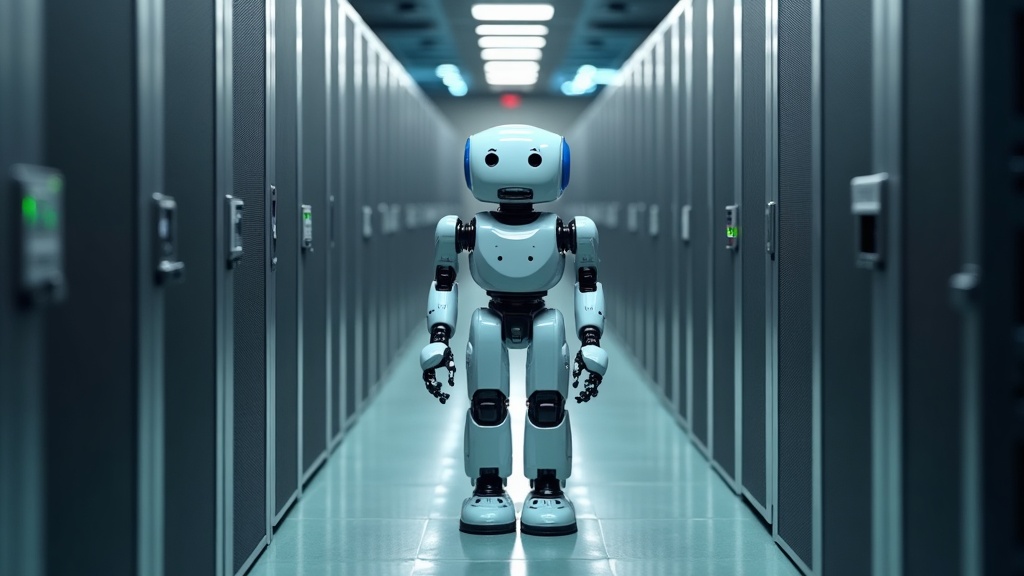
Alibaba just dropped three AI models that don't chat with you. They drive robots. On June 16, Alibaba's Tongyi Lab released the Qwen-Robot suite, a family of interconnected embodied AI models designed specifically to give machines the ability to navigate physical spaces, simulate the consequences of their actions before taking them, and execute precise physical manipulation tasks. This isn't a chatbot upgrade. It's Alibaba planting a flag in what many consider the next major battleground in AI: the physical world.
What Actually Happened
Tongyi Lab, the AI research division of Alibaba Cloud, released three distinct models that together form a complete robotics AI stack. The first, Qwen-RobotNav, is a vision-language navigation model that enables robots to parse natural language instructions and translate them into autonomous movement through physical environments. It introduces what Alibaba calls a task-adaptive observation mechanism, which allows a robot to dynamically adjust what it pays attention to depending on what it's been asked to do. Rather than scanning everything at full resolution all the time, the model allocates computational attention selectively, making navigation both faster and more energy-efficient. According to South China Morning Post, pilot testing with Alibaba Cloud enterprise clients is already underway.
The second model, Qwen-RobotWorld, is a video world model that represents perhaps the most architecturally novel piece of the suite. Before a robot acts, Qwen-RobotWorld simulates the physical consequences of potential action trajectories, essentially letting the robot rehearse in a virtual representation of the scene before committing physical motion. This closes a fundamental gap that has plagued robotics AI: models that can see and reason about environments but lack a causal understanding of how their actions change those environments. As The Next Web reported, the launch reflects a broader industry pivot away from chatbots and toward agents and embodied systems capable of carrying out complex physical tasks rather than just answering questions.
The third model, Qwen-RobotManip, is a generalist vision-language-action (VLA) model built on the Qwen3.5-4B architecture and designed for physical execution. It uses an 80-dimensional unified action representation combined with relative perception to enable what Alibaba describes as rapid cross-hardware adaptation, meaning the same model can theoretically control different robotic hardware without full retraining from scratch. Alibaba also disclosed a fourth component: Qwen-RobotClaw, an internal robotic agent framework that enables Qwen VLM agents to invoke the Qwen-Robot Suite models as tools while managing the context and memory required for long-horizon tasks. Per reporting by Futunn, the full suite is currently in pilot testing with selected enterprise clients, with Alibaba positioning it as the software layer for a coming wave of commercial robot deployments.
Why This Matters More Than People Think
Alibaba releasing a robotics AI suite is not a side project. It's a strategic repositioning. The company commands one of the world's largest cloud computing ecosystems and has over 200 million enterprise customers on Alibaba Cloud. Distributing Qwen-Robot through that infrastructure gives the models a commercial runway that standalone robotics AI startups simply cannot match. When Qwen-Robot moves from pilot testing to general availability, it won't be seeding into a vacuum: it enters a customer base that is already paying for cloud services, already accustomed to Alibaba's API stack, and increasingly under pressure from Chinese government and industrial customers to automate factory and logistics operations across automotive, electronics, and consumer goods sectors.
The three-model architecture matters because it mirrors how biological systems actually work. Humans don't navigate, predict, and manipulate simultaneously using one undifferentiated neural process. They use specialized circuits for spatial navigation, mental simulation of future states, and fine motor control, with a higher-level executive system orchestrating between them. Qwen-RobotClaw plays the executive role in Alibaba's architecture, which means the whole system is designed to tackle tasks that unfold over long time horizons, not just single-step commands. This is precisely the class of tasks that industrial manufacturing and logistics require: multi-step assembly sequences, conditional branching based on inspection results, and context-dependent tool use on production lines that operate seven days a week.
The commercial timing is also highly specific. China's humanoid robot shipments are expected to surge 94 percent in 2026, with Unitree and AgiBot projected to capture nearly 80 percent of domestic production according to TrendForce data. That wave of hardware needs software capable of running on it and adapting to diverse factory floor conditions. Qwen-Robot is explicitly designed with cross-hardware adaptability as a core feature. If Alibaba can establish Qwen-Robot as the de facto AI brain for Chinese-manufactured humanoid robots, it locks in a software-hardware flywheel that will be extremely difficult for Western competitors to dislodge from that market. Every robot that ships running Qwen-Robot sends operational telemetry back into Alibaba's training pipeline, compounding the model's advantage over time.
Scale compounds the advantage in ways that pure performance benchmarks don't capture. Consider what happens when ten thousand Qwen-Robot-powered robots are running on factory floors simultaneously: the operational data they generate becomes a continuous fine-tuning stream that refines navigation routes, improves manipulation success rates on specific part geometries, and surfaces edge cases that no lab environment would surface. This is the same dynamic that made Tesla's Autopilot formidable despite not having the best AI team in autonomous driving: fleet scale generates training signal that lab experiments cannot replicate. Alibaba is positioning itself to sit at the center of that data flywheel, and the company has both the cloud infrastructure to collect and process the data and the enterprise relationships to deploy the robots that generate it.
The Competitive Landscape
The embodied AI foundation model space has been moving fast all year. Physical Intelligence (pi), the startup backed by Jeff Bezos, raised funds to build general-purpose robotics AI. NVIDIA released GR00T N2, a foundation model for humanoid robots that it described as achieving double the task success rate compared to prior approaches, and simultaneously named Unitree's H2 Plus as the hardware foundation for its open reference humanoid platform. Google DeepMind has continued iterating on its robotic transformer models. The entry of Alibaba into this space via Qwen-Robot represents the first time a Chinese internet hyperscaler has built purpose-built foundation models for embodied AI, as distinct from the hardware-first approach of Unitree or the specialized deployment approach of AgiBot.
The comparison to NVIDIA's GR00T is instructive. GR00T is designed to be a universal foundation and then fine-tuned by hardware partners. Qwen-Robot takes a more vertical approach: Alibaba built a complete sense-predict-act stack and will distribute it through its own cloud. The GR00T model is effectively middleware. Qwen-Robot is closer to a complete operating system for a robot's AI functions. Neither approach is definitively superior, but they create very different competitive dynamics. GR00T benefits from NVIDIA's chip relationships and the hardware partnerships that give it access to diverse robot platforms. Qwen-Robot benefits from Alibaba's direct relationships with enterprise customers who are the actual buyers of robotic systems and have existing procurement relationships already in place.
Critics argue that Alibaba's Qwen-Robot, like many Chinese AI robotics models, will face a well-documented hardware-software integration gap that limits real-world deployment speed. Chinese manufacturers like Unitree and AgiBot have strong hardware platforms, but bridging the gap between a capable AI model and reliable unsupervised factory operation requires thousands of hours of real-world iteration that no amount of simulation can fully replace. Companies like Figure AI and Agility Robotics learned this the hard way, going through multiple hardware generations and extensive software iterations before their units could reliably handle the variability of real-world industrial environments. Qwen-Robot faces the same challenge, and Alibaba has not disclosed any reliability metrics or task completion rates from its pilots, which makes it impossible to assess where it actually sits on the maturity curve.
Hidden Insight: The World Model Is the Real Story
Most of the coverage of Alibaba's announcement focused on Qwen-RobotManip, the manipulation model, because manipulation is what most people picture when they think of robot AI: a mechanical arm picking up objects. But Qwen-RobotWorld, the video world model that simulates action trajectories before execution, is actually the more consequential architectural innovation. The ability to mentally simulate a physical action before committing to it is what separates robots that can operate safely and autonomously in unstructured environments from robots that require constant human supervision or can only handle narrowly defined, highly repetitive tasks that were encoded explicitly during training.
World models have been a major research frontier since Yann LeCun argued they are the critical missing ingredient in AI systems that can reason about the physical world. OpenAI's Sora demonstrated that large video models can generate physically plausible footage. DeepMind has been building world models explicitly for robotic planning. The difference with Qwen-RobotWorld is that it's not positioned as a research project: it's packaged into a production-ready suite alongside navigation and manipulation models, with Alibaba Cloud as the distribution channel. If the world model works reliably in production, it means robots using Qwen-RobotWorld can plan around obstacles they haven't encountered during training, adapt to unexpected object positions, and avoid actions that their simulated physics engine predicts would cause problems or collisions.
This has a second-order implication that is easy to miss: a working robot world model changes the data flywheel entirely. Once deployed, robots running Qwen-RobotWorld can generate synthetic training data by running simulations of failed or uncertain trajectories, then feeding the results back into training. This is analogous to how AlphaGo's self-play mechanism allowed it to generate vast quantities of training data that no human opponent could have produced. Robots that can simulate their own failures become dramatically cheaper to improve because they don't require human experts to design every training scenario. Alibaba is positioning itself to sit at the center of that data flywheel if Qwen-Robot achieves deployment scale across Unitree, AgiBot, and other major robotic hardware platforms in Chinese manufacturing.
There is also a geopolitical angle worth taking seriously. The United States has tightened export controls on advanced AI chips and imposed restrictions on specific Anthropic models. China has responded by accelerating domestic alternatives across every layer of the AI stack, from custom AI processors to open-weight language models. Qwen-Robot fits cleanly into a strategy of creating a China-native full-stack robotics AI platform that doesn't depend on any technology that could be restricted by US export controls. Alibaba's Qwen3.5-4B, on which Qwen-RobotManip is built, is a domestically developed architecture. The entire Qwen-Robot stack can run on Huawei Ascend chips if Alibaba chooses to support that configuration, which means the Chinese manufacturing sector could deploy this technology without any exposure to US technology restrictions or supply chain vulnerabilities linked to NVIDIA or AMD hardware.
What to Watch Next
The most important near-term signal is when Alibaba moves Qwen-Robot out of pilot testing and announces general availability on Alibaba Cloud. Pilot testing with "selected enterprise clients" is the expected first step, but the timeline from pilot to GA will determine whether this becomes a competitive threat to Physical Intelligence, NVIDIA GR00T, and Western robotics AI companies within the next 12 months or settles into a China-domestic market story. Watch for announcements from Alibaba Cloud about specific enterprise customer deployments in the automotive, logistics, or electronics manufacturing sectors. Those verticals represent the highest-volume commercial opportunities and would signal that Qwen-Robot has cleared the reliability bar required for unsupervised industrial deployment.
The second indicator is hardware partnerships. Alibaba claimed cross-hardware adaptability as a core feature. If Unitree, AgiBot, or other major Chinese humanoid robot manufacturers announce that they're integrating Qwen-Robot models into their platforms in the next 90 days, that confirms the cross-hardware claim and begins building the network effects that would make Qwen-Robot the default robotics AI layer for Chinese-manufactured humanoids. If no hardware partnerships materialize within that window, it suggests the cross-hardware adaptability is more aspirational than practical at this stage of development, and the suite may need another iteration before it can generalize effectively across different actuator configurations.
Over the next 180 days, watch whether Alibaba publishes benchmark results comparing Qwen-RobotManip and Qwen-RobotNav against Physical Intelligence's pi0 model, NVIDIA GR00T N2, and Google's robotic transformer models. The embodied AI field has been clearly lacking in standardized benchmarks compared to language model evaluation, and any company that establishes its model as the benchmark standard gains a decisive narrative and commercial advantage. Alibaba has the research firepower to compete on benchmarks and the commercial motivation to do so. If Qwen-Robot posts competitive results against Western models on standardized robotics tasks, the framing shifts from "China's answer to Western robotics AI" to "a global competitor in a technology race that the United States no longer leads by default."
The robot that can simulate its own mistakes before making them doesn't need human supervision to get smarter: it needs scale.
Key Takeaways
- Three-model suite released June 16 by Alibaba's Tongyi Lab: Qwen-RobotNav, Qwen-RobotWorld, and Qwen-RobotManip form a complete sense-predict-act stack for embodied AI robots across industrial settings.
- Qwen-RobotManip built on Qwen3.5-4B with 80-dimensional action representation: designed for rapid cross-hardware adaptation without full retraining, a key requirement for deployment across diverse robot platforms.
- Qwen-RobotWorld simulates action trajectories before execution: a world model capability that allows robots to plan around obstacles and avoid predicted failures before committing to physical motion in real environments.
- Pilot testing already underway with Alibaba Cloud enterprise clients: the distribution channel gives Qwen-Robot access to over 200 million enterprise customers who are the actual buyers of robotic systems in Chinese manufacturing.
- China's humanoid robot shipments projected to surge 94 percent in 2026: Alibaba's cross-hardware adaptability positions Qwen-Robot as a candidate default AI brain for that hardware wave, creating a software-hardware flywheel that compounds advantage over time.
Questions Worth Asking
- If Qwen-RobotWorld's simulation capability works at production scale, does it mean the next generation of robotics AI will be trained primarily on synthetic data generated by the robots themselves, making human-designed training scenarios less relevant over time?
- Alibaba's distribution advantage via Alibaba Cloud is formidable in China, but how does that advantage translate to Western markets where the company faces regulatory scrutiny and customer hesitation around Chinese-controlled AI infrastructure running on factory floors?
- The pilot testing phase for robotics AI has historically exposed the gap between research performance and production reliability: what task completion rate and uptime threshold does Qwen-Robot need to hit before industrial manufacturers will trust it for unsupervised overnight operations?