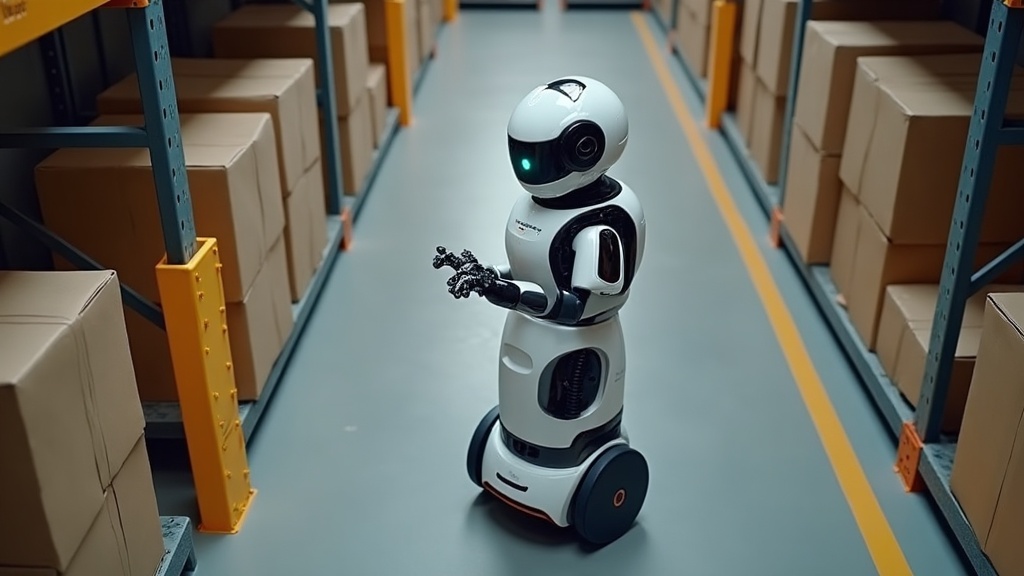
Amazon's warehouse robots used to need engineers to tell them what to do. Now they need a sentence. At its Delivering the Future event in London on June 4, 2026, Amazon unveiled a next-generation Proteus robot that takes plain-English instructions from ordinary workers, no code and no technical syntax required. The same week, Amazon also said it would hire 25,000 more people and spend more than 11 billion dollars expanding in Europe, a juxtaposition that captures the central tension of automation in 2026: the machines are getting smarter and the headcount is still growing, for now.
What Actually Happened
Amazon introduced the upgraded Proteus, its autonomous mobile robot, with a new ability to understand natural-language commands. Instead of programming a route or issuing a technical instruction, a warehouse worker can simply tell Proteus where to go and what to move, and the robot handles the rest. Scott Dresser, vice president of Amazon Robotics, summed up the leap: the robot "figures out the priority, the route, the timing." The capability is currently being piloted in Amazon's labs, with deployment in Europe planned for the first half of next year. The point is to let non-technical staff redirect robots on the fly, the way a shift lead would reassign a human teammate.
Proteus is not new hardware, but its brain is. The robot already operates at 25 Amazon facilities across the United States, where it primarily moves heavy carts in dock areas, transfers containers between workstations, and assists employees at delivery sites. What changed is the interface. Earlier versions followed pre-mapped paths and pre-set tasks. The new Proteus interprets a spoken or typed request, plans the task, and executes it autonomously, which turns the robot from a fixed-function machine into something closer to a general-purpose helper that can be retasked in seconds without an engineer in the loop.
The announcement came wrapped in a large spending commitment. Amazon said it will invest more than 10 billion euros, roughly 11.6 billion dollars, to modernize and expand its fulfillment operations across Europe over the coming years, and that it plans to hire 25,000 additional employees in the region. The robot reveal and the hiring pledge were deliberately paired. Amazon has spent years defending itself against the claim that automation destroys jobs, and presenting a smarter robot alongside a 25,000-person hiring plan is the company's way of arguing that the two can rise together. Whether that pairing holds over a decade is the question critics immediately raised.
Why This Matters More Than People Think
The breakthrough is not that a robot moves a cart, Amazon has done that for years. The breakthrough is that the robot now understands intent. Natural-language control removes the single biggest bottleneck in warehouse robotics: the need for specialized programming to deploy or redirect a machine. When any worker can retask a robot by speaking to it, the cost and friction of automation collapse, and robots can be assigned to the constantly shifting micro-tasks of a fulfillment center rather than a few fixed routes. That flexibility is what turns robotics from a capital project into an everyday operational tool, and it is the difference between dozens of robots and thousands.
This is the same large-language-model capability that powers chatbots, now pointed at physical work. For years, AI's language understanding lived on screens, summarizing documents and answering questions. Embedding that understanding into a machine that moves freight is the moment AI crosses from the digital world into the physical one at industrial scale. Amazon, which already operates one of the largest robot fleets on earth with more than a million machines deployed across its network, is uniquely positioned to push this transition, because it has both the language models and the physical footprint to deploy them against. The warehouse becomes the proving ground for embodied AI.
The scale of what this enables is easy to underestimate. A fulfillment center runs on thousands of small, irregular decisions: a cart that needs moving here, a container redirected there, a spill to route around, a surge at one dock. Fixed-route robots could never touch most of that work because programming each contingency was uneconomical. A robot that accepts plain-language instruction can be folded into all of it, which means automation stops being confined to a few high-volume choke points and starts seeping into the long tail of warehouse tasks. That expansion of scope, from a handful of jobs to most of them, is the quiet engine behind Amazon's robotics spending.
The bear case, however, is the one Amazon is working hard to talk around. Critics argue that natural-language robots are precisely the technology that eventually shrinks warehouse headcount, and that the 25,000-job pledge is a present-tense sweetener for a future-tense substitution. The risk for workers is that each generation of more capable robot raises the share of tasks a machine can absorb, so even if total employment grows during the build-out, the long-run trajectory bends toward fewer humans per package shipped. CNBC framed the Proteus reveal bluntly against a backdrop of continuing AI-driven layoffs across the tech industry, and that framing is the uncomfortable subtext Amazon cannot fully dispel with a hiring announcement.
The Competitive Landscape
Amazon is racing a crowded field toward the same goal of flexible, AI-driven physical labor. Figure AI, recently valued near 39 billion dollars, is building humanoid robots aimed partly at warehouse and logistics work. Boston Dynamics, owned by Hyundai, is deploying its Atlas humanoid into manufacturing plants. Nvidia is supplying the chips and foundation models, from Jetson Thor to its GR00T robot models, that many of these systems run on. Amazon's edge is not the most advanced robot body, it is the largest real-world deployment surface and a closed loop of data from billions of package movements that no competitor can replicate.
The historical parallel is Amazon's 2012 acquisition of Kiva Systems, the move that put shelf-moving robots into its warehouses and forced the entire logistics industry to follow. That decision did not reduce Amazon's workforce, it coincided with the company growing from roughly 88,000 employees to over 1.5 million, because automation expanded what Amazon could profitably do and pulled more volume into its network. Natural-language Proteus could rhyme with that pattern, where smarter robots enable faster growth that absorbs more workers rather than fewer, at least through the expansion phase. The open question is whether the second act, once growth slows, looks different from the first.
For rivals like Walmart, Ocado, and a wave of warehouse-automation startups, the natural-language interface raises the bar. Competing now requires not just robots but robots that frontline staff can operate without retraining, which favors players with deep language-model capability and massive operational data. That is a short list, and Amazon sits at the top of it. The companies most exposed are the pure-hardware robotics vendors that sell machines but lack the AI brain to make them conversational, because Amazon has just reset customer expectations for what a usable warehouse robot should be able to understand.
Hidden Insight: The Interface Is the Disruption
The story everyone will tell is about robots versus jobs. The more important story is about the interface. For decades, the binding constraint on industrial automation was not the machines, it was the integration: every robot needed expensive specialists to program, configure, and maintain it, which made automation viable only for the largest, most repetitive tasks. Natural-language control dissolves that constraint. When the programming layer disappears, the economics of automating a task change overnight, because the cost of deployment drops from an engineering project to a conversation.
This is why the Proteus upgrade matters more than its modest hardware change suggests. The same shift that made software universal, moving from command-line tools that required expertise to graphical and then conversational interfaces that anyone could use, is now happening to physical machines. Once a robot can be directed in plain language, the population of people who can deploy it expands from a handful of robotics engineers to every worker on the floor. That democratization of control, not any single robot capability, is what unlocks automation across the millions of irregular, low-volume tasks that were never worth the integration cost before.
The second-order effect is a data flywheel that compounds Amazon's lead. Every plain-language command a worker gives Proteus is a labeled example of human intent paired with a physical outcome, and Amazon collects millions of them across its network. That data trains the next model to understand instructions better, which makes the robots more useful, which generates more commands, which improves the data. Competitors without a comparable deployment footprint cannot bootstrap this loop, because they lack the real-world volume to generate the training signal. The interface change is not just a feature, it is the on-ramp to a proprietary dataset of embodied intent.
There is a sharper insight buried in the labor debate. The relevant question is not whether robots replace workers, it is which tasks become uneconomical to do with humans once the deployment cost of a robot falls to near zero. As natural-language control removes the integration cost, the threshold for automating a task drops, and tasks that were marginal yesterday become automatable today. The 25,000 new hires are real, but so is the steady expansion of the set of jobs a conversational robot can absorb. Both things are happening at once, and the honest forecast is not robots versus humans but a moving line between them that conversational AI is pushing in one direction.
What to Watch Next
In the next 30 days, watch for the pilot results and any independent footage of natural-language Proteus in action. Amazon says the system is still in its labs, so the first real test is how the robots perform outside a controlled demo, with the accents, noise, and ambiguity of a live warehouse floor. Watch whether Amazon publishes task-success rates or keeps the numbers vague, because specificity signals confidence and vagueness signals a system that is not yet production-ready. Any reporting on how workers actually experience commanding a robot will be the most telling early indicator.
Over the next 90 days, the European deployment timeline is the marker that matters. Amazon committed to rolling Proteus into Europe in the first half of next year alongside its 11.6 billion dollar fulfillment investment, so watch which facilities go first and how many robots are deployed per site. Track Amazon's hiring data in the same regions, because the real test of the jobs-and-robots-rise-together claim is whether headcount actually grows where the robots land. Watch too for union and regulatory responses in Europe, where labor protections are stronger and automation draws sharper scrutiny than in the United States.
Also watch how Amazon positions the technology politically. The company has every incentive to keep pairing robot announcements with hiring pledges, especially in Europe where regulators and unions watch automation closely, so the messaging itself is a signal worth tracking. If future robot reveals quietly drop the headcount commitments, that shift in tone will say more about Amazon's real labor trajectory than any single deployment number. The gap between what the company demonstrates in its labs and what it promises about jobs is the space where the truth of this transition will actually play out.
The 180-day question is whether natural-language control spreads from Proteus to Amazon's broader robot fleet and then to the industry. If Amazon extends conversational control to its other machines and competitors scramble to match it, that confirms the interface, not the hardware, was the breakthrough. Watch the ratio that ultimately decides the labor argument: packages shipped per employee. If that number climbs steeply as conversational robots scale, the efficiency gains are coming from automation, and the long-run pressure on warehouse jobs will become harder for any hiring pledge to obscure. That single ratio will tell the real story long after the London keynote is forgotten.
Keep an eye on the rest of the industry's response as well. If Figure, Boston Dynamics, and the warehouse-automation startups rush to add conversational control to their own machines within months, that is the clearest confirmation that Amazon defined the new standard. The speed of that imitation, more than any benchmark, will reveal whether plain-language robot control is a genuine inflection point or a well-staged demo that the rest of the field can safely ignore.
The breakthrough is not a robot that moves a cart. It is a robot that understands the sentence telling it to.
Key Takeaways
- Unveiled June 4, 2026 Amazon showed a next-gen Proteus robot that takes plain-English commands at its London Delivering the Future event.
- No code required workers can direct the robot by speaking, and it figures out the priority, route, and timing on its own.
- Already at 25 US facilities Proteus moves heavy carts and containers in dock areas, with Europe deployment set for the first half of next year.
- 11.6 billion dollar Europe push Amazon paired the robot reveal with a plan to hire 25,000 more workers in the region.
- Language meets freight the same model capability behind chatbots now directs machines that move physical goods at industrial scale.
Questions Worth Asking
- If deploying a robot drops from an engineering project to a sentence, which tasks in your operation suddenly become automatable?
- Can headcount and automation really rise together for a decade, or only during the growth phase?
- Who owns the data flywheel when every spoken command trains the next, more capable robot?