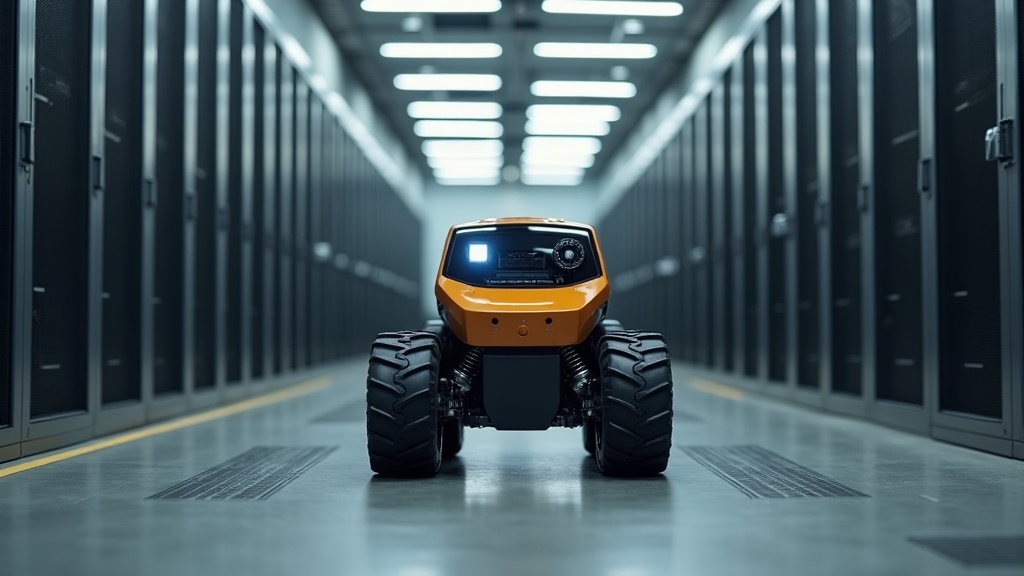
The robot that hauled bins across strawberry fields for three years just got a larger sibling capable of moving stage equipment, construction materials, and industrial pallets. Burro, the agricultural robotics company that built one of the most commercially proven autonomous follow platforms in any industry, announced Burro Grande on June 15, 2026: a 44-horsepower robot designed for heavy payload work in construction, event logistics, and manufacturing environments. The announcement is not a research preview. Burro is taking orders.
What Actually Happened
Burro announced Burro Grande through a product launch covered by The Robot Report on June 15, 2026. The new platform is designed for payloads up to 3,000 pounds and is powered by a 44-horsepower engine, a 10x increase in power over the original Burro agricultural robot. The Grande maintains Burro's signature autonomous follow functionality: the robot follows a designated human worker or another vehicle, matching pace and path without requiring manual operation. It adds waypoint navigation and facility mapping capabilities that allow it to operate predefined routes in structured environments like warehouses, construction sites, and event venues without a human leader in range.
The target verticals are specific and deliberate. And Now You Know's interview with Burro CEO Charlie Andersen revealed that the company's initial commercial focus is on three segments: event production and staging, where crews move heavy equipment repeatedly across venues; commercial construction, where material transport between staging areas and active work zones consumes 20–30% of crew labor; and industrial logistics, where facility operators need to move heavy loads between fixed points without dedicated forklift operators. Each segment shares a common profile: high labor cost for repetitive transport tasks, variable terrain that makes conveyor systems impractical, and a workforce that is already expensive and difficult to hire. Burro Grande's economics are designed to address all three simultaneously.
The company's commercial foundation distinguishes this launch from typical robotics announcements. Burro has deployed over 500 original-platform units across agricultural operations in California, Florida, and other major growing regions, accumulating millions of hours of real-world autonomous operation. That deployment base provided the training data, reliability testing, and customer feedback that informed the Grande platform's design. The company's original robot achieved commercial viability in one of the most demanding outdoor environments in agricultural robotics: uneven terrain, variable lighting, dense crop canopies, and extreme temperature ranges. Moving into construction and industrial logistics represents a vertical expansion built on proven hardware and navigation software, not a pivot from research to commercialization.
Why This Matters More Than People Think
The robotics industry has a well-documented pattern of companies that demonstrate impressive capability in controlled environments and then fail to achieve commercial deployment at scale. The graveyard of well-funded robotics startups that solved the engineering problem but not the commercial adoption problem is long: Rethink Robotics, Savioke, Marble, and dozens of others raised tens of millions of dollars and then shut down or pivoted before reaching meaningful revenue. Burro's path is structurally different, and the Grande launch reflects that difference. The company is not moving from lab to field. It is moving from one field to another, carrying operational knowledge, customer relationships, and a service infrastructure that took three years to build in agriculture.
The labor market context makes the timing precise. Construction labor costs rose 18% between 2023 and 2026 according to the Associated General Contractors of America, and the industry-wide vacancy rate for laborer positions reached 7.2% by Q1 2026. Event production has faced similar pressure: the live events industry recovered sharply after 2022, but crew wages rose faster than ticket prices, compressing margins for staging and production companies. Both industries have been looking for labor substitution options that don't require the controlled, structured environments that made early warehouse robots viable. Burro Grande's outdoor capable, autonomous follow design directly addresses that gap.
Skeptics point out, however, that Burro's commercial track record is almost entirely in agriculture, an industry with specific regulatory, terrain, and operational characteristics that don't map cleanly onto construction or event logistics. The bear case is that Burro's existing 500-unit deployment is survivor bias: it reflects the customers who succeeded in integrating autonomous follow robots into their workflows, not the broader market of customers who evaluated the technology and decided it wasn't operationally mature enough. Construction environments introduce variables that agricultural deployments don't face: mixed-use spaces with pedestrians who don't behave predictably, dynamically changing terrain as work progresses, and liability structures that create higher stakes for any autonomous system incident. The risk is that Burro's agriculture success proves harder to replicate than the company's commercial expansion thesis assumes.
The Competitive Landscape
Burro Grande enters a heavy-payload autonomous mobile robot market that has attracted substantial investment but limited commercial deployment at scale. Boston Dynamics's Stretch robot targets warehouse and logistics environments but has focused on container unloading, not general material transport. Locus Robotics and 6 River Systems have achieved real deployment in warehouse settings but operate in structured indoor environments with predictable terrain. Vecna Robotics and Agilox have deployed autonomous forklifts in manufacturing and distribution, but their platforms require significant facility preparation including floor markings, fixed infrastructure, and environmental controls that limit deployment to purpose-built spaces. None of these competitors offer the outdoor-capable autonomous follow functionality that defines Burro's differentiation.
The agricultural robotics adjacent competitors are worth watching specifically. FarmWise, Carbon Robotics, and Tortoise have all built navigation and autonomy capabilities in outdoor unstructured environments, but none have targeted heavy industrial applications. Monarch Tractor has built autonomous tractors for agricultural use that exceed Burro Grande's power rating, but agricultural tractor platforms are not designed for construction site material transport or event logistics deployment. The competitive white space that Burro Grande is targeting, heavy-payload outdoor autonomous follow in non-agricultural commercial settings, is genuinely underserved by the current field of deployed commercial robots.
The longer-term competitive threat comes from the humanoid robot platforms that are now reaching pilot deployment. USA Robotics analysis of Burro Grande notes that Boston Dynamics Atlas, Figure 02, and Unitree H1 are all targeting general labor tasks that include material transport, and their developers explicitly position them as replacements for purpose-built mobile platforms as capability matures. The timeline for humanoid robots to reach the reliability levels needed for commercial material transport in outdoor environments is debated, but the 2028–2030 range appears realistic based on current deployment data from early pilots at BMW, Mercedes-Benz, and Amazon. Burro Grande's commercial window may be a 3-to-5-year opportunity before humanoid platforms reach cost and reliability parity in the same application space.
The most underappreciated aspect of Burro's technology is not the hardware. It is the follow platform architecture itself. Most commercial robots in industrial settings are designed to operate autonomously on predefined routes, requiring significant upfront investment in facility mapping, infrastructure preparation, and workflow integration. The autonomous follow model inverts that requirement: the robot learns routes by following human workers, adapts to changes in the environment by observing human navigation choices, and integrates into existing workflows without requiring those workflows to be redesigned around the robot's capabilities. That inversion dramatically reduces the deployment friction that has historically been the primary barrier to commercial robotics adoption outside of highly controlled environments.
The agricultural deployment data quantifies what that friction reduction means commercially. Burro's existing customers reported average deployment timelines of under four hours from unboxing to operational use, compared to industry averages of several weeks for autonomous mobile robot deployments in warehouse and manufacturing settings. That deployment speed difference is not primarily a hardware achievement. It reflects the follow architecture's ability to acquire operational knowledge from existing human workflows rather than requiring those workflows to be encoded in advance by integration engineers. The economic implication is that Burro can serve customers that would never justify the integration cost of traditional autonomous mobile robot platforms, including small and medium construction contractors, regional event production companies, and mid-size manufacturers that lack dedicated robotics integration teams.
There is a second hidden dynamic in the Grande announcement that the press coverage has almost entirely missed: the data flywheel. Every Burro Grande deployment generates operational data about how workers navigate construction sites, event venues, and industrial facilities. That data, aggregated across hundreds of deployments, builds a training dataset for outdoor autonomous navigation in unstructured environments that no other company is currently accumulating at commercial scale. The value of that dataset compounds over time: it improves Burro's navigation performance, creates a barrier to entry for competitors who would need years of deployment to accumulate comparable real-world operational data, and potentially becomes licensable to other robotics platforms targeting adjacent applications. The Robotics Center's 2026 state-of-robotics report identified proprietary operational data as the primary long-term differentiator in commercial robotics, ahead of hardware design, software capability, and manufacturing scale.
The uncomfortable reality about the heavy-payload autonomous robot market is that the technology has been commercially ready for several years, but the adoption curve has been slower than the industry expected. The missing variable was not capability: it was trust, built through visible commercial deployment in demanding real-world environments. Burro's agricultural deployment base provides exactly the trust signal that construction and event logistics buyers need to justify capital expenditure on an unproven platform in their specific industry. The 500-unit deployed base is not just a revenue number. It is a reference customer network that collapses the sales cycle for Grande in exactly the same way that Amazon Web Services' early cloud deployments collapsed the sales cycle for enterprise cloud adoption by demonstrating that the technology worked reliably under real production load.
What to Watch Next
The most important near-term signal is Burro's order pipeline for Grande over the next 90 days. The company is taking orders now, and the conversion rate from announcement to deposit will reveal whether construction and event logistics buyers are ready to commit capital at the launch price point or whether they want to see additional proof of concept deployments first. Industry analysts should watch specifically for Grande deployments at named commercial construction projects or major event productions, because visible deployments in recognizable contexts will accelerate adoption in both sectors faster than any sales or marketing activity Burro could otherwise pursue.
The regulatory environment deserves attention in parallel. Autonomous vehicles and robots operating in public-adjacent spaces, including construction sites, are subject to OSHA regulations governing worker safety near autonomous equipment, insurance requirements that vary by state and municipality, and in some jurisdictions permitting requirements for autonomous equipment deployment. Burro's agricultural deployments occurred primarily on private property with relatively straightforward regulatory frameworks. Construction sites, particularly in urban environments, involve multiple overlapping jurisdictions and liability structures that could create deployment friction the company hasn't encountered in agriculture. How Burro structures its liability and insurance terms for Grande deployments will be a leading indicator of how seriously it has worked through the regulatory complexity of its new target verticals.
The 180-day benchmark to set is 50 commercial Grande deployments outside of agriculture by the end of 2026. That number, if reached, would validate that Burro's cross-vertical expansion thesis is commercially executable and not just a product announcement that generates press coverage without converting to revenue. It would also establish a deployment density sufficient to begin generating the cross-industry operational data that makes the follow platform thesis defensible against the longer-term humanoid robot competition. Fewer than 20 deployments by year-end would suggest that construction and event logistics buyers are more resistant to early adoption than Burro's pricing and positioning assumed, and would warrant reassessing the timeline for the Grande platform reaching commercial scale.
Burro didn't build a farm robot that grew up: it built a navigation architecture that happens to work everywhere humans walk, and Burro Grande is what happens when you point that architecture at a $200 billion material transport problem that nobody else has solved outdoors.
Key Takeaways
- 44 horsepower, 3,000-pound payload defines Burro Grande's physical specifications, a 10x power increase over the original agricultural platform targeting construction, event logistics, and industrial material transport.
- 500+ units deployed commercially in agriculture give Burro a real-world operational foundation that most robotics companies announcing heavy-payload platforms lack, with millions of hours of autonomous outdoor navigation data accumulated.
- Sub-four-hour deployment time from unboxing to operation, enabled by the autonomous follow architecture, contrasts sharply with the weeks-long integration timelines typical of competing autonomous mobile robot platforms in industrial settings.
- Construction labor costs rose 18% between 2023 and 2026 per the Associated General Contractors of America, with a 7.2% vacancy rate for laborer positions in Q1 2026, creating the economic pressure that makes Burro Grande's ROI case compelling.
- 2028 to 2030 humanoid robot window is the estimated timeline for Boston Dynamics, Figure, and Unitree platforms to reach reliability parity in outdoor material transport, giving Burro Grande a defined commercial window before general-purpose humanoids can match its specific application.
Questions Worth Asking
- Burro's autonomous follow architecture reduces deployment friction by learning from human workers rather than requiring pre-programmed routes: if this architecture proves more commercially adoptable than traditional autonomous mobile robot designs, which incumbent warehouse and logistics robot companies are most exposed to disruption?
- The 2028-2030 humanoid robot timeline assumes current development trajectories hold: what specific technical or regulatory event would accelerate that timeline by 18 to 24 months, and how should Burro's investors and customers think about that scenario?
- Burro's 500-unit agricultural deployment generated the trust signal and operational data that makes Grande commercially credible: what is the equivalent proof-of-deployment threshold in construction or event logistics that would trigger the same accelerated adoption dynamic in those verticals?