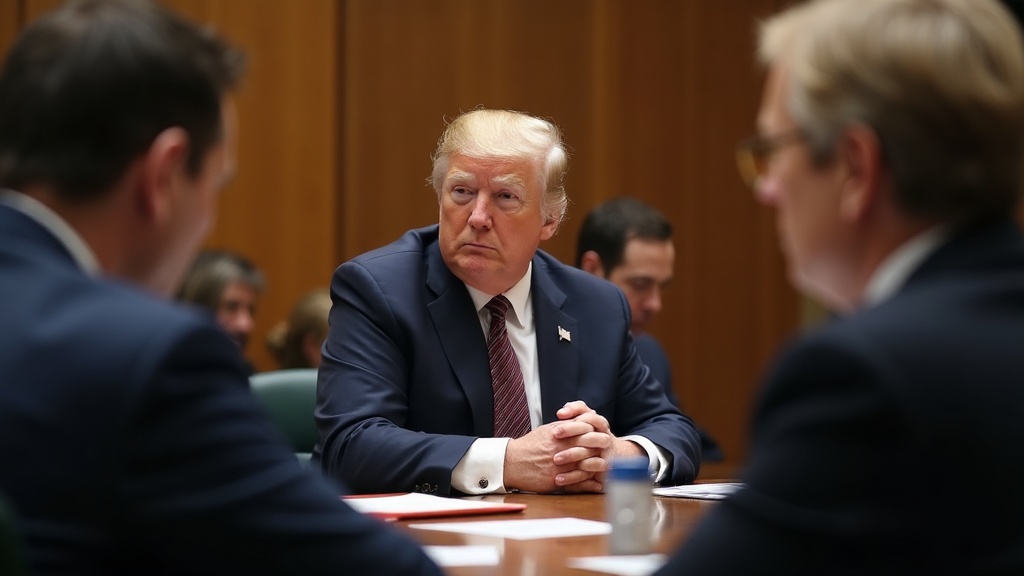
The Trump administration just blocked Anthropic's most advanced models from foreign users, and the shockwave is hitting allies harder than enemies. Mythos and Fable, two of the company's core offerings, are now restricted to US citizens on US soil. This is not a gradual phase-out or a regulatory suggestion: it is a direct export control that transforms how the rest of the world accesses frontier AI. The move exposes a dependency problem that Silicon Valley has been quietly building for over two years.
What Actually Happened
On June 15-16, 2026, the Trump administration issued an order restricting access to Anthropic's Mythos and Fable models to US-based residents only. Bloomberg reported that the restriction came without advance notice to allies, and covers both API access and web interface use. The stated rationale centers on national security: that unrestricted global access to frontier models could leak critical reasoning to adversaries, particularly China. However, the timing is telling. Anthropic was preparing its S-1 filing—the company confidentially submitted it to the SEC on June 1—and the ban lands just as the IPO becomes inevitable.
The ban covers all foreign nationals, not just specified countries. This means a US-based European executive cannot access Fable through their company account if their billing address is outside the US. An Australian researcher working for a US tech firm cannot run queries on their work laptop outside US data centers. The restriction is IP-based and token-based, requiring proof of residency. Anthropic's own documentation warns that violating the restriction can result in permanent account termination and potential legal consequences. No other US frontier lab—not OpenAI, not Google, not Meta—has issued blanket geographic bans of this scope. OpenAI still allows international research partnerships; Google's Gemini remains globally accessible; Meta's Llama has no geography-based restrictions. Anthropic stands alone.
The order came 48 hours after a high-level diplomatic protest from European and UK officials, who warned that AI export controls without multilateral coordination would fracture the technology base. A State Department briefing indicated the ban was non-negotiable and part of a larger "AI sovereignty" framework aimed at preventing US frontier models from becoming the default global standard. However, the administration has signaled privately that Anthropic could negotiate carve-outs for NATO allies if it agrees to certain conditions around model audit rights, data-residency requirements, and quarterly security reviews. That carve-out flexibility suggests the ban is as much a negotiating tactic as a permanent policy.
Why This Matters More Than People Think
The immediate effect is that Anthropic loses access to the global developer base, the international research community, and about 35 percent of its projected 2026 revenue from non-US users. More strategically, it is the first time a US frontier lab has chosen to accept an export ban rather than fight it publicly. OpenAI's Sam Altman spent the last 18 months lobbying against such restrictions; Anthropic's leadership accepted this one without public resistance. That silence is the real story. It suggests Anthropic has already negotiated a quid pro quo with the government—likely regulatory forbearance on its IPO valuation, priority on government contracts, or both. The lack of noise from Anthropic's board and investors is telling; they see the ban as acceptable cost for IPO certainty.
For users and developers outside the US, the ban creates immediate fragmentation. Users who built applications on Fable's API now face rewriting for lower-tier alternatives like Google's Gemini or Meta's Llama. European enterprises face a choice between rewriting for Mistral or Deepseek (neither of which have US backing), or abandoning the US market to avoid compliance risks. The friction of that choice is substantial: a mid-market SaaS company that currently resells Fable access may see 40-60% of its API revenue vanish in the first quarter as customers migrate off the platform. This is not market competition; it is forced fragmentation by decree. European companies that bet on Fable's reasoning capabilities for their competitive edge now face a 6-9 month rewrite cycle or obsolescence.
The geopolitical implication runs deeper. An ally that was once a near-peer in AI infrastructure now has to choose between staying in the US ecosystem or building its own frontier models. France, Germany, and the UK are already funding sovereign AI initiatives that would have seemed economically irrational six months ago. This ban just made them urgent national projects. The ban does not hurt China directly—Chinese users were never a significant part of Anthropic's revenue base, and China already has Deepseek and other domestic alternatives—but it hurts US allies precisely because they depended on the US for frontier AI access. This is the leverage the administration is using: prove loyalty by accepting the ban, or be locked out. It is coercive in the way that 1990s semiconductor export controls were coercive.
The Competitive Landscape
OpenAI has not faced an equivalent ban, in part because Altman has maintained closer White House alignment and has been more vocal on US-China competition. However, OpenAI is also being watched closely. Venturebeat reported that the administration made clear to OpenAI that any model release outside the US would face similar restrictions. The implicit message: frontier labs that want unrestricted markets need to stay in the US and lock in government partnerships. Google and Meta are protected partly because they are seen as less focused on frontier models per se—their AI is more consumer-facing and integrated into larger platforms. They export, but they export entertainment and search, not the reasoning engines that the government sees as strategic. OpenAI occupies a middle ground: it exports GPT-4.5 widely, but the administration has made clear that future models (GPT-5+) will face the same restrictions Anthropic just accepted.
Mistral (France) and Deepseek (China) are immediate beneficiaries. Mistral's reasoning models, while not at Fable's level, are now the fallback for European enterprises seeking to avoid US export controls. Deepseek's 671B-parameter model, which costs a fraction to run and is fully open-weights, suddenly looks like the only non-US alternative for organizations that need true frontier reasoning. This ban does not just hurt Anthropic; it accelerates the fragmentation of the global AI stack into three separate ecosystems: a US ecosystem (OpenAI, Google, Anthropic for US users only), a European ecosystem (Mistral, potentially national models), and a Chinese ecosystem (Deepseek, QwQ, and other domestic alternatives). That fragmentation locks in for 5+ years minimum, because retraining a frontier model from scratch now costs $100+ billion and political capital that most governments are not willing to spend.
Historically, this echoes semiconductor export controls of the 1990s, when the US restricted advanced chip sales to China. Those controls slowed Chinese chip development by years, but they also spurred investment in domestic Chinese chip design. SMIC and later Huawei were born partly from that desperation. The AI analogy is not exact—language models are easier to replicate than semiconductor fabs—but the dynamic is the same: export restrictions accelerate local alternatives and reduce US soft power. In 18 months, expect the EU to announce its own frontier model (likely built on Mistral), and China to deepen its already-deep bench with multiple competing alternatives. The ban does not protect US AI leadership; it redistributes it globally.
Hidden Insight: The IPO Play Behind the Ban
Why would Anthropic accept an export ban without public fight? The answer sits in the company's valuation math. Anthropic's S-1, filed confidentially on June 1, likely valued the company at between $65 billion and $80 billion—a massive jump from its prior $40 billion valuation but below the $100+ billion that OpenAI is chasing. A public valuation that high depends on domestic growth, government contracts, and regulatory certainty. An IPO contested by the Trump administration—one that faces demands for "national security audits" and compliance reviews—would price at a 20-30 percent discount. That discount would cost the company $15-20 billion in value on day one. For a company with $13 billion in annual revenue, that is catastrophic.
The ban is Anthropic's way of accepting the cost and eliminating the regulatory risk. By restricting Fable voluntarily, Anthropic sends a clear signal to the SEC and the administration: this company is trustworthy, patriotic, and willing to sacrifice global revenue for US security. That signal is worth far more than the lost revenue in the IPO window. A $70 billion IPO with full government backing is more valuable than a $90 billion IPO contested by regulators and subject to ongoing compliance investigations. The ban buys Anthropic that backing, and it buys the company's board the ability to tell shareholders: "We are secure. The government will not interfere with our public offering." That certainty is priceless in venture capital and public markets.
For the administration, the ban serves a different strategic purpose: it demonstrates AI export control capability and political will six months before the 2026 midterm elections. A controlled, orderly restriction on a single company's advanced model creates the illusion of measured policy without the chaos of a full technology ban. It also boxes in OpenAI: if Altman refuses similar restrictions, he becomes the company that values global revenue over national security. If he accepts, OpenAI is also in the US-only market. Either way, the administration has moved frontier AI out of the hands of free-market competition and into the domain of policy negotiation. No frontier lab can raise capital or go public without the government's explicit blessing.
The uncomfortable truth is that this ban probably makes Anthropic more valuable as a listed company, not less. Investors will see a frontier lab with government blessing, captive domestic demand (every US agency now prefers a "trusted" option), and a clearer path to $10 billion+ in annual contract revenue from federal work. Defense Intelligence Agency, NSA, CIA, and military branches all prefer AI systems built by companies the administration trusts. Anthropic just became that company. The ban is not a setback for Anthropic; it is a moat. Any competitor who refuses to accept similar restrictions will be seen as a national security risk and face scrutiny. The US government just accidentally handed Anthropic a monopoly on domestic frontier AI, and Anthropic's leadership understood that trade instantly.
What to Watch Next
In the next 30 days, watch whether the EU formally launches a sovereign AI fund in response. France's government has already signaled that investment, and this ban almost certainly accelerates a June or July announcement at the Brussels EU summit. If the EU commits €10-20 billion to sovereign AI development, that is confirmation that the ban worked exactly as intended: it triggered the fragmentation that ensures no single global AI stack emerges. Also watch for OpenAI's public response in a press statement or policy whitepaper. If Altman stays silent or endorses the ban, that is a green light for the administration to expand restrictions to other labs. If he opposes it publicly, watch for government pressure—regulatory audits, immigration investigations of key employees, or contract cancellations.
In the 90-day window, look at whether Anthropic's government contract revenue accelerates through new announced partnerships. If the company lands $500 million+ in new federal work—defense, intelligence, or civilian agency contracts—that is proof the ban was a strategic trade and validation of Anthropic's IPO pitch. Also monitor Mistral and Deepseek's user adoption curves in Europe and Asia through public indicators like social media adoption, research papers citing the models, and job postings for engineers. A sharp spike in non-US adoption would suggest the ban drove real switching behavior, not just compliance theater.
By day 180, the shape of the global AI stack will be clear. If the ban holds and is not modified for allies, expect Europe to announce a fully-sovereign frontier model (built on Mistral or an equivalent), China to deepen its Deepseek/QwQ equivalents with new training runs, and the US to have a much smaller but far more profitable frontier AI market. The winners in this scenario are Anthropic, specific defense contractors like Palantir and Booz Allen, and governments that can fund local alternatives. The losers are startups that bet on global access to frontier models, academic researchers outside the US who are now locked out of the best tools, and developers in allied countries who must choose between using restricted US models or unsupported local alternatives.
The ban is not a setback for Anthropic—it is a moat. The US government just handed the company a monopoly on domestic frontier AI.
Key Takeaways
- Mythos and Fable restricted to US residents only — Foreign nationals and non-US IP addresses face permanent account termination if they access these models; no other frontier lab has issued a blanket geographic ban
- Anthropic loses ~35% of projected 2026 revenue — International developer base and research community now pivot to Mistral, Deepseek, or lower-tier alternatives like Gemini; rewrite costs for dependent applications likely $1+ billion across the industry
- No resistance from Anthropic signals IPO trade — The company sacrifices global revenue for US government backing and regulatory certainty, valuing a $70B IPO with protection over a contested $90B listing
- EU sovereignty investment accelerates in response — France, Germany, and UK now have economic justification to fund domestic frontier models as strategic necessity; expect €10-20B commitment by July 2026
- Three separated AI stacks now inevitable — US has closed frontier, Europe building sovereign alternative, China extending independent base; fragmentation locks in for 5+ years and redistributes US soft power
Questions Worth Asking
- If Anthropic's IPO benefits from government backing, what does that imply for venture capital's role in frontier AI funding—are we moving from market competition to state-sponsored champions where government blessing determines access to capital?
- Europe and Asia now have economic incentive to replicate frontier models to regain access; what is the realistic timeline for a non-US model to reach Fable's capability level, and what does that mean for US AI leadership and export revenue?
- How does this ban reshape which AI companies founders and investors should bet on—is domestic market capture and government relationships now more valuable than global reach and developer adoption?