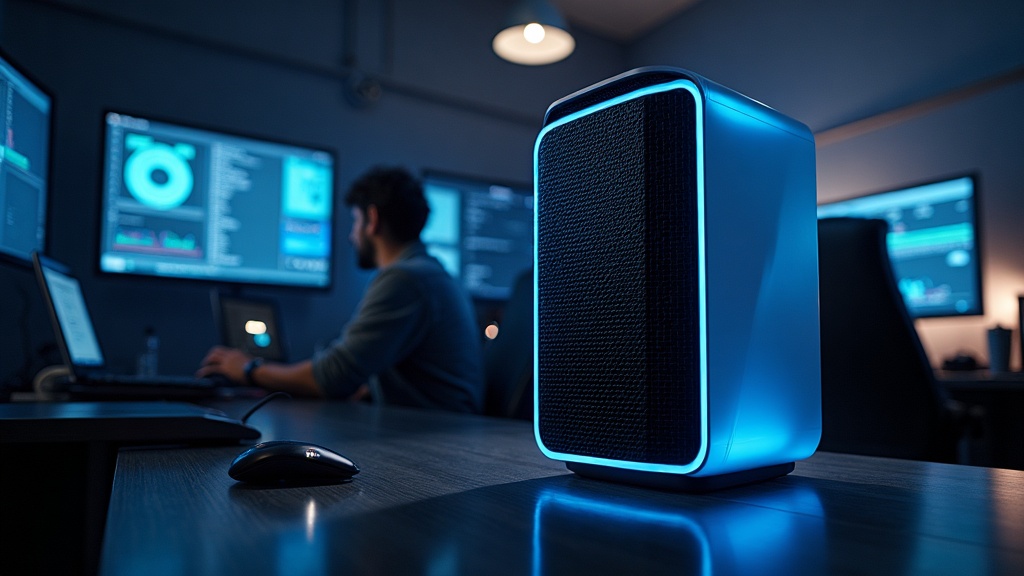
Running a one-trillion-parameter AI model has always required renting a hyperscaler data center or owning one. That changed on June 15, 2026, when ASUS launched the ExpertCenter Pro ET900N G3, a deskside workstation powered by the NVIDIA GB300 Grace Blackwell Ultra Desktop Superchip that delivers 20 petaFLOPS of AI performance and 748 gigabytes of coherent CPU-GPU memory. For the first time, a box that fits next to a desk can run the same class of models that previously required liquid-cooled server racks in a purpose-built facility. The practical barrier separating enterprise AI labs from hyperscaler compute just dropped significantly.
What Actually Happened
On June 15, 2026, ASUS announced the global availability of the ExpertCenter Pro ET900N G3, a next-generation deskside AI supercomputer built on the NVIDIA DGX Station GB300 architecture. The system is powered by the NVIDIA GB300 Grace Blackwell Ultra Desktop Superchip, which combines NVIDIA's Blackwell Ultra GPU architecture with Arm Neoverse-based Grace CPU cores in a single coherent memory fabric. The coherent memory design eliminates the traditional PCIe bottleneck that forces GPU and CPU workloads to exchange data across a high-latency interconnect, enabling the system to treat all 748 gigabytes of memory as a single pool accessible by both compute units simultaneously. In practical terms, this allows LLM inference workloads to load significantly larger models into addressable memory than traditional discrete GPU configurations of equivalent or even greater GPU memory capacity.
The performance specifications position the ET900N G3 as the first desktop-class machine capable of running frontier-scale model workloads. ASUS's technical documentation, reported by TechPowerUp, states the system delivers 20 PFLOPS of AI inference performance, which positions it ahead of many multi-GPU cloud instances currently offered by AWS, Azure, and Google Cloud. The company reports approximately 864 tokens per second on output throughput using the Qwen model series, a benchmark that matches or exceeds what enterprise teams currently access through mid-tier cloud GPU instances. The system also runs models with up to 1 trillion parameters locally, a capability that until this announcement required coordination with hyperscaler infrastructure. ASUS has confirmed worldwide availability as of the announcement date, with enterprise pricing available through direct consultation, no specific list price has been disclosed.
The architectural foundation is NVIDIA's DGX Station GB300 platform, which NVIDIA describes as designed to bring data-center-class AI performance to a workstation form factor. The GB300 NVL72 rack-scale system uses 72 Blackwell Ultra GPUs and 36 Grace CPUs in a single liquid-cooled rack delivering 1.5 times the AI performance of the GB200 NVL72. The DGX Station derivative scales this architecture down to a deskside unit that can operate in standard enterprise environments without specialized data center infrastructure. ASUS's ET900N G3 is among the first commercial implementations of this platform targeting enterprise buyers outside of academic and government research settings, marking a clear step in NVIDIA's strategy to expand its compute footprint beyond data center deployments.
Why This Matters More Than People Think
The most obvious reading of this launch is that ASUS built a very powerful workstation. That reading is correct but misses the strategic inflection point it represents. The 748-gigabyte coherent memory pool is not primarily a performance specification, it is a statement about AI model economics. The fundamental cost driver in enterprise LLM inference is memory bandwidth and capacity. When a large language model is loaded into fragmented GPU memory pools connected by PCIe, data movement overhead becomes a dominant bottleneck, especially for models above 70 billion parameters. Coherent memory eliminates this overhead entirely. The practical result is that the ET900N G3 does not just match discrete multi-GPU configurations in benchmark performance; it exceeds them in many inference patterns because the data movement overhead that hobbles traditional multi-GPU setups is simply absent.
The cloud dependency argument is more more consequential than it appears. Over the past 18 months, enterprise AI teams have built production workflows that depend entirely on cloud GPU availability, cloud provider uptime, and cloud provider pricing decisions. Each of those dependencies has proven costly in different ways: GPU availability has been constrained by hyperscaler demand, uptime has been less than advertised for specialized hardware, and pricing for frontier GPU classes has remained stubbornly high despite competition. A system that delivers frontier-scale inference locally does not require enterprises to choose between cloud dependency and capability; it offers a third path where the highest-sensitivity and highest-throughput workloads run locally while batch and exploratory work continues in the cloud. For enterprises with data residency requirements or regulatory constraints on cloud data processing, this third path is not just attractive, it may be legally required.
The bear case for this launch, however, centers on price. ASUS has not disclosed a list price, which almost always signals that the number is large enough to limit the addressable market significantly. Historical context is instructive: NVIDIA's DGX A100 system, when it launched, carried an $199,000 list price. The DGX H100 was priced at approximately $300,000. Extrapolating from the GB300 architecture's component costs, a fully configured ET900N G3 is unlikely to be available for less than $300,000 and could easily exceed $500,000 depending on memory and storage configurations. At that price point, the addressable market narrows to large enterprises with dedicated AI research budgets, well-funded AI startups, and government labs, not the broad enterprise market the press release language implies. True democratization of frontier-scale inference would require pricing well below $100,000, and the GB300 architecture's manufacturing costs make that implausible in the near term.
The Competitive Landscape
ASUS's ET900N G3 enters a market that has no direct competitor at its claimed performance tier. The closest desktop-class AI workstations available before this launch were based on multi-GPU configurations using NVIDIA H100 or H200 cards, which top out at 80 gigabytes of GPU memory per card and require 8-card configurations to reach 640 gigabytes of total GPU memory, and even then, that memory is not coherent with the CPU, meaning the full bandwidth advantage of the GB300 design is not replicated. Apple's M-series Ultra and M4 Max chips demonstrate coherent CPU-GPU memory at the consumer and professional workstation tier, with the M4 Ultra delivering up to 512 gigabytes of unified memory in Mac Studio and Mac Pro configurations. The GB300-based ET900N G3 outperforms Apple's architecture by roughly 40 times in raw AI FLOPS, operating at a price point that is correspondingly different.
The more real competitive threat to the ET900N G3 is not from workstation competitors but from cloud GPU providers who are rapidly reducing per-token inference costs through infrastructure optimization. AWS, Google Cloud, and Microsoft Azure have all announced aggressive capacity expansions using the GB200 NVL72 rack systems that share the same GB300 Blackwell Ultra GPU architecture as the ASUS workstation. As cloud providers deploy more of this hardware, per-token costs for frontier-scale inference will decline, potentially undermining the economic case for on-premises deployment. The question for enterprise buyers is not just whether the ET900N G3 is capable, clearly it is, but whether the amortized cost of purchasing and maintaining an expensive workstation over three to five years competes favorably with cloud inference costs that may decline significantly over that same period.
The historical parallel that comes to mind is the SGI workstation era of the 1990s. Silicon Graphics made 3D rendering accessible to studios and production houses that could not afford mainframe-class compute, bringing Hollywood-grade rendering capability to a workstation that cost between $30,000 and $200,000. The democratization was genuine but selective: it reached studios, architectural firms, and simulation-heavy defense contractors, not small creative agencies. SGI's ultimate challenge was not technical, its workstations were genuinely excellent, but economic and architectural: commodity hardware caught up faster than expected, and the economics of specialized hardware eventually collapsed under general-purpose competition. NVIDIA's GB300 platform faces the same structural tension. It is genuinely more powerful than any alternative today. Whether it remains so in three years, as competitive pressure from AMD, Intel, and open-source hardware accelerators intensifies, is the unresolved question.
Hidden Insight: Sovereignty Without the Data Center
The timing of this launch is not coincidental. Enterprise AI infrastructure strategy has been in crisis since mid-2026, as concerns about cloud provider concentration risk, regulatory intervention in AI services, and data residency requirements have mounted simultaneously. Enterprises that built critical workflows on cloud AI infrastructure discovered that their operational risk was entirely concentrated in decisions made by a handful of providers. The ET900N G3 does not solve all of those problems, but it offers something that cloud infrastructure cannot: a compute asset that is entirely under the buyer's physical and operational control. The machine cannot be taken offline remotely, its outputs cannot be monitored by the provider, and its software stack can be configured without reference to any cloud provider's acceptable use policies.
This sovereignty angle is most acute for organizations operating in sensitive sectors. Financial services firms running proprietary trading models, pharmaceutical companies running clinical trial analysis, and defense contractors running classified AI workloads all face regulatory and competitive constraints that make cloud AI infrastructure architecturally problematic regardless of performance or price. For these buyers, the ET900N G3 is not a workstation, it is infrastructure sovereignty at a price that, while high, is orders of magnitude cheaper than building a dedicated private data center with comparable capability. The addressable market for sovereign AI compute is smaller than the general enterprise AI market, but it is also far less price-sensitive and far more likely to make purchasing decisions based on regulatory compliance rather than cost per token.
There is also a less obvious workforce implication. The ability to run 1-trillion-parameter models locally changes the character of the AI research and engineering work that enterprises can do without cloud accounts, credit approvals, or provider policy review. A research team with an ET900N G3 can run experiments on proprietary datasets, iterate on fine-tuning runs, and develop novel model architectures without any data leaving their network perimeter. This changes the risk calculus for AI research programs at enterprises that handle sensitive customer data, trade secrets, or regulated health information. The capability has existed in principle for enterprises willing to build private GPU clusters, but the operational burden of managing a cluster versus managing a single workstation is real, and the ET900N G3 eliminates that burden entirely for workloads that fit within its memory capacity.
The product launch also signals something important about NVIDIA's long-term strategy. NVIDIA has historically been a chip and rack company, selling into data centers through OEM partners and hyperscalers. The DGX Station platform, and its commercialization through partners like ASUS, represents a deliberate push into the enterprise workstation market that NVIDIA had largely ceded to Apple at the high end and to commodity GPU vendors at the mid-range. If the GB300 DGX Station architecture achieves real traction at enterprise accounts, NVIDIA gains a direct relationship with a customer segment it has historically touched only indirectly through cloud provider pricing. That direct relationship is valuable not just for hardware sales but for the software, services, and developer ecosystem that NVIDIA has been building through its CUDA and NIM software stacks.
What to Watch Next
The price point will be the most important disclosure to watch over the next 30 days. ASUS's decision to require direct consultation rather than publish a list price signals either that pricing is highly customized, which is common for enterprise hardware, or that the number is high enough to require careful framing by a sales representative. Industry analysts expect configurations to begin above $300,000, but the actual floor pricing will determine whether the ET900N G3 is a niche tool for the top tier of enterprise AI buyers or a genuinely broad market product. Watch for pricing announcements at forthcoming enterprise technology events, including the NVIDIA GTC Paris conference running June 17-20 at VivaTech, where Jensen Huang is scheduled to discuss the sovereign AI factory strategy.
Competitive responses will arrive quickly. Dell, HP, and Lenovo all have enterprise workstation divisions and NVIDIA GPU partnerships that would allow them to bring comparable DGX Station-based products to market within six to twelve months if the ASUS launch demonstrates commercial traction. AMD's MI450 instinct platform, which Meta committed to in a 6-gigawatt multi-year procurement agreement earlier this year, represents a competing architecture that could be integrated into workstation-class products if AMD sees the market opportunity. The 90-day window after the ASUS announcement will reveal whether the GB300 deskside market is ASUS's alone to define or whether it rapidly becomes a competitive segment with multiple vendors and falling prices.
For enterprise AI buyers, the key evaluation timeline is now. The ET900N G3's coherent memory architecture represents a genuine technical advance over existing discrete GPU workstation configurations, and the performance-per-rack-unit advantage will remain durable for at least 18 to 24 months while the competitive response develops. Organizations with sovereignty requirements, data residency constraints, or throughput needs that make cloud inference economically impractical should evaluate this system against their specific workload profiles before the market becomes crowded and the purchasing decision becomes routine. The window where early adopters gain a technical edge from sovereign frontier-scale compute is likely measured in quarters, not years.
The first machine that runs a trillion-parameter model without a cloud account does not just change what enterprises can afford, it changes what they can do without asking permission.
Key Takeaways
- 20 PFLOPS, 748 GB coherent memory, The ASUS ExpertCenter Pro ET900N G3 delivers data-center-class AI inference in a deskside workstation, available worldwide as of June 15, 2026.
- 1-trillion-parameter models run locally, The coherent CPU-GPU memory architecture enables model classes previously requiring hyperscaler infrastructure to run entirely on-premises without cloud dependency.
- 864 tokens per second on Qwen benchmarks, The throughput performance matches or exceeds mid-tier cloud GPU instances, making on-premises inference economically competitive for high-volume workloads at sufficient scale.
- No list price disclosed, Industry estimates based on GB300 component costs suggest configurations will begin above $300,000, limiting initial adoption to large enterprises, well-funded AI labs, and compliance-driven buyers.
- Sovereignty is the key differentiator, For organizations with data residency requirements, regulatory constraints, or competitive sensitivity, local frontier-scale inference eliminates the operational and legal risks of cloud AI dependency entirely.
Questions Worth Asking
- If a machine that costs $300,000-$500,000 can run a 1-trillion-parameter model locally, what does that imply about the long-term pricing power of cloud AI inference providers who are charging per token for the same capability?
- The coherent memory architecture is the key technical differentiator here, but TSMC's 3nm and 2nm processes will allow AMD and future NVIDIA generations to pack even more coherent memory into smaller packages. How long before this level of capability is available at a fraction of the current price?
- Enterprise sovereignty over AI compute sounds appealing, but it also means enterprises bear the full maintenance, upgrade, and obsolescence cost, is that trade-off actually favorable compared to paying cloud providers to absorb hardware risk?