
Funding 13 min
Firmus Raises $2B to Build Nvidia-Backed AI Factories
Firmus secures $2 billion at a $10.5 billion valuation from Coatue, Nvidia, and Blackstone to build AI factories across Asia-Pacific.
Jordan HaleAug 9, 2026
Chips, data centers, and the trillion-dollar buildout
Compute, not capital, has become the binding constraint of the AI industry. Hyperscalers have announced over $660B in data center capex, frontier labs sign multi-year GPU leases worth tens of billions, and a single training cluster can consume the power of a small city. This hub tracks the silicon roadmaps, data center buildouts, supply chain moves, and compute economics that decide which AI companies can actually scale.
Firmus secures $2 billion at a $10.5 billion valuation from Coatue, Nvidia, and Blackstone to build AI factories across Asia-Pacific.
AMD buys Taalas, a startup that etches model weights into silicon at 16,000 tokens per second, as inference hardware races past GPU-first design.
ByteDance is pretraining a model with up to 10 trillion parameters targeting Anthropic Mythos quality, the largest Chinese AI training run on record.

Firmus secured $2B at a $10.5B valuation from Nvidia and Blackstone to build AI data centers across Asia-Pacific, doubling its valuation in four months.
Tesla and SpaceX commit $16.8B to build Terafab in Texas, a chip campus for Optimus robots and Cybercabs, targeting 1 terawatt of combined demand.
Tesla and SpaceX commit $16.8 billion to Terafab, a Texas chip facility for Optimus robots, Cybercabs, and SpaceX space-based data centers.
Tesla and SpaceX committed $16.8 billion to build Terafab, a chip factory in Texas targeting 1 terawatt of compute, ending US reliance on TSMC.
China's CXMT chips reach HP and Asus amid AI-driven memory shortage, threatening the grip of Samsung, SK hynix, and Micron on global DRAM supply.
Google's $15 billion India data center with Adani faces water shortages and wildlife lawsuits, testing whether AI infrastructure can expand responsibly.
Anthropic assembles custom silicon engineers at up to $485K salary as Samsung 2nm talks advance, the last frontier AI lab to build its own chips.
Anthropic signs a $10B compute deal with Volta for Norway and reveals a custom silicon team paying up to $485K for Claude's AI architecture.
Tesla and SpaceX launch Terafab in Texas with $16.8B initial spend, targeting the edge-inference chips that power Optimus robots and Cybercabs.
Anthropic assembles a lean silicon design team targeting 50% cuts in Claude inference costs, completing the frontier lab's vertical AI stack.
Anthropic's $10B deal with startup Volta for 121MW of Nvidia Vera Rubin compute in Norway signals a new model of AI infrastructure finance.
Anthropic commits to a six-year, $10 billion compute contract with startup Volta for 121 MW of Nvidia Vera Rubin capacity in Tydal, Norway.
Anthropic signs a six-year, $10B compute deal with Volta, a seven-month-old startup using Nvidia Vera Rubin chips at Bitdeer's Norway campus.
Anthropic locks in $10 billion of Nvidia Vera Rubin compute at Volta's Norway data center, with J.P. Morgan credit backstop for March 2027 delivery.
Anthropic's $10B Volta deal secures a 133MW Norway facility running Nvidia Vera Rubin chips on 100% hydropower, with capacity due by March 2027.
Apple briefly topped Nvidia's record $4.88T market cap on July 17, signaling investor doubts about AI infrastructure capex assumptions and custom silicon competition.
OpenAI released three GPT-5.6 tiers on July 9: Sol, Terra, Luna priced at $5, $2.50, $1 per million tokens, undercutting Anthropic and signaling pricing war.
NVIDIA's Rubin ships across hyperscalers in H2 2026, ending GPU scarcity but intensifying power grid constraints now favoring only three frontier labs.
Data Center Power Coalition launches July 1 with 12 partners to standardize on-site power for AI data centers facing 5-year grid transformer backlogs.
OpenAI's Jalapeño chip offers 50% cost savings on inference, undermining Nvidia's GPU dominance as frontier labs shift to custom silicon.
OpenAI and Broadcom ship custom LLM inference chip with 50% lower costs versus NVIDIA, targeting production deployment Q4 2026 with gigawatt-scale rollouts.
50,000 attendees, Kawasaki's 8-DOF humanoid, and ABB's physical AI standard reveal enterprises moving from evaluation to procurement in manufacturing.
xAI Grok 4.3 achieves sub-1% hallucination while costing 2-5x less than GPT-4o Reasoning, now available on Amazon Bedrock with configurable reasoning effort.
SandboxAQ secures $500 million CHIPS R&D award to discover AI-driven materials replacing toxic forever chemicals in semiconductor fabs
Hydra Host's $100M Series A, backed by Nvidia and ARK Invest, builds a GPU marketplace across 50+ data centers to solve AI compute fragmentation.
Anthropic's Fable 5 export control shutdown reveals the fatal flaw in cloud-first AI: when governments act, tenants lose and infrastructure owners survive.
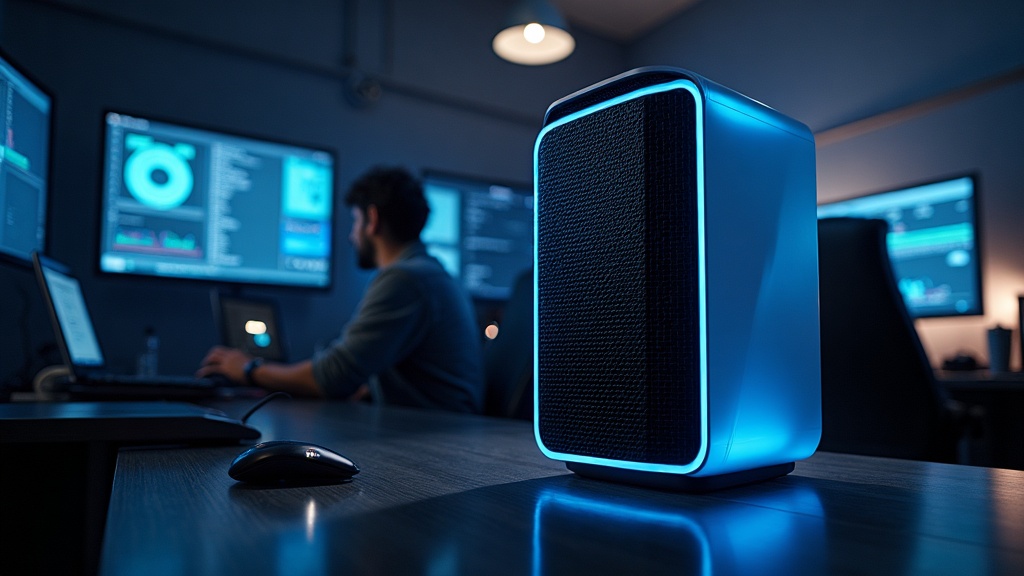
ASUS GB300 ExpertCenter Pro runs 1-trillion-parameter models on a desktop, bringing 20 PFLOPS to enterprise without renting cloud infrastructure.