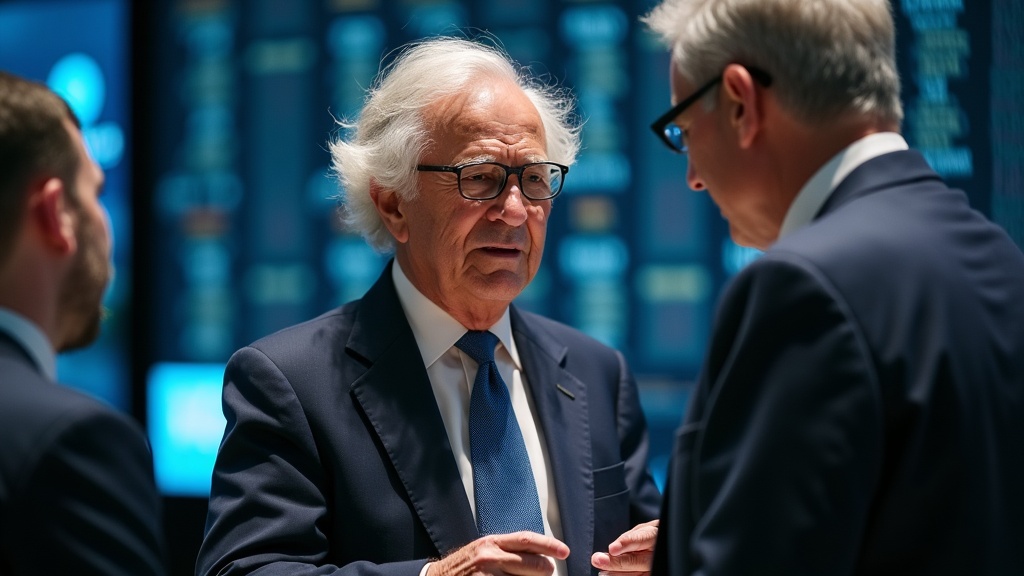
Warren Buffett spent two decades telling shareholders he did not understand technology well enough to own it. On June 1, 2026, Berkshire Hathaway wired $10 billion into Alphabet as part of the search giant's $80 billion equity raise to build artificial intelligence infrastructure. The firm that sat out the entire cloud era just made the single largest AI bet in its history, and it did so by buying the most boring stock in the trade.
What Actually Happened
Alphabet announced on June 1, 2026 that it would raise roughly $80 billion in equity to fund a buildout of AI compute capacity its executives described as necessary to meet unprecedented customer demand. The headline number was unusual on its own: a company sitting on more than $95 billion in cash and generating over $30 billion in quarterly free cash flow does not normally sell stock. The fact that Alphabet chose dilution over debt or internal funding told the market how steep the capital curve for frontier AI has become.
Buried inside the announcement was the detail that moved the story from large to historic. Berkshire Hathaway agreed to a concurrent private placement worth $10 billion, split evenly between $5 billion of Class A shares priced at $351.81 and $5 billion of Class C shares at $348.20. Alongside a $40 billion at-the-market offering program and the main equity sale, Alphabet disclosed that the total package could reach $84.75 billion, making it one of the largest equity raises any public company has ever attempted in a single move.
The Berkshire piece was not a cold open. Regulatory filings over the prior three quarters had already shown the conglomerate quietly accumulating Alphabet stock, doubling its position twice in consecutive quarters until Alphabet ranked among Berkshire's largest holdings. The June private placement converted a steadily growing public-market stake into a direct, negotiated capital injection. For a firm that has historically demanded a discount and a wide moat before committing nine figures, committing eleven figures to an AI capital-expenditure cycle is a reversal worth pausing on.
The demand context explains the urgency. Google Cloud has been capacity-constrained for much of the past year, turning away enterprise AI workloads it could not serve and watching customers sign with rivals that had spare GPUs. Alphabet leadership framed the raise as a response to that shortfall, a way to convert backlog into booked revenue. When a company that mints cash decides the fastest route to capacity is selling stock, the message is that the bottleneck is no longer money or ambition but the physical buildout of power, land, and silicon that even an $80 billion check cannot accelerate overnight.
Why This Matters More Than People Think
The obvious reading is that Buffett, or more precisely the Berkshire investment apparatus now run increasingly by Greg Abel and the firm's investment lieutenants, has finally blessed AI. The deeper signal is about which AI. Berkshire did not buy a foundation-model startup, a chip designer, or a robotics venture. It bought the company with the strongest balance sheet, the captive distribution of Search and Android, and its own tensor processing units. The bet is not on AI as a frontier science project. It is on AI as an infrastructure toll road owned by an incumbent that already prints cash.
That distinction reframes how value investors are being told to play this cycle. For three years the market rewarded the riskiest exposure: pre-revenue model labs raising at hundred-billion-dollar valuations on narrative alone. Berkshire's move argues the opposite, that the durable returns will accrue to whoever controls compute, data, and distribution at scale, and that those assets are concentrated in a handful of profitable hyperscalers rather than in the long tail of startups. When the most patient capital on earth picks the incumbent, it is making a statement about where the moat actually sits.
There is also a financing-structure lesson hiding in plain sight. Alphabet could have borrowed $80 billion at investment-grade rates without blinking. Choosing equity instead signals that management views the AI buildout as a multi-year, uncertain-return commitment it would rather not lever against. Raising permanent capital for a capital-expenditure supercycle, and anchoring it with a marquee long-term holder like Berkshire, is how a company tells the market it is digging in for a decade, not a quarter.
Consider the timing against the macro backdrop. Alphabet went to market on the same day Anthropic filed for its IPO and within the same week that its rivals were each scrambling for tens of billions in fresh capital. When every player raises at once, the cost of capital for the entire sector rises, because only so much institutional money is willing to fund data centers in a single quarter. Securing Berkshire first, before the crowd, let Alphabet price its placement against a credible anchor rather than against a saturated market. That sequencing advantage is worth more than the headline $10 billion, because it sets the terms every later raise gets measured against.
For Google Cloud customers, the raise is a quiet reassurance. Enterprises hesitate to standardize on a cloud platform whose capacity they doubt, and a visible $80 billion commitment to compute removes one of the main objections sales teams hear in competitive deals against Amazon and Microsoft. The Berkshire anchor adds a second layer of comfort, signaling that the buildout is funded by the most conservative money in finance rather than by fragile vendor credit. In enterprise procurement, perceived staying power is itself a feature, and Alphabet just bought a large dose of it.
The Competitive Landscape
Alphabet's raise lands in the middle of the most aggressive capital-raising sprint the technology industry has ever run. OpenAI closed a $122 billion round at an $852 billion valuation earlier in 2026, anchored by Amazon, Nvidia, and SoftBank. Anthropic completed a $65 billion Series H that pushed its valuation to $965 billion and filed confidentially for an IPO on June 1, the very same day Alphabet went to market. Every major AI player is now racing to lock in the capital required for compute before the window narrows.
The competitive contrast is what makes the Berkshire stamp interesting. OpenAI and Anthropic are funding their compute through a mix of private mega-rounds, debt, and circular vendor financing arrangements with the very chip and cloud suppliers they pay. Alphabet funds its compute from operating profit and, now, from the deepest value-investor pockets in the world. In a downturn, the company that financed its data centers with permanent equity from Berkshire is structurally safer than the one that financed them with $1.25 billion monthly rental commitments. Capital structure, not benchmark scores, may decide who survives the next compute glut.
History offers a sharp parallel. In 2011, when the market doubted Bank of America's solvency, Buffett injected $5 billion on preferential terms and the mere association restored confidence overnight. The Alphabet placement is not a rescue, but it borrows the same playbook: Berkshire's name functions as a seal of credibility that re-rates the whole transaction. The difference is that in 2011 Buffett was buying fear in a bank. In 2026 he is buying confidence in a technology platform, which is a category he spent most of his career refusing to touch.
The closest modern analogy may be the 2016 pivot into Apple. Buffett resisted Apple for years as a technology stock, then concluded it was really a consumer business with a fortress moat and bought aggressively, turning it into the largest position in the portfolio and one of the most profitable trades in the conglomerate history. The Alphabet placement rhymes with that decision: reclassify a feared technology name as a durable cash machine, then buy it at scale. If the Apple parallel holds, this opening stake is the beginning of accumulation rather than the end of it, and more buying likely follows.
Hidden Insight: Buffett Is Betting Against the Startups, Not With Them
The framing everyone reached for was that Berkshire finally went AI. The more accurate framing is that Berkshire went anti-startup. By routing $10 billion into Alphabet rather than into any of the dozen private labs raising at the same moment, the firm is expressing a precise thesis: the economics of AI will resemble the economics of railroads and utilities, where the winners are the asset owners who collect rent, not the inventors who burn capital to push the frontier. That is the most Buffett-shaped idea imaginable, dressed in a 2026 costume.
Consider what this implies for the valuation gap. A model lab raising at twenty times forward revenue is priced for a future in which its technical lead is permanent and defensible. Alphabet, trading at a far more modest multiple despite owning comparable model capability in Gemini, is priced as if its lead is fragile. Berkshire's $10 billion is a wager that the market has the risk premium exactly backwards, that the incumbent with cash flow and distribution is underpriced while the challenger with a benchmark lead is overpriced. If that view is right, the great repricing of this cycle has not happened yet.
There is a governance subtext as well. Berkshire is entering its post-Buffett era, with Greg Abel taking operational command and the investment managers handling capital allocation. A $10 billion technology placement is exactly the kind of move the old Buffett would have been mocked for missing during the 1990s. The new Berkshire is signaling that it can act on a structural shift without abandoning its core discipline, by choosing the cash-generative incumbent over the speculative entrant. The lesson for every value investor watching is that you can participate in a technology supercycle without buying the technology lottery tickets.
This also rewrites the risk calculus for investors who have spent three years feeling priced out of AI. The only way to own real exposure to the frontier was to chase private rounds at escalating valuations or to buy the chipmakers at forty times earnings. Berkshire just demonstrated a third path: buy the profitable platform that already embeds frontier capability inside a business with predictable cash flow. Gemini sits inside Search, Android, Workspace, and Cloud, distribution channels no startup can replicate and that convert model quality directly into revenue. The implicit argument is that you do not need to pick the winning model if you own the rails every model rides on.
The most uncomfortable implication is for the venture capital industry. If the smartest patient money concludes that AI returns concentrate in three or four profitable hyperscalers, then the thousands of AI startups raising on the promise of disruption are competing for a much smaller pool of durable value than their valuations assume. Berkshire is not just buying Alphabet. It is implicitly shorting the thesis that this time the incumbents get disrupted, a thesis the entire startup ecosystem depends on being true.
What to Watch Next
In the next 30 days, watch whether other long-only institutional anchors follow Berkshire into the Alphabet placement or into similar hyperscaler raises. Berkshire's participation tends to attract a herd of conservative capital that waited for a credibility signal. If pension funds and sovereign wealth vehicles pile into AI through profitable incumbents rather than private labs, the relative cost of capital for OpenAI and Anthropic will quietly rise, and the funding gap between cash-rich and cash-burning AI players will widen.
Over 90 days, track Alphabet's capital-expenditure guidance and whether the $80 billion actually accelerates Gemini deployment, TPU production, and cloud capacity in a way that shows up in Google Cloud growth rates. The bull case requires that this money convert into revenue, not just into depreciation. Watch the next two earnings calls for capex-to-revenue conversion. If Cloud reaccelerates above 35 percent year over year, the Berkshire thesis looks prescient. If capex balloons while growth stalls, the dilution will sting.
Over 180 days, the indicator that matters most is whether the AI funding market bifurcates. The bear case, however, is straightforward: if compute prices keep falling and open-weight models keep closing the quality gap, then owning the incumbent is no safer than owning the startup, because the moat everyone is paying for erodes from below. Skeptics point out that Alphabet is raising $80 billion precisely because the arms race has no natural ceiling, and a company forced to sell equity to keep up may be revealing weakness, not strength. Watch model-pricing trends and open-weight benchmark gains as the real tell on whether Berkshire bought a toll road or a treadmill.
Berkshire did not bet on artificial intelligence. It bet that the oldest rule in capitalism still holds: in a gold rush, you want to own the company selling shovels and collecting rent, not the prospector with the best map.
Key Takeaways
- $10 billion Berkshire private placement, split as $5B Class A at $351.81 and $5B Class C at $348.20, anchors Alphabet's raise
- $84.75 billion total potential raise including a $40B at-the-market program makes this one of the largest equity offerings ever
- This is Berkshire's first major AI investment, executed by a firm that famously avoided technology for most of Buffett's career
- Berkshire chose the profitable incumbent over a dozen private labs raising at the same moment, a bet on infrastructure rent over frontier risk
- Alphabet chose equity over cheap debt, signaling a multi-year capital commitment it would rather not lever against
Questions Worth Asking
- If the most patient capital on earth thinks AI value accrues to incumbents, what does that say about the valuations of the private labs you may be exposed to?
- Is Alphabet raising $80 billion from strength, to extend a lead, or from weakness, because the compute arms race has no ceiling?
- When a company with $95 billion in cash sells equity instead of borrowing, what is it telling you about how uncertain the returns on that spending really are?