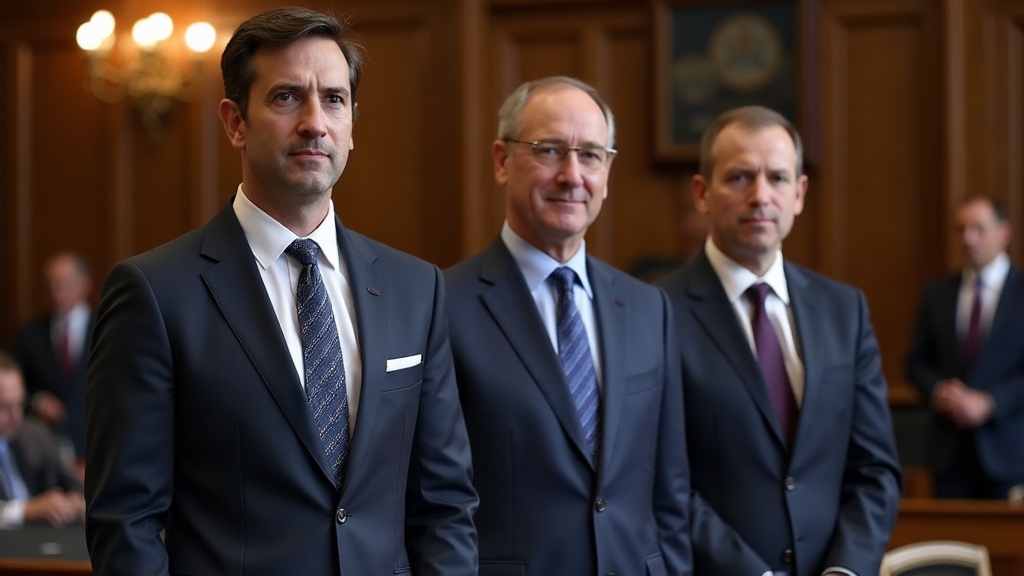
The three most powerful rivals in artificial intelligence walked into the same room on Monday for the first time in history. Sam Altman of OpenAI, Dario Amodei of Anthropic, and Demis Hassabis of Google DeepMind all arrived at the 52nd G7 summit in Evian-les-Bains, France, invited to participate in the first formal AI working session at a meeting of the world's seven largest democracies. The US government had shut down two of Anthropic's flagship models three days before the summit opened. Nobody was entirely certain what Amodei would say when he sat across from the heads of state whose ally had just issued the order.
What Actually Happened
The G7 summit runs June 15 through 17 in Evian-les-Bains, France, hosted by President Macron under France's rotating G7 presidency. Macron personally invited Altman, Hassabis, and Amodei, making this the first G7 gathering where representatives from all three major frontier AI laboratories are present at the same time. The invitation list extends well beyond the headline trio: Arthur Mensch of Mistral AI, Aidan Gomez of Cohere, Robin Rombach of Black Forest Labs, Pratyush Kumar of Sarvam AI, Victor Riparbelli of Synthesia, Alex Wang of Meta, Marc Benioff of Salesforce, and Ren Ito of Sakana AI are also attending. Together, these executives manage AI systems used by more than 1 billion people and represent combined company valuations exceeding $2 trillion, according to reporting by The Next Web and Dataconomy.
France's Elysee arranged a dedicated working lunch on Wednesday, June 17, where G7 heads of state will sit with the assembled AI company leaders to discuss what the host government is calling "safe, rapid, and effective AI deployment." According to Chris Lehane, OpenAI's chief global affairs officer, the company expects a package of voluntary commitments to emerge from the summit, with youth safety at the top of Altman's personal agenda. Frontier AI risks in the cyber and biological domains form the second major cluster of topics the assembled delegation plans to address. The summit arrives less than three years after the Hiroshima AI Process, which in October 2023 produced G7 AI Principles and a voluntary Code of Conduct for advanced AI systems but generated no binding obligations and no enforcement mechanism for any of its signatories.
The timing is not incidental. Both Anthropic and OpenAI have recently filed confidential S-1 prospectuses with the US Securities and Exchange Commission, positioning both companies for public market debuts in the second half of 2026. TechPolicy Press noted ahead of the summit that a widening rift over AI sovereignty is visible among G7 allies, with European nations increasingly uncomfortable with the reality that hospitals, defense agencies, and financial regulators in their jurisdictions run critical workflows on models that a US government directive can switch off overnight. For Altman and Amodei specifically, the G7 appearance serves a dual strategic purpose: positioning their companies as responsible governance partners at exactly the moment that public investors are being asked to value them above $1 trillion apiece.
Why This Matters More Than People Think
The Hiroshima AI Process generated eleven guiding principles and a voluntary code of conduct signed by all seven G7 nations plus the EU. Since that October 2023 agreement, not a single G7 member has enacted domestic legislation that references those principles as a binding legal standard. That track record matters because the Evian summit's output is structurally unlikely to be different. AI executives are not in France to accept regulation; they are there to shape the terrain on which future regulation might eventually land. The working lunch format and the voluntary commitment framing, reported consistently across all coverage leading up to the summit, confirms that what emerges will be aspirational rather than actionable in the short term. The historical comparison that deserves attention is the OECD AI Principles of 2019, which were also voluntary and became the conceptual foundation for the EU AI Act, the world's first binding AI regulation. Voluntary frameworks have a habit of becoming mandatory anchors.
The Fable 5 situation has handed France, the EU, and every non-US G7 member a live case study in AI sovereignty risk that abstract policy debates could never provide. When the US Commerce Department ordered Anthropic to suspend access to Fable 5 and Mythos 5 for all foreign nationals on June 12, the order was not targeted at governments or military entities. It applied to any individual who was not a US citizen or permanent resident, including employees of Anthropic's own UK and European offices, including the Indian engineers at TCS who had spent months retooling their consulting workflows on Fable 5, and including the researchers at European universities using Anthropic's API. The breadth of the order shocked even allied nations that expected US export controls to distinguish between adversary and partner. That shock is now the central topic of G7 AI governance discussions, though none of the official communique language will say so this directly.
The economic stakes compound the geopolitical pressure. Goldman Sachs projects $7.6 trillion in AI-driven capital expenditure from 2026 through 2031. Europe's share of that investment depends substantially on whether European AI companies can build credible alternatives to US frontier models, a project that is structurally difficult without sovereign compute infrastructure, training data governance, and domestic chip manufacturing. France's decision to place AI at the center of its G7 presidency is not diplomatic posturing. France hosts Mistral AI, Europe's most technically credible frontier laboratory, and the Evian summit gives Macron a platform to demonstrate that a European path in AI is viable, and that it deserves the same geopolitical status as the US-or-China binary currently frames as the only choice available.
The Competitive Landscape
The assembled AI leadership in Evian does not represent a unified front. Altman and Amodei are commercial competitors in a race to IPO at combined valuations that may exceed $2 trillion. Hassabis runs Google DeepMind, which is structurally embedded in Alphabet's infrastructure and does not face the same IPO pressure or the same regulatory friction with the US government that Anthropic encountered over Fable 5. Mensch of Mistral represents a third model entirely: a European company that has prioritized open-weight releases and active cooperation with EU regulatory bodies, a strategy that gives Mistral political legitimacy in Brussels that OpenAI lacks. The presence of Pratyush Kumar from Sarvam AI, building Hindi and multilingual models in Bangalore, and Ren Ito from Sakana AI in Tokyo, signals that Macron's invitation list was deliberately constructed to include non-Western democratic AI perspectives. This summit is not only about the US governing AI. It is about what the democratic world collectively decides it wants AI governance to look like.
China is notably absent from Evian. Beijing is not a G7 member, but China has emerged as the most technically capable alternative AI ecosystem. Huawei's Ascend chips are projected to command 62% of China's domestic AI accelerator market in 2026, and Chinese frontier models including DeepSeek V4 and Moonshot's Kimi K2.7 are closing the benchmark gap with US alternatives. A G7 AI framework that excludes China creates a predictable fragmentation problem: global enterprises operating in both the democratic and Chinese market blocs will face two distinct regulatory regimes, and the compliance friction of operating in both may actually disadvantage Western AI companies competing in markets where Chinese alternatives face no equivalent burden. The Hiroshima process attempted to engage China indirectly through multilateral bodies, without success.
The historical analogy worth examining is the Nuclear Non-Proliferation Treaty. The NPT did not eliminate nuclear weapons; it created a two-tier international architecture of nuclear states operating within agreed norms and non-nuclear states committed to not developing them. A G7 AI framework backed by the world's seven largest economies could similarly establish a tiered AI order: responsible frontier laboratories operating within agreed safety commitments, and a separate tier of actors outside that framework. Critics, however, point out a structural difference that makes this analogy imperfect. Unlike nuclear weapons, AI capability is not scarce in the way fissile material is scarce. The compute, algorithms, and engineering talent required to build frontier-class models are increasingly distributed globally. A governance framework that powerful nations honor while others ignore creates compliance costs without delivering proportional safety benefits.
Hidden Insight: The Real Stakes Behind the CEO Attendance
The presence of Altman and Amodei in France matters strategically for a reason that has received almost no analysis in coverage of the summit: both men are in the functional equivalent of a pre-IPO roadshow. Not technically, because neither S-1 is public yet, but reputationally. Every public statement they make, every photograph at a G7 working lunch with heads of state, every voluntary commitment they endorse is a form of investor relations. When OpenAI prices its IPO at a target valuation exceeding $1 trillion later this year, its regulatory track record and its perceived relationship with governments will be part of the story that Goldman Sachs and Morgan Stanley tell institutional investors. A company that was invited to the G7 to help shape international AI governance is a very different investment story from one that regulators view as an adversarial actor. The Evian invitation is, among other things, reputational insurance valued in hundreds of billions of dollars.
The bear case, however, is straightforward: voluntary commitments made at G7 summits have historically had a short half-life when they conflict with commercial incentives. AI companies face enormous pressure to push the capabilities of their models as fast as computing economics allow. Youth safety commitments are relatively low-cost to honor, because restricting minors from the most dangerous AI features costs almost nothing in revenue terms. Frontier AI risk commitments are far harder to operationalize, because the same models that generate the most revenue are also the models whose risks are most difficult to anticipate in advance. Critics including the AI Now Institute and the Center for AI Safety have argued consistently that voluntary commitments made under reputational pressure are not a substitute for binding regulation with real enforcement mechanisms and meaningful penalties for violation.
The moment that nobody at the working lunch will acknowledge out loud is the contradiction embedded in Amodei's presence at the table. He is attending a summit co-organized by US allies three days after the US government issued an order that disrupted Anthropic's international business without consultation with any of those allies. The countries whose heads of state will share a working lunch with Amodei on Wednesday all had companies, institutions, and researchers that lost access to Fable 5 on June 12. They did not receive advance notice. They did not have the opportunity to negotiate a carve-out. They simply received an abrupt service termination that a US export control directive made overnight. That structural reality, the ability of the US government to unilaterally shut down AI access for allied nations, is the unstated subject of every AI governance conversation at Evian.
What makes the Evian summit genuinely historic is not the voluntary commitments text that will emerge from it. It is the moment when the heads of government of the seven largest democratic economies formally acknowledged that the three or four companies building frontier AI models are now geopolitically consequential actors in their own right, comparable in some respects to the sovereign states they are visiting. Altman and Amodei are not in Evian as corporate guests. They are there as principals in a negotiation about the rules governing technologies that will restructure every economy on the planet within the decade. That recognition, once established at the head-of-state level, permanently changes the political grammar through which AI governance is debated, and it does not get revoked when the summit ends.
What to Watch Next
The most important output of the Evian summit is not the communique text but whether France and the EU use the framework as the basis for further regulatory action. Watch specifically for whether the European Commission references the G7 voluntary commitments in its upcoming AI Act enforcement guidelines, expected in September 2026. If Brussels treats the Evian framework as a floor rather than a ceiling for AI governance obligations, voluntary commitments will morph into de facto binding requirements within the EU's digital single market, the world's most consequential regulatory jurisdiction for technology products. That outcome, which is plausible given the EU's track record of turning soft law into hard regulation, would be the most consequential outcome of a summit that produces no binding text of its own.
Watch Anthropic's position over the next 30 days. The company is simultaneously managing a US government export control order on its flagship models, preparing for a public market debut targeting a valuation near $1 trillion, and presenting itself as a responsible AI governance partner at the G7. Those three roles generate directly conflicting incentives. If the US government demands further restrictions on Fable 5 access or imposes new capability reporting requirements, Anthropic may face a choice between compliance that damages its international commercial standing and resistance that demonstrates it will push back against government authority. How Amodei manages the tension between the Evian optics and the Washington reality will be one of the most closely watched corporate governance narratives of the second half of 2026.
Finally, watch the G7's treatment of AI compute as a strategic resource. The FERC ruling on whether AI data centers or regular electricity consumers bear the cost of grid expansion is a domestic US regulatory question, but AI compute infrastructure is increasingly a geopolitical asset. Nations that can build and power gigawatt-scale AI training clusters have a strategic advantage analogous to nations that control oil refining or semiconductor fabrication. If the Evian communique includes any language framing compute access as a shared democratic resource, or calls for allied coordination on AI infrastructure investment, that sentence will be the most consequential output of the summit, because it signals that AI hardware governance is moving from the private sector to the state level, with implications that will play out over the coming decade.
Three rivals walked into France together, and the world finally understood that AI governance is no longer a technology company problem; it is a heads-of-state problem that no voluntary commitment text can resolve.
Key Takeaways
- First G7 with all three major AI labs represented: OpenAI's Altman, Anthropic's Amodei, and Google DeepMind's Hassabis attend the June 15-17 Evian summit alongside seven other AI company leaders including Mistral's Mensch and Meta's Wang.
- Voluntary commitments expected, not binding rules: OpenAI says a package of pledges on youth safety and frontier AI risks will emerge, continuing the pattern of the 2023 Hiroshima AI Process which produced principles but no enforcement mechanism.
- Fable 5 ban provides the live case study: the US export control order on Anthropic's models three days before the summit gave European and allied nations concrete evidence of AI sovereignty risk that years of abstract policy debate could not.
- IPO strategy shapes CEO behavior at G7: both Altman and Amodei are preparing public market debuts at valuations above $1 trillion; their G7 participation functions as reputational positioning for institutional investors evaluating those offerings.
- China absent, fragmentation risk real: Huawei commands an estimated 62% of China's domestic AI accelerator market; a G7 framework that excludes China risks creating a split AI governance world in which compliance costs fall asymmetrically on Western companies.
Questions Worth Asking
- If the US government can shut off a frontier AI model with a single export control directive, can G7 voluntary commitments from those same companies' CEOs actually constrain their government's future behavior toward allied nations?
- What happens to the G7 AI framework if OpenAI or Anthropic prices its IPO and the financial incentive to expand capabilities as fast as possible structurally overwhelms the reputational incentive to self-regulate?
- Should G7 AI governance treat compute infrastructure the way the NPT treated enrichment facilities, with allied coordination on who builds gigawatt-scale AI factories and under what accountability conditions?