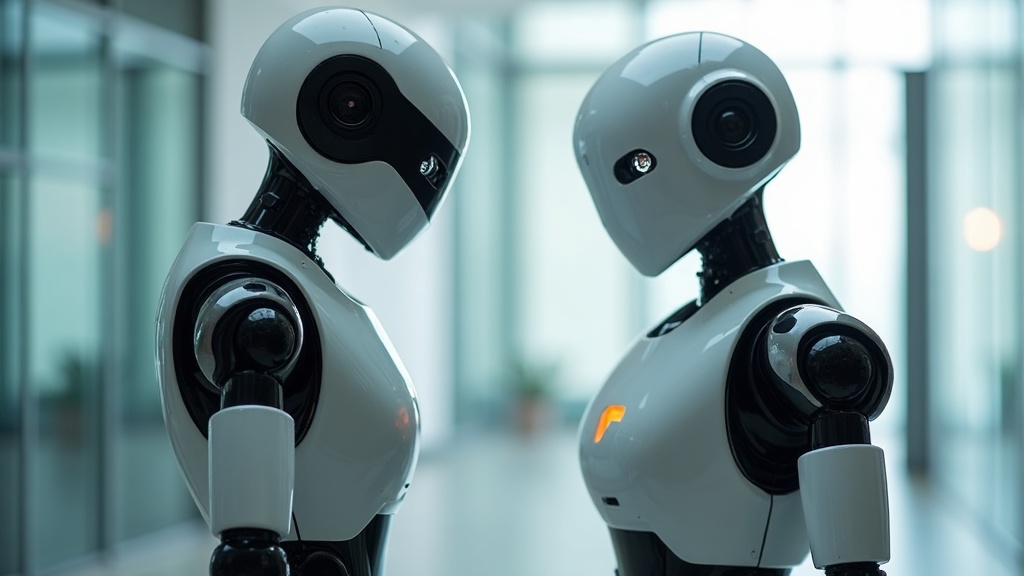
The question for humanoid robots has always been: when does the money get serious? Germany just answered it. Neura Robotics, a Munich-based startup that began shipping its MAiRA humanoid just 18 months ago, announced a $1.4 billion Series C on June 10, 2026, backed by stablecoin giant Tether, chipmaker Nvidia, Amazon, Qualcomm, Robert Bosch, and Schaeffler. At a reported valuation of approximately $7 billion, it is one of the largest private investment rounds ever recorded in the physical AI sector, and its investor list reads less like a venture portfolio than like a supply chain consortium assembling for a manufacturing arms race.
What Actually Happened
On June 10, 2026, Neura Robotics announced it had raised up to $1.4 billion in a Series C financing round, with Tether Holdings acting as lead investor. According to Bloomberg, the round values the company at approximately $7 billion based on sources familiar with the terms, placing Neura among a small cohort of robotics startups that have crossed into multi-billion dollar territory. The round's participants include Nvidia and Qualcomm on the semiconductor side, Amazon on the logistics and cloud side, Robert Bosch GmbH as a German industrial anchor, and Schaeffler AG as a precision manufacturing supplier. The European Investment Bank also participated, lending an unusual public-sector imprimatur that reflects Europe's strategic interest in competing with China and the United States in physical AI. The funding is structured with milestone contingencies: the full $1.4 billion is not released upfront but tied to performance thresholds around production ramp and commercial deployment targets. Neura's current product lineup includes the MAiRA humanoid platform for collaborative work environments and the 4NE-1 platform designed for industrial and logistics tasks.
Tether's lead position deserves careful attention. As the issuer of USDT, the world's largest stablecoin by circulating volume at over $150 billion, Tether is not primarily a venture capital firm. Its decision to lead a humanoid robotics round is a strategic bet that stablecoins will become the payment currency for robot-completed tasks in autonomous commercial workflows. Tether's official announcement confirmed that beyond capital, Tether will deploy its open-source Wallet Development Kit directly into Neura's robotic platforms. This means MAiRA and 4NE-1 robots will carry self-custodial cryptocurrency wallet functionality, enabling them to receive payment in stablecoins for completed tasks and execute transactions within predefined operational parameters. The phrase "self-custodial wallet" is critical: the robot itself holds the private key to its own wallet, not a human administrator. Tether and Mastercard, which launched its own machine payment protocol AP4M the same day, are building the financial infrastructure of the AI economy from different angles simultaneously.
Neura Robotics was founded in 2019 by CEO David Reger, who previously built and sold an industrial automation company. The company's approach differs from US competitors like Figure AI and Boston Dynamics in that it targets cognitive collaborative tasks: the kind that require a machine to work alongside humans in shared physical environments, rather than fully autonomous factory lines. CNBC's coverage noted that Neura has been shipping MAiRA units to enterprise customers in Germany, Austria, and Switzerland over the past 18 months, with installations in automotive assembly support, pharmaceutical logistics, and research laboratory assistance. Schaeffler's precision bearings and drive systems are already inside several Neura prototypes, making the investment as much a supplier relationship as a financial one. Bosch's participation similarly signals integration into the German industrial ecosystem at the component supply chain level, giving Neura preferential access to industrial-grade sensors, actuators, and manufacturing tooling that its US competitors must source on open markets.
Why This Matters More Than People Think
The Neura round has three implications that will be underappreciated in initial coverage. The first is European industrial strategy. Germany's automotive and manufacturing economy, which accounts for over $340 billion in annual export value, faces an existential cost challenge from Chinese manufacturers and US AI investment. A German humanoid startup raising $1.4 billion from American chipmakers, a global e-commerce giant, and a European development bank is not just a startup story. It is the early shape of a European physical AI stack: hardware built in Germany, chips from Nvidia and Qualcomm, logistics deployment through Amazon, and financial rails from Tether. If Neura succeeds at scale, it becomes Europe's strongest candidate for a homegrown physical AI champion to set against Tesla's Optimus and China's Unitree and AgiBot, both of which have benefited from state-backed capital that Neura is now matching through a private consortium.
The second implication is what the investor composition reveals about the supply chain of humanoid robotics. Nvidia's participation is not purely financial. Nvidia's GR00T N2 robot foundation model and its Isaac robotics simulation platform are dependencies that Neura and virtually every humanoid manufacturer will need to train dexterous tasks at scale. Nvidia investing in Neura creates a preferred-customer relationship that could translate into early access to next-generation foundation models, simulation infrastructure, and Jetson Thor compute modules that power on-robot inference. Qualcomm's participation signals similar logic on the edge compute side. As robots move into environments where cloud connectivity is intermittent or latency-sensitive, on-device inference becomes the required architecture, and Qualcomm's Snapdragon-based robot compute platforms are the leading alternative to Nvidia's Jetson family. Neura's likely path is a dual-chip strategy, and these two investments are essentially the silicon supply chain locking in its position before a competitor can secure the same relationships.
The third implication is temporal. Until 2025, humanoid robots were demo-stage technology. The consensus view held that commercial deployments at scale were five to ten years away. The Neura round, following Figure AI's $675 million raise in early 2024, Agility Robotics' Amazon partnership in 2024, and Physical Intelligence's $400 million round in 2024, constitutes a wave of capital deployment that puts commercial timelines at two to three years rather than a decade. The combined invested capital in humanoid robotics across major players in 2025 and 2026 now exceeds $8 billion. Capital at this velocity does not flow into demo-stage technology. It flows into near-commercial infrastructure that needs manufacturing scale, distribution networks, and service organizations. That is the stage the humanoid industry has entered, and Neura's round is the European confirmation of a global trend that began in the United States and is being simultaneously validated by Chinese production numbers.
The Competitive Landscape
The humanoid robotics market in 2026 has a clear three-tier structure. The Chinese tier, led by Unitree Robotics and AgiBot, dominates on production volume. AgiBot rolled its 10,000th humanoid robot off its Shanghai assembly line in late March 2026, and TrendForce projects that Chinese humanoid output will surge 94 percent in 2026, with Unitree and AgiBot together capturing nearly 80 percent of global shipments by unit count. The US tier, led by Figure AI, Boston Dynamics, and Agility Robotics, is stronger on software sophistication and enterprise integration but has been slower on production ramp. Figure's BotQ factory in San Jose now produces one Figure 03 per hour. The European tier is forming around Neura, with Schaeffler and Bosch as industrial anchors. This three-region structure mirrors the automotive industry's geography, which is the sector most likely to be the first at-scale customer for humanoid manufacturing labor and where Germany has a 140-year head start on trust and supply chain relationships.
The direct competitive framing for Neura is against Boston Dynamics and 1X Technologies in the collaborative, human-adjacent category. Boston Dynamics' Atlas electric robot has superior athletic capability but is positioned primarily for Hyundai's internal manufacturing rather than broad commercial sale. 1X Technologies, the Norwegian startup backed by OpenAI, is developing its NEO humanoid for home and office environments but has not achieved the production rates or funding depth of its Chinese competitors. Neura sits between these positions: it targets industrial and research environments where Atlas's agility is overkill but 1X's softer form factor is underpowered. Critics argue that Neura's home geography is its biggest obstacle: European labor law and union structures make it politically difficult to deploy humanoid workers in the manufacturing settings where the economics are clearest. Germany's IG Metall union, the largest industrial union in Europe, has already raised concerns about human-robot displacement in automotive manufacturing, and any co-determination process in that sector will add time and constraints to Neura's primary deployment opportunity.
The Tether-Neura combination creates a competitive axis that has no direct rival yet. Mastercard's AP4M protocol targets the payment infrastructure for AI agents broadly, but Tether's Wallet Development Kit embedded directly in Neura's robots creates a hardware-anchored stablecoin payment system: robots that carry their own financial identity and can be paid in USDT for completed tasks without a human intermediary in the payment chain. The risk is that regulators in Germany and the EU, which have been among the most aggressive globally in regulating both crypto assets and automated decision-making systems, may require a licensed financial institution to sit between the robot and its wallet. If that requirement is imposed, the self-custodial model breaks down and Tether's WDK must be re-architected around a compliant custodian structure. This is not a hypothetical concern: the EU's Markets in Crypto-Assets Regulation, MiCA, which came into full force in late 2024, includes provisions on self-custodial wallets that Tether's lawyers are certainly tracking but have not addressed in public statements.
Hidden Insight: Europe's Physical AI Industrial Policy
The European Investment Bank's participation in the Neura round has been overlooked in most coverage. The EIB is not a passive investor seeking returns. It has a mandate to fund economic development in European strategic sectors, and its presence signals that the EU views humanoid robotics as a strategic technology in the same category as semiconductors and battery manufacturing. The EU has spent three years standing up the European Chips Act, battery gigafactory programs, and a green hydrogen initiative. Physical AI is the next frontier of this industrial policy, and the Neura round is the earliest marker of where European strategic capital is moving. Separately, the German government's KfW development bank has been in conversations with several German robotics companies about subordinated debt facilities for manufacturing scale-up. The pieces of a coordinated European physical AI strategy are assembling around Neura whether or not the company itself is coordinating it.
The geographic distribution of the investor consortium signals where Neura intends to sell. Amazon's presence is the most commercially specific: Amazon operates the world's largest automated warehouse network and has been publicly committed to deploying humanoid robots alongside its existing autonomous mobile robots. Amazon's investment in Agility Robotics in 2024 was its first humanoid bet; the Neura investment may represent a second-supplier strategy, ensuring competition between humanoid providers in its deployment pipeline rather than a single-vendor dependency. If Amazon begins deploying MAiRA units in its roughly 50 major European fulfillment facilities, Neura achieves both commercial validation and a direct distribution channel through one of the world's most sophisticated logistics operators. Amazon's operational standards are exceptionally demanding, requiring high uptime, predictable task completion rates, and seamless integration with existing warehouse management systems. A successful Amazon European deployment would be the most credible commercial reference in the European humanoid market by a wide margin.
The stablecoin-embedded robot is a more radical idea than it first appears. A robot with an autonomous financial identity can enter into smart contracts, automatically renew service agreements, pay for its own maintenance parts from approved suppliers, and report its earnings to a corporate treasury system without human intervention in the financial workflow. The ERC-20 and SPL token standards on Ethereum and Solana already support this type of programmable financial logic. What Tether's WDK provides is the user-experience and compliance layer that makes this deployable in an enterprise context rather than a blockchain developer's sandbox. The robots that adopt this model earliest will generate the most compelling unit economics data for enterprise customers, because the elimination of payment administration overhead is a real and measurable cost reduction that shows up directly in deployment ROI calculations rather than requiring actuarial modeling or market share projections.
The 18-month timeline on Neura's commercial deployments is worth testing against the market. If Neura has achieved meaningful unit economics in its current deployments, it would be the fastest European humanoid company to move from first commercial shipment to a billion-dollar-plus capital raise, eclipsing even Figure AI's pace from a lower base of initial momentum. The milestone-contingent structure of the $1.4 billion round suggests that investors are not writing a check based on past performance alone. They are funding a specific roadmap: probably a target number of commercial units shipped by end of 2026, a production cost-per-unit target for the MAiRA platform, and a geographic expansion plan that includes the Amazon fulfillment network as a key deployment milestone. The details of those milestones, when they become public through regulatory filings or investor updates, will be the most important signal to watch in the next 90 days, because the milestone thresholds reveal what the investors actually believe is achievable in the near term.
What to Watch Next
The 30-day signal is Neura's production announcement. The company's current production rate has not been publicly disclosed, but in the wake of a $1.4 billion raise, expect a factory expansion announcement or a disclosed unit production target for the balance of 2026. If Neura announces a target above 500 units for the year, it will have crossed the threshold where humanoid robotics shifts from an expensive pilot category to a scalable hardware segment. The comparison point is Figure AI's one-unit-per-hour production rate at its BotQ factory, which puts Figure on a trajectory of roughly 8,000 units annually at full capacity. Neura's production ambitions relative to that benchmark will define how quickly it can participate in the volume game that Chinese producers are currently winning by a large margin in unit terms.
The 90-day signal is the Amazon deployment. Amazon's European fulfillment centers are the logical first deployment target for MAiRA, given Amazon's dual status as both equity holder and potential customer. An announcement of a pilot deployment in any of Amazon's major European facilities would confirm that the industrial-logistics use case is viable for Neura's specific form factor and sensor suite. The deployment would also generate the operational data that Neura needs to iterate on task performance in a real-world warehouse environment: pick rates, error rates, recharge frequency, and maintenance intervals. These are the numbers that will define whether MAiRA can compete with specialized warehouse AMRs on total cost of ownership rather than just on the novelty of its humanoid form factor.
At 180 days, the question is regulatory. IG Metall's position on humanoid robot deployment in European automotive and manufacturing settings will either accelerate or constrain Neura's addressable market in its home country. A co-determination agreement between Neura, its enterprise customers, and IG Metall that defines safe deployment parameters and human oversight requirements would be a major unlock for the German manufacturing market. Its absence would push Neura's near-term commercial focus toward pharmaceutical, research, and logistics environments where union influence is lower, which are real markets but smaller than the automotive and heavy manufacturing sectors that justify the largest capital deployments. The shape of that regulatory negotiation over the next six months will tell investors more about Neura's true near-term addressable market than any benchmark score or production target announcement.
Neura Robotics just raised $1.4 billion from the companies building the chips, cloud, and cash rails of the AI economy. The robots aren't coming. They're arriving, and they have their own wallets.
Key Takeaways
- $1.4 billion Series C at a $7 billion valuation closed June 10, 2026, with Tether as lead investor alongside Nvidia, Amazon, Qualcomm, Bosch, and Schaeffler, and the European Investment Bank
- Tether's Wallet Development Kit embedded in Neura robots gives humanoid machines self-custodial USDT wallets, the first hardware-anchored stablecoin payment system in commercial robotics
- Milestone-contingent funding structure means the full $1.4 billion unlocks against production and deployment targets, making Neura's near-term execution the primary investor signal to track
- European Investment Bank participation signals EU-level strategic interest in physical AI as industrial policy, parallel to the European Chips Act and battery manufacturing programs
- Amazon as dual investor and potential customer positions European fulfillment centers as the most likely first large-scale commercial deployment for MAiRA, with roughly 50 major EU facilities as the target deployment network
Questions Worth Asking
- If a robot holds its own financial identity and can receive payment autonomously, how should labor law classify its earnings: as company revenue, as machine depreciation, or as a new legal category requiring entirely new regulatory frameworks?
- The investor consortium for Neura includes companies from the US, Germany, and crypto ecosystems. If geopolitical tensions deepen between these blocs, how does a transatlantic robot supply chain handle technology export controls on AI chips, foundation models, or software licenses?
- Amazon is both an equity investor in Neura and a potential customer. How should enterprises evaluating humanoid robots weight the competitive risk that their logistics provider is also their robot supplier, and that Amazon sees both sides of the deployment data?