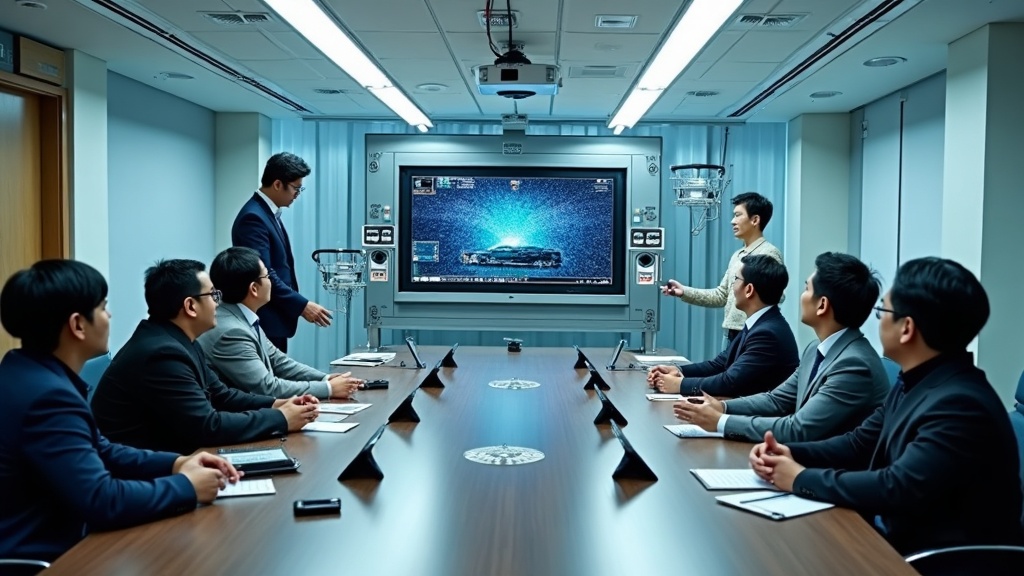
Jensen Huang flew to Seoul on June 8 and walked out of LG Twin Towers with something no single press release could fully capture: a strategic partnership that commits LG Group's six largest business divisions to Nvidia's physical AI stack. This is not a chip sale. This is Nvidia embedding itself into the manufacturing and mobility nervous system of one of the world's most diversified electronics conglomerates, a move that repositions Nvidia not just as a GPU vendor but as the infrastructure layer underpinning a $180 billion enterprise's transformation into an AI-native industrial company.
What Actually Happened
On June 8, 2026, Nvidia CEO Jensen Huang met LG Group Chairman and CEO Kwang Mo Koo at LG Twin Towers in Seoul to finalize an expansive strategic collaboration covering physical AI, robotics, autonomous driving, and advanced data center infrastructure. The scope is unusually broad even by Nvidia's partnership standards: the deal touches six distinct LG business divisions, each integrating Nvidia's AI stack at a different layer of the industrial and consumer value chain. LG Electronics, the flagship consumer electronics arm, will use Nvidia's Isaac GR00T model as the core intelligence for its next-generation home robot product line and will build a dedicated physical AI data factory to generate the training data required for consumer robotics at scale. The agreement formalizes what has been months of quiet collaboration between the two companies on robot hardware, sensor fusion, and simulation environments.
On the infrastructure side, LG CNS, LG Group's IT services and systems integration division, will begin building enterprise AI data centers using Nvidia's DSX reference architecture, a liquid-cooled, GPU-dense design optimized for training large neural networks at hyperscale density. This means LG CNS effectively becomes a certified builder of Nvidia-standard AI factories, capable of deploying infrastructure for LG's internal compute needs while also offering similar capacity to external enterprise clients across South Korea and Southeast Asia. Meanwhile, LG Innotek, the automotive components subsidiary, will develop next-generation automotive parts optimized for Nvidia DRIVE Hyperion, the centralized compute platform that powers advanced driver assistance systems and autonomous driving pipelines for major global automakers. LG Innotek already supplies camera modules and sensor components to Tier-1 automotive partners; the Hyperion integration means those components will now be designed around Nvidia's autonomous driving compute architecture from the ground up.
The partnership also extends into Nvidia's broader physical AI simulation platform. LG will integrate Nvidia Isaac, Cosmos, and GR00T technologies into its 'PhysicalWorks' industrial platform, which connects raw material procurement through final customer delivery in real time. Cosmos provides the world simulation environment where LG robots and autonomous systems can accumulate millions of virtual operational hours before touching real hardware. GR00T provides the embodied intelligence layer, and Isaac supplies the sensor-to-action pipeline for real-time robot control. Additionally, LG AI Research, the group's in-house AI lab, will continue developing EXAONE, its sovereign AI model family, using Nvidia's training infrastructure. The EXAONE family is designed to run on LG-controlled compute rather than third-party API providers, giving LG independence over its most sensitive enterprise AI workloads across manufacturing, supply chain, and customer service applications.
Why This Matters More Than People Think
The partnership is being reported primarily as a robotics story, which undersells its strategic importance. What Nvidia has actually secured is a guaranteed demand anchor for its physical AI stack across one of Asia's most complex manufacturing conglomerates. LG Group operates at a scale that most Western observers underestimate: its subsidiaries collectively produce home appliances for roughly 200 million households globally, manufacture automotive components for dozens of Tier-1 OEM clients, run enterprise IT infrastructure for thousands of Korean and international corporations, and generate over $180 billion in annual revenue across the group. Embedding Nvidia's compute architecture at all six business unit levels means that every LG robot, every LG-built ADAS component, every LG CNS data center rack, and every EXAONE training run flows through Nvidia's hardware and software stack. That is not a partnership; that is a structural integration that will compound for years regardless of which specific models or products lead at any given moment.
The economic architecture of physical AI is fundamentally different from cloud AI. A software API deal generates per-token revenue that scales with inference volume. A physical AI factory deal generates recurring revenue across hardware sales, software licensing, simulation tool access, developer support contracts, and data center buildout. Nvidia's alliance with LG is structured at every level of this stack. When LG Electronics ships a home robot running Isaac GR00T, that robot's training, simulation, and ongoing model updates all run on Nvidia infrastructure. When LG CNS builds a DSX-design data center for an external Korean enterprise client, Nvidia earns revenue on the GPU cluster, the networking fabric, and the software tools. The multiplier effect across six business units operating in different verticals creates a recurring revenue flywheel that no single model partnership can replicate. This is the Nvidia playbook from semiconductor to platform company, and it is executing in Asia at a scale that the Western tech press has consistently underweighted.
Physical AI is also where compute intensity is orders of magnitude higher than cloud inference. A home robot navigating a cluttered living room in real time, a self-driving assistance system processing eight cameras at 100 frames per second, an industrial robot arm replanning its motion path in milliseconds: each of these applications demands local compute that cannot be offloaded to a remote data center. Nvidia's Jetson platform, its Isaac robotics stack, and its Cosmos simulation environment are specifically engineered for this deployment model. By locking LG Group into these platforms at the design level, Nvidia is establishing the AI equivalent of an industrial standard: future LG robotics engineers, automotive teams, and data center architects will all train on Nvidia tools, build with Nvidia APIs, and optimize for Nvidia hardware. Switching costs, once embedded at this depth, become prohibitive within three to five years. That is the real strategic prize, not the immediate revenue from this single announcement.
The Competitive Landscape
Nvidia has executed similar physical AI factory deals before, but none at LG Group's breadth. The Nvidia-Foxconn partnership announced in 2023 covers manufacturing automation for Foxconn's electronics production lines and server rack production. The BMW Group partnership runs Nvidia's Omniverse as the digital twin backbone for factory planning across BMW's global manufacturing network. The partnership with Amazon Robotics focuses on warehouse automation and fulfillment center AI. What distinguishes the LG deal is its simultaneous penetration of consumer robotics, automotive ADAS, cloud infrastructure, and sovereign AI within a single corporate family. Foxconn builds things; BMW drives things; Amazon ships things. LG does all three, plus it builds the infrastructure for others to do the same. This multi-vertical depth is unprecedented in Nvidia's partnership portfolio.
The competitive response from Nvidia's rivals will be difficult. AMD's ROCm software ecosystem remains years behind Nvidia's Isaac, Cosmos, and Omniverse stack on robotics-specific tooling. Intel's Gaudi platform is competitive on training cost for large language models but has no equivalent robotics simulation environment or embodied AI model like GR00T. Qualcomm is Nvidia's most credible threat in automotive ADAS, where its Snapdragon Ride platform competes with DRIVE Hyperion, and the LG Innotek design win for Hyperion-optimized components is a direct competitive blow to Qualcomm's automotive ambitions in Korea. Critics argue, however, that Qualcomm's existing design relationships with Korean automotive OEM Hyundai and Korean Tier-1 suppliers give it a resilient foothold that a single Nvidia-LG announcement cannot displace quickly. Platform transitions in automotive take three to seven years from design win to production vehicle; the bear case is that LG Innotek's DRIVE Hyperion commitment affects 2029-2031 model year vehicles at the earliest, leaving ample time for Qualcomm to compete for adjacent programs.
The historical parallel that best illuminates this deal is not another chip partnership; it is IBM's move in the 1980s to make its PC architecture the industry default by licensing it broadly to manufacturers. By the time competitors understood what IBM had done, the IBM PC standard was so deeply embedded in the ecosystem that dislodging it required an entirely different computing paradigm. Nvidia is attempting to do something analogous with physical AI infrastructure: establish its simulation tools, robot models, and data center architectures as the default standards before the physical AI market is large enough to attract credible open alternatives. LG Group, with its global manufacturing scale and its six-division reach across verticals, is precisely the kind of anchor partner that validates a standard and makes it harder for the next entrant to propose something different. The IBM PC parallel is not perfect, but the strategic logic is the same: control the platform during the formative period and the market structure that emerges will favor you for a decade.
Hidden Insight: EXAONE Is Nvidia's Data Flywheel in Korea
The least-discussed element of the LG partnership is the EXAONE sovereign model integration, and it may be the most consequential and underreported component of the entire deal. LG AI Research built EXAONE to reduce the group's dependence on external AI API providers, specifically to keep sensitive manufacturing, logistics, and customer data within LG-controlled infrastructure. By training and running EXAONE on Nvidia compute, LG is effectively embedding Nvidia as the hardware layer beneath its sovereign AI ambition. This creates a compounding dynamic: the more LG trains EXAONE to understand its own factories, supply chains, and customer bases, the more compute it consumes, and the more Nvidia earns on that compute. Sovereign AI is typically framed as a geopolitical or data-privacy initiative; for Nvidia, it is a recurring infrastructure revenue stream that grows in direct proportion to the customer's AI maturity.
The Korean market dynamics amplify this effect. South Korea is one of the highest-density manufacturing economies in the world, producing semiconductors, displays, electric vehicles, steel, and petrochemicals at global scale. LG Group's adoption of Nvidia's physical AI factory design gives Nvidia a reference architecture that Korean industrial conglomerates and Korean government AI initiatives will observe closely. Samsung Electronics, SK Hynix, Hyundai, and Posco all operate in adjacent spaces where physical AI is becoming a strategic priority. A visible, comprehensive LG deployment creates a market demonstration effect that no amount of marketing spend could replicate. When LG CNS builds NVIDIA DSX-designed data centers and publicly validates the performance and reliability of that architecture, it provides a reference case that competing Korean enterprises can evaluate. Nvidia is using LG as the first mover anchor to establish its physical AI factory design as the Korean industrial standard.
There is also a robotics training data angle that has not been widely covered. Home robots are uniquely difficult to train because the environments they operate in, human living spaces, are highly variable, socially complex, and safety-critical in ways that industrial robot environments are not. LG Electronics has access to a global installed base of smart home appliances in hundreds of millions of homes, generating behavioral and environmental data that is invaluable for training home robots to navigate realistic human spaces. By building a physical AI data factory specifically to curate and structure this data for Isaac GR00T training, LG is creating a proprietary data asset. Nvidia benefits from this because the models trained on LG's data will be optimized for Nvidia's Isaac platform and will run most efficiently on Nvidia hardware. The data flywheel, data generated by LG's appliance network feeding training for GR00T-based robots running on Nvidia hardware, is a compounding advantage that neither LG nor Nvidia can access independently.
The risk in this arrangement, and it is real, is that LG Group's execution track record on software-intensive ventures is mixed. LG exited the smartphone business in 2021 after failing to compete with Samsung and Apple despite years of investment. Its webOS platform, acquired from HP, had promising moments but never achieved the developer ecosystem density needed to become a platform standard. Skeptics point out that building an AI data factory for home robotics is a far more complex software engineering challenge than manufacturing a television, and that LG's organizational capabilities in data infrastructure and ML engineering may not match the ambition of this partnership. If LG's home robot product line stumbles commercially, or if its EXAONE sovereign model fails to achieve production-grade performance within enterprise workflows, the physical AI factory deal with Nvidia may produce impressive press releases but limited commercial results for either party.
What to Watch Next
The first 30-day signals to track are product-level. Watch for LG Electronics to publish new home robot specifications that reference NVIDIA Isaac GR00T capabilities, and for LG CNS to announce its first external enterprise client for an NVIDIA DSX-designed AI data center. If LG CNS signs a Korean government or Korean banking client for DSX-standard infrastructure within 30 days of this announcement, it validates that the data center partnership is generating commercial momentum rather than remaining an internal capability buildout. Also watch for Nvidia's quarterly earnings commentary in late July: if Jensen Huang specifically calls out the LG partnership as a new model for physical AI factory deals, it signals that Nvidia plans to use the LG template as a go-to-market approach for similar multi-vertical industrial conglomerates globally.
The 90-day markers center on automotive and robotics. LG Innotek's DRIVE Hyperion design activity will show up in component specification announcements from Korean automotive OEM suppliers. If Hyundai or Kia publicly reference Hyperion-optimized LG Innotek sensor components in their 2028-2029 model year vehicle programs, that confirms the automotive leg of the partnership is converting into real design wins. On the robotics side, LG Electronics' home robot product roadmap events, typically scheduled in advance of Korean trade shows like Korea Electronics Show and CES, will be the first opportunity to see Isaac GR00T publicly demonstrated in an LG-branded consumer context. A compelling home robot demonstration running Nvidia's embodied AI model would generate media amplification that accelerates enterprise credibility for the entire partnership.
Looking 180 days out, the EXAONE sovereign model development is the highest-stakes indicator. If LG AI Research publishes an EXAONE performance benchmark showing competitive results against GPT-4 class models on Korean industrial and manufacturing domain tasks, it validates that sovereign AI training on Nvidia infrastructure can produce world-class models. That result would carry enormous signal for every other Korean chaebol considering whether to invest in their own sovereign AI program. The prediction markets on this outcome split roughly at 60 percent probability of a credible benchmark publication by December 2026, with the remaining 40 percent suggesting LG may keep EXAONE results proprietary to preserve competitive advantage. Either outcome is informative: publication builds Nvidia's platform credibility in Korea; silence suggests LG is seeing commercial traction it wants to protect.
When Nvidia leaves Seoul with six business units committed to its physical AI stack, it has not sold chips: it has become the industrial operating system for a $180 billion conglomerate, and that is a different kind of win entirely.
Key Takeaways
- Six LG business divisions are committing to Nvidia's physical AI stack, spanning home robots, automotive ADAS, AI data centers, and sovereign AI model development.
- LG Electronics will use Nvidia Isaac GR00T for its home robot product line, supported by a new physical AI data factory drawing on LG's global appliance installed base.
- LG CNS will build NVIDIA DSX-designed data centers, positioning LG as a certified builder of Nvidia-standard AI factory infrastructure for enterprise clients across Korea and Southeast Asia.
- LG Innotek joins NVIDIA DRIVE Hyperion for automotive ADAS components, a design-level commitment that affects 2029-2031 model year vehicles and directly competes with Qualcomm's Snapdragon Ride platform.
- EXAONE sovereign model training runs on Nvidia hardware, creating a recurring compute revenue flywheel as LG's internal AI maturity grows and its enterprise data processing needs compound over time.
Questions Worth Asking
- If LG Group's execution on software-intensive platforms has historically been inconsistent, what specific organizational changes would need to happen for this physical AI factory partnership to reach its full potential?
- Nvidia now has anchor physical AI factory deals with Foxconn, BMW, Amazon, and LG Group: at what point does platform concentration become a regulatory risk that governments in Korea, the EU, or the US feel compelled to address?
- LG's EXAONE sovereign model is designed to keep sensitive industrial data within LG-controlled infrastructure: if EXAONE succeeds commercially, does that model make enterprises less dependent on Nvidia's software tools even as they remain dependent on Nvidia's hardware?