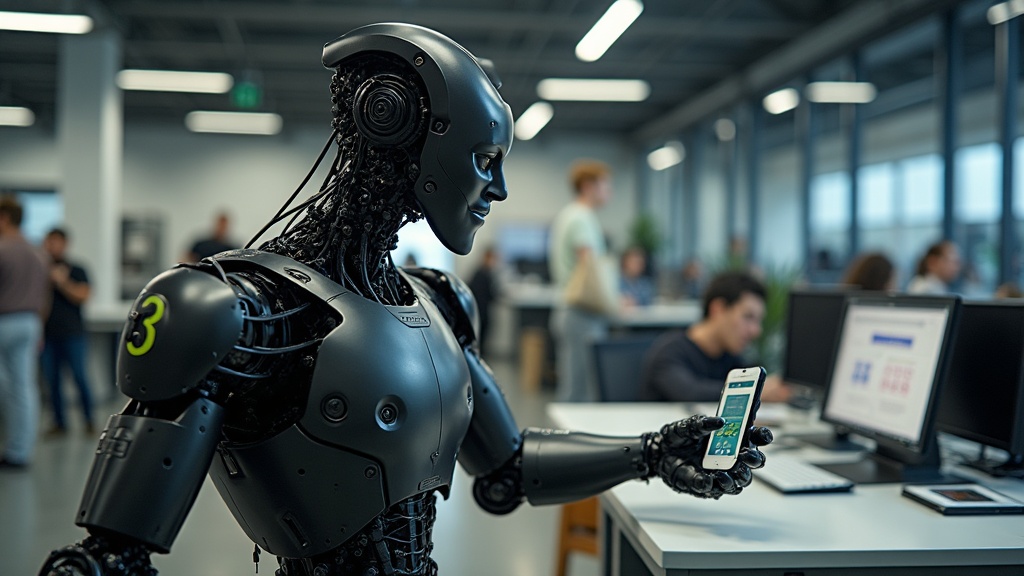
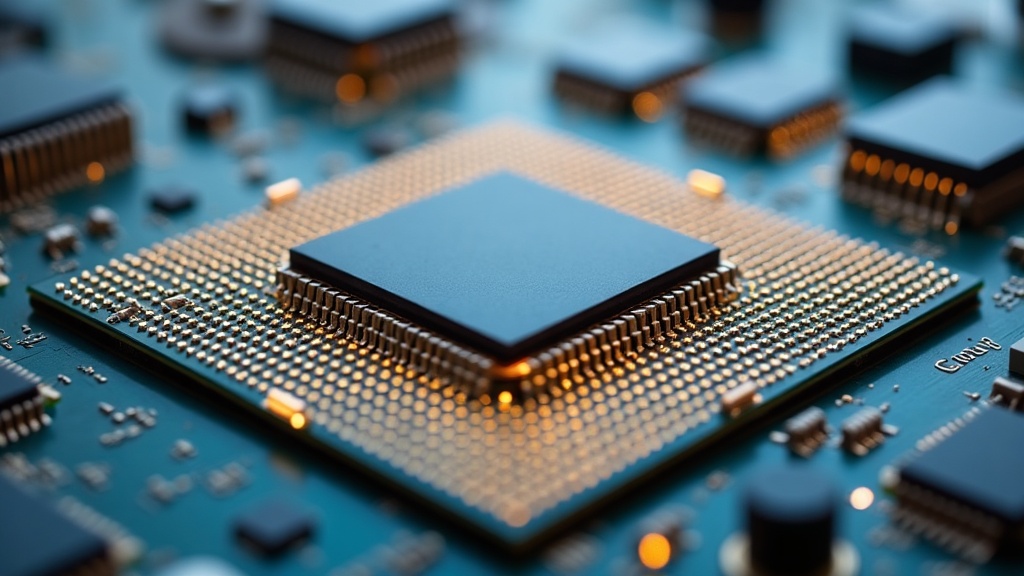
For a decade, the bottleneck in robotics was not the motors or the cameras. It was the brain. A humanoid robot needs to see, reason, and react in milliseconds without phoning home to a data center, and no edge chip could carry a frontier-grade model fast enough. Nvidia just shipped the part it says closes that gap, and it is built on the same Blackwell architecture powering the data centers training those models in the first place.
What Actually Happened
Nvidia made its Blackwell-powered Jetson Thor robotics computer generally available, positioning it as the on-board brain for the coming wave of humanoid and industrial robots. The flagship module delivers up to 2,070 FP4 teraflops of AI compute paired with 128 GB of LPDDR5X memory, which the company says is roughly 7.5 times the AI performance and 3.5 times the energy efficiency of the previous-generation Jetson AGX Orin, all within a 40 to 130 watt power envelope. The developer kit starts at $3,499, with lower-cost production modules aimed at high-volume robot builders.
The chip is the centerpiece of a broader physical-AI push Nvidia detailed at Computex. Alongside Jetson Thor, the company released new open foundation models for robots and showcased an Isaac GR00T humanoid reference design standing nearly 1.83 meters tall, built on a Unitree chassis with five-fingered dexterous hands from Singapore-based Sharpa. The message is that Nvidia wants to own every layer of the robot stack: the simulation environment where robots are trained, the foundation models that give them reasoning, and now the silicon that runs those models inside the machine.
The early adopter list is the real signal of intent. Nvidia named Agility Robotics, Amazon Robotics, Boston Dynamics, Caterpillar, Figure, Hexagon, Medtronic, and Meta among the companies already designing around Jetson Thor, and the company says more than 2 million developers now use its robotics software stack. That spread, from warehouse logistics to construction equipment to surgical devices, tells you Nvidia is not betting on humanoids alone. It is betting that almost every category of machine that moves through physical space will need a frontier-class brain, and that it should be the default supplier of that brain.
Pricing strategy reinforces the ambition. The ,499 developer kit is meant to get the chip into the hands of researchers and startups, but the modules that go into shipping products are priced for volume, with cheaper configurations trading memory and teraflops for cost. That tiering lets Nvidia serve both a university lab building one experimental humanoid and a logistics firm deploying thousands of identical machines. It is the same segmentation that let the company dominate gaming and then data-center GPUs: a halo part at the top to define the category, and a ladder of cheaper parts beneath it to capture the volume where the real revenue lives.
Why This Matters More Than People Think
The reason this lands harder than a typical chip launch is timing. Robotics foundation models have improved faster in the last 18 months than in the prior decade, with Google DeepMind, Figure, and others showing vision-language-action systems that can generalize across tasks. Those models are useless on a robot if the on-board computer cannot run them at the speed physical interaction demands. Jetson Thor is Nvidia's answer to the question every robotics startup has been stuck on: where does the model actually live when latency, power, and heat all matter and the cloud is too far away?
The strategic move is to recreate, at the edge, the lock-in Nvidia already enjoys in the data center. Developers who build on Isaac, Omniverse, and CUDA for robotics simulation will find it natural to deploy on Jetson hardware, because the same software stack runs end to end. That continuity from training to simulation to deployment is the moat. A competitor can match the raw teraflops on a spec sheet, but matching the decade of accumulated robotics software, sample code, and developer habit is far harder. Nvidia learned this lesson once in graphics and again in AI training, and it is running the identical playbook in physical AI.
There is a macro story underneath the product story. Every major economy is now treating humanoid robotics as a strategic priority, driven by aging populations, labor shortages, and the desire to reshore manufacturing. China has poured state money into humanoid makers like Unitree and UBTech, and the United States is leaning on Figure, Boston Dynamics, and Tesla. Whoever supplies the compute that powers those robots sits in the same position Nvidia occupies in AI today: selling the indispensable pick-and-shovel input to a gold rush, regardless of which individual robot company wins.
Skeptics point out that the bottleneck story is not so simple, and the risk is that raw teraflops were never the thing actually holding humanoids back. Battery life, hand dexterity, reliable manipulation of soft or irregular objects, and the sheer cost of collecting real-world training data are arguably harder problems than on-board compute. A faster brain does not teach a robot to fold laundry or recover from a stumble; that still requires data and learning that the field is only beginning to gather. The bear case is that Jetson Thor solves a constraint that had already loosened, while the genuinely hard constraints remain, which would make this a powerful chip in search of robots good enough to need it.
The Competitive Landscape
Nvidia does not have this market to itself, even if it would like to. Qualcomm has pushed its own robotics and edge-AI platforms, leaning on the power efficiency it perfected in mobile. Intel has marketed its Core Ultra line for robotics and claims edge-AI design wins, and AMD is positioning its embedded and adaptive silicon for the same workloads. Beyond the chip incumbents, the bigger long-term threat is vertical integration: Tesla designs its own inference silicon for Optimus, and other well-funded humanoid makers may follow rather than pay Nvidia's margins on every unit they ship.
The historical parallel is the smartphone application processor wars of the late 2000s. Early on, merchant silicon from Qualcomm and Nvidia's own Tegra powered most devices, but the most valuable players, Apple above all, eventually designed their own chips to capture margin and control the roadmap. Robotics could rhyme with that arc. For now, building a custom robotics brain is too expensive for all but the largest players, so Jetson Thor is the obvious choice. The open question is whether, five years out, the Figures and Teslas of the world conclude that the brain is too strategic to outsource.
For the moment, Nvidia's advantage is that it sells the whole pipeline. A startup that wants to train a robot policy in simulation, validate it in Omniverse, and deploy it on hardware can do all three without leaving the Nvidia ecosystem. Qualcomm and Intel sell strong chips but lack the equivalent end-to-end simulation and foundation-model layer. That gap is why even companies with the resources to consider custom silicon, like Amazon and Meta, are showing up on the Jetson Thor adopter list rather than going it alone. Convenience and time-to-market still beat marginal cost savings while the category is young.
China complicates the picture in a way the adopter list does not capture. Export controls limit which Nvidia parts can ship into Chinese robot makers, and Beijing is actively funding domestic alternatives so its humanoid champions are not dependent on American silicon. That means the global robotics-brain market may split along the same geopolitical fault line as AI training chips, with Nvidia dominant in the West and a state-backed domestic stack rising in China. For a category every major government now treats as strategic, the supplier question is not only commercial; it is a matter of industrial sovereignty, and that politics will shape the roadmap as much as raw performance does.
Hidden Insight: The Brain Is a Trojan Horse for the Whole Stack
The chip is not really the product. It is the wedge. Once a robot company commits to Jetson Thor, it is also committing, in practice, to Nvidia's simulation tools, its foundation models, its networking, and its cloud GPUs for the heavy training runs that happen off the robot. The on-board brain is the visible 5 percent of an iceberg whose other 95 percent is recurring spend across Nvidia's data-center and software businesses. This is why Nvidia can afford to price the hardware aggressively: the module is a customer-acquisition cost for a much larger and stickier relationship.
This reframes how to read the adopter list. When Amazon Robotics or Caterpillar standardizes on Jetson Thor, the number that matters is not the price of the chip. It is the multi-year compute commitment that follows, because training the policies for a fleet of thousands of robots requires enormous data-center capacity, and that capacity is overwhelmingly Nvidia GPUs. The robot is the demand-generation engine for the cloud business. Every humanoid that ships with a Jetson brain implies a long tail of training, retraining, and fleet-learning workloads that flow back to Nvidia's highest-margin products.
The deeper signal for the next 24 months is about data, not silicon. The scarce resource in robotics is not compute or models; it is real-world interaction data showing how to grasp, balance, and recover from failure. By putting its hardware and software inside millions of robots, Nvidia positions itself at the center of the data flywheel that will train the next generation of physical-AI models. Whoever sits closest to that data stream has the same structural advantage that search and social companies enjoyed in the last era. The Jetson Thor launch is, in that light, less a chip release and more a land grab for the most valuable data source in robotics.
There is a financial dimension that the spec sheet hides. Nvidia books robotics today as a small slice of a data-center business measured in the tens of billions per quarter, which means the Jetson line does not need to be a large revenue driver on its own to be strategically decisive. Its job is to seed the installed base that pulls through high-margin training compute later. That is a luxury no pure-play robotics-chip startup can match, because a startup has to make money on the chip itself, while Nvidia can treat the chip as marketing for the cloud. The asymmetry in business models, not in transistors, is what makes the competitive position so durable.
The uncomfortable truth is how dependent the entire robotics field now is on a single vendor. If humanoid robots become as common as Nvidia's customers hope, then one company will supply the brains, the training compute, and much of the software for an entire new category of physical labor. That concentration is great for Nvidia shareholders and unnerving for everyone else, from regulators worried about a compute monopoly to robot makers who would rather not hand a single supplier a toll booth on the future of automation. The launch is a reminder that the AI infrastructure bottleneck is not loosening; it is migrating from the data center into the physical world.
What to Watch Next
Over the next 30 days, watch for design-win announcements that move beyond the named launch partners. The tell that Jetson Thor is winning the category will be smaller, less famous robot makers disclosing it as their default compute, because broad mid-market adoption, not a handful of marquee logos, is what builds an unassailable platform. Also watch pricing on the high-volume production modules, since the developer kit price is not what a company shipping ten thousand robots will actually pay.
Over the next 90 days, the key marker is whether any major humanoid maker publicly commits to custom silicon instead. A credible defection by Figure, Tesla, or a large Chinese maker would signal that the brain is too strategic to outsource and would cap Nvidia's long-term share of the robot, even if it keeps the training business. The opposite, continued consolidation onto Jetson, would suggest the lock-in is hardening exactly as Nvidia intends. Earnings commentary from Nvidia on robotics and edge revenue will be the first quantitative read on traction.
Over the next 180 days, the question is deployment versus demo. Robotics has a long history of dazzling stage demonstrations that never reach reliable, paid, at-scale operation. The leading indicator to track is the number of robots running Jetson Thor in actual revenue-generating work, in warehouses, factories, and hospitals, rather than in promotional videos. If that number climbs into the tens of thousands by late 2026, the physical-AI era has genuinely begun. If it stalls in pilots, this launch will look like another inflection point that arrived a few years early.
Nvidia is not selling a robot brain. It is selling the on-ramp to its entire stack, and every humanoid that ships with a Jetson inside is a multi-year compute contract wearing a chassis.
Key Takeaways
- 2,070 FP4 teraflops and 128 GB of memory, roughly 7.5x the AI performance and 3.5x the efficiency of Jetson AGX Orin at 40 to 130 watts.
- Developer kit starts at $3,499, with cheaper production modules aimed at high-volume humanoid and industrial robot builders.
- Agility, Amazon, Boston Dynamics, Caterpillar, Figure, Hexagon, Medtronic, and Meta are early adopters, with 2 million developers on the robotics stack.
- The chip is a wedge: it pulls customers into Nvidia simulation, foundation models, and data-center GPUs for fleet training.
- The strategic prize is data: sitting inside millions of robots gives Nvidia the real-world interaction data that trains the next physical-AI models.
Questions Worth Asking
- If the robot brain is a wedge for the whole stack, how much of a humanoid's lifetime cost will quietly flow to a single compute supplier?
- At what scale does designing custom robotics silicon become cheaper than paying Nvidia's margin, and which maker crosses that line first?
- If one company supplies the brains and training compute for an entire category of physical labor, who should be comfortable with that concentration?