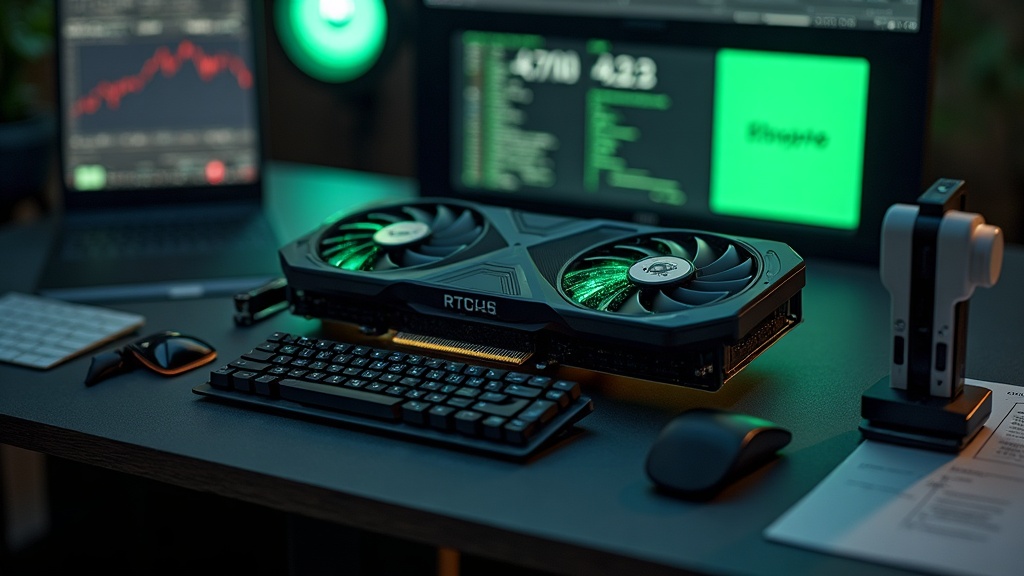
Nvidia just walked into the one market it had carefully avoided for thirty years: the Windows PC processor. At Computex 2026, Jensen Huang unveiled RTX Spark, a superchip that pairs a custom Arm CPU with a Blackwell GPU and 128GB of unified memory on a single package. The pitch is not faster gaming. It is a Windows laptop that runs a personal AI agent locally, all day, without ever touching a charger or a cloud API. For a company that built its empire selling chips to data centers, walking onto the desk of every Windows user is the most aggressive expansion Nvidia has attempted, and it tells you the company no longer thinks of inference as something that lives only in the cloud.
What Actually Happened
At Computex 2026 in Taipei, Nvidia introduced RTX Spark, describing it as a superchip purpose-built to make Windows PCs into machines for personal AI agents. At full configuration the chip carries up to 20 Arm CPU cores, a Blackwell GPU with 6,144 CUDA cores, 128GB of LPDDR5X unified memory, and up to 300 GB/s of memory bandwidth, delivering what Nvidia calls 1 petaflop of AI performance in a thin-and-light form factor. The unified memory architecture is the structural trick: CPU and GPU share one large pool, so a sizable model can sit resident in memory and respond instantly rather than streaming weights across a bottlenecked bus.
Nvidia did not build the CPU alone. MediaTek, the Taiwanese leader in Arm system-on-chip design, is Nvidia's exclusive partner for RTX Spark and engineered the custom CPU, the high-speed memory architecture, the power management, and the connectivity. That division of labor matters: Nvidia supplies the GPU and the AI stack it has spent two decades perfecting, while MediaTek supplies the low-power Arm expertise that Nvidia has never had. The result is a chip neither company could have shipped alone, aimed squarely at a category, the AI PC, that barely existed two years ago.
The hardware reaches buyers this fall. Nvidia says RTX Spark-powered slim laptops with all-day battery life and premium displays, plus compact desktop PCs, will be available from ASUS, Dell, HP, Lenovo, Microsoft Surface, and MSI, with Acer and GIGABYTE models to follow. That is essentially the entire Windows OEM ecosystem committing to a single new silicon platform at once. Microsoft putting its own Surface line on RTX Spark is the loudest signal, because it means the company that defines the Windows reference experience is willing to anchor its flagship hardware to an Nvidia-MediaTek chip rather than Intel, AMD, or Qualcomm.
Why This Matters More Than People Think
For three decades the Windows PC has run on x86 processors from Intel and, later, AMD. RTX Spark is an Arm-based assault on that arrangement, and it arrives with Nvidia's brand and the full Windows OEM roster behind it. The strategic logic is that the PC is being redefined from a productivity device into an agent host, and the chip that wins is the one that can run a capable model locally with low power draw. That reframing favors exactly the kind of unified-memory, GPU-heavy, Arm-efficient design that Nvidia and MediaTek built, and disfavors the CPU-centric architecture that has defined the PC since the 1980s.
The local-inference angle is the real business case, not gaming benchmarks. A personal agent that runs on-device can read your files, watch your screen, and act continuously without sending data to a cloud API or burning per-token fees. That is attractive to privacy-conscious users and, more importantly, to enterprises that cannot legally ship internal documents to a third-party model. With 128GB of unified memory, RTX Spark can hold a genuinely capable model resident, which means the agent responds at conversational speed instead of waiting on a network round trip. Local, private, always-on, and free at the margin is a combination cloud agents structurally cannot match, and it is the first genuinely new reason to buy a PC in roughly a decade. The last time the industry had a hardware story this clean was the shift to solid-state storage, and Nvidia is betting the local agent is a bigger inflection than that.
There is also a defensive dimension for Nvidia. The company makes its fortune in the data center, and the looming threat is that inference migrates to cheaper custom silicon over time. By establishing RTX Spark as the local-inference standard on hundreds of millions of future PCs, Nvidia plants its architecture and software stack on the edge of the network, not just in the cloud. Every developer who optimizes a local agent for RTX Spark is one more developer locked into Nvidia's tooling, which compounds the same CUDA advantage that protects its server business. The PC is a beachhead, not a side project. If even a fraction of the personal-agent workload that would otherwise run in a data center instead runs locally on RTX Spark, Nvidia captures that compute on its own silicon at the edge while denying a custom-chip rival the chance to win it in the cloud. Owning both ends of the network is the kind of structural position that is almost impossible to dislodge once it sets.
The Competitive Landscape
RTX Spark lands directly on top of AMD's Ryzen AI Max and Qualcomm's Snapdragon X2, the two chips that have defined the AI PC conversation so far. Qualcomm spent two years arguing that Arm-on-Windows was the future of efficient, always-connected laptops, and largely won the architectural argument while struggling with software compatibility. Nvidia has now arrived with a more powerful Arm design, a far stronger GPU, and a brand that consumers actively want, which threatens to take the category Qualcomm opened. AMD, meanwhile, just shipped Ryzen AI Max Pro 400 into a market Nvidia is now attacking from above with a petaflop-class part.
Intel is the player with the most to lose and the least visible answer. The x86 incumbent has watched its data-center relevance erode against Nvidia for years, and RTX Spark now opens a second front in the consumer PC market that has been Intel's last reliable stronghold. If Microsoft, Dell, HP, and Lenovo are willing to put their flagship machines on an Nvidia-MediaTek Arm chip, the assumption that every Windows laptop needs an Intel CPU inside is no longer safe. Intel's counter, a competitive on-device AI part with the GPU muscle to match, has not materialized, and the window to ship one is closing fast. The company is simultaneously trying to rebuild its foundry business, defend its server share, and answer Nvidia in the PC, and fighting three wars at once is how incumbents lose the one that matters most. Each quarter without a credible RTX Spark rival hardens the perception that the premium AI laptop simply runs Nvidia.
The historical parallel is Apple's 2020 move from Intel to its own Arm-based M1 silicon, which proved that a tightly integrated Arm chip with unified memory could outperform x86 laptops on both speed and battery life. That transition reshaped the Mac and stranded Intel. RTX Spark is the Windows world's belated answer, except it arrives as a coalition rather than a single vertically integrated company. The risk and the opportunity both flow from that structure: a coalition can move the whole ecosystem at once, but it lacks the unified control that made Apple's transition so clean. Apple owned the chip, the operating system, and the application ecosystem, so it could force the whole stack to move together. The Windows coalition has to coordinate Nvidia, MediaTek, Microsoft, and six OEMs, and any weak link in that chain can stall the transition that Apple completed in a single confident sweep.
Hidden Insight: The PC is being rebuilt around the agent, not the app
The deeper story is that RTX Spark is hardware built for a software paradigm that barely exists yet. Today almost nobody runs a capable AI agent locally on a laptop, because the hardware to do it well has not shipped. Nvidia is betting that within two years the default Windows experience will be an always-on personal agent that sees your screen, manages your files, and takes actions on your behalf, and that this agent will demand a GPU-heavy, large-memory machine to run locally. The chip is a bet on a behavior change that has not happened yet, not a response to existing measured demand from real buyers.
That bet rewires the economics of the entire PC industry. If the agent becomes the primary interface, the value of a PC shifts from how fast it opens applications to how well it runs a resident model, which is a spec dominated by GPU throughput and memory capacity rather than CPU clock speed. Nvidia wins that contest by definition, because it has spent twenty years building the best inference silicon on earth. The whole premise of RTX Spark is to redefine what a good PC even means so that the answer is always a machine with an Nvidia GPU at its center. It is the same maneuver Nvidia ran in the data center, where it convinced an entire industry that the unit of compute was the GPU rather than the CPU, and then sold the GPUs. Doing it again on the desktop would extend that redefinition to a market measured in hundreds of millions of units a year.
However, skeptics point out that the AI PC has been overpromised before and badly under-delivered. The first wave of Copilot+ PCs in 2024 arrived with neural processing units that most users never noticed and few applications used, and the on-device AI features were thin enough that buyers could not tell the difference from an ordinary laptop. The bear case for RTX Spark is that the killer local-agent application simply does not arrive on schedule, leaving expensive, power-hungry chips running the same web browser and spreadsheet that a cheap x86 laptop runs fine. Hardware that is two years ahead of its software is a financial liability, not an advantage, until the software finally shows up to justify the premium that buyers paid for it.
There is a compatibility risk on top of the demand risk. Arm-on-Windows has historically stumbled on application emulation, where x86 software runs slower or breaks outright, and that friction is exactly what kept Qualcomm's Snapdragon laptops from mainstream adoption despite strong hardware. Nvidia and MediaTek are inheriting that same emulation problem, and a personal agent that is brilliant but cannot reliably drive the legacy Windows apps users depend on will frustrate rather than delight. The success of RTX Spark hinges as much on Microsoft's emulation layer maturing as on the silicon itself, and that dependency sits outside Nvidia's control.
What to Watch Next
In the next 30 days, watch for independent power and performance reviews once review units circulate ahead of the fall launch, and specifically for battery-life numbers under sustained local-inference load rather than idle benchmarks. The all-day battery claim is the entire selling point of an Arm AI laptop, and if running a resident agent drains the battery in three hours the value proposition collapses. Also watch pricing, because a petaflop-class chip with 128GB of memory will not be cheap, and a premium that pushes these machines well above mainstream laptop prices would cap the category at the high end.
Over 90 days, the question is whether a genuinely useful local-agent application ships alongside the hardware or shortly after. Watch Microsoft's Windows agent roadmap and whether the operating system itself exposes a local model that developers can build on, because the platform-level agent is what would turn RTX Spark from a spec sheet into a reason to buy. Watch too for AMD's and Intel's responses, since both will be forced to either match the unified-memory, GPU-heavy approach or concede the premium AI PC tier to the Nvidia-MediaTek coalition.
By 180 days, the real signal is attach rate and developer momentum: how many of the fall RTX Spark machines actually sell, and how many developers ship apps optimized for local inference on the platform. If the coalition can demonstrate a real install base of agent-capable PCs by early 2027, the local-AI ecosystem tips toward Nvidia and Intel's consumer stronghold cracks. If the machines sell as ordinary premium laptops and the local agents never materialize, RTX Spark becomes an expensive proof of concept and x86 keeps the desk it has owned for forty years. The cleanest tell will be whether a second-generation RTX Spark roadmap appears on schedule, because Nvidia has already outlined multiple future generations, and a company does not commit a multi-year silicon roadmap to a category it expects to abandon. Sustained roadmap investment, more than launch-day sales, is the signal that Nvidia believes the agent PC is permanent.
Nvidia is not selling a faster laptop. It is betting the next PC is an agent that happens to need an Nvidia GPU to live on your desk.
Key Takeaways
- 20 Arm cores, 6,144 CUDA cores, 128GB unified memory on one superchip delivering 1 petaflop of local AI performance
- MediaTek is the exclusive CPU partner, supplying the Arm and power expertise Nvidia lacks
- ASUS, Dell, HP, Lenovo, Microsoft Surface, and MSI ship RTX Spark machines this fall, with Acer and GIGABYTE to follow
- The target is local AI agents: private, always-on, and free at the margin versus per-token cloud APIs
- It is an Arm assault on x86, hitting AMD Ryzen AI Max, Qualcomm Snapdragon X2, and Intel's last consumer stronghold
Questions Worth Asking
- If the PC becomes an agent host, does CPU clock speed still matter, or have you been buying the wrong spec for the next decade?
- Would your organization run a private on-device agent that can read internal files locally, and what would that change about your cloud AI spend?
- Has the AI PC actually earned its premium yet, or are you paying for hardware two years ahead of the software that justifies it?