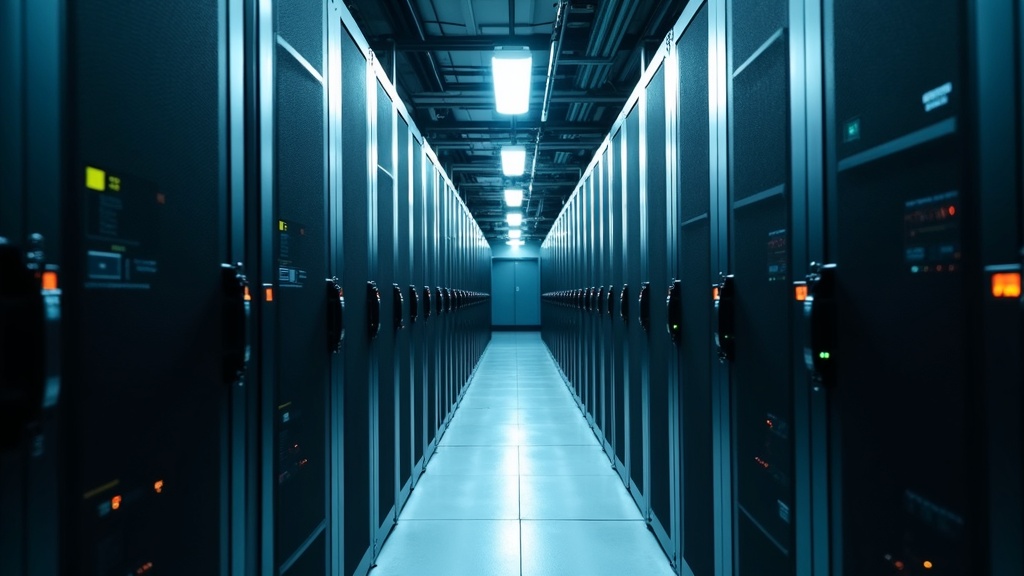
For three years, the central question in AI infrastructure was: can you get enough GPUs? That question has been answered. The new question, harder and slower to solve, is whether the power grid can support the GPUs that now exist. A DIGITIMES analysis published on June 10, 2026, synthesizing findings from Computex 2026 and Nvidia GTC Taipei, made formal what data center operators have been saying privately for months: electricity availability, not chip supply, is now the binding constraint on AI infrastructure expansion globally.
What Actually Happened
The DIGITIMES report, titled "Power, not chips, is now the binding constraint for AI data centers," marks a formal inflection point in AI infrastructure planning. The shift is being driven by Nvidia's Rubin architecture, which represents a step-change in GPU power consumption that the grid was not designed to absorb at scale. Nvidia's Vera Rubin platform, entering volume production in the second half of 2026, introduces racks that draw between 190 and 230 kilowatts per unit in the VR200 NVL72 configuration, nearly double the 120-130 kW draw of its Blackwell predecessor. For context: a typical US home consumes approximately 10-11 kW at peak. A single Rubin rack needs the electrical equivalent of roughly 20 average American homes. The largest planned configurations, the NVL576 rack, are estimated at 600 kW per rack and require purpose-built liquid cooling infrastructure designed from the ground up. According to analysis from ARC Compute, data centers planning Rubin deployments face a fundamental infrastructure redesign requirement that goes well beyond swapping out servers: new power distribution, new cooling architecture, and new civil engineering at the facility level.
The industry numbers behind this shift are substantial. Big tech's aggregate AI data center appetite has reached an estimated 125 gigawatts of contracted or committed power capacity, according to infrastructure analysts cited in the Bloomberg data center redesign investigation published in June 2026. US utilities are planning to spend $1.4 trillion over the next five years in grid upgrades to meet this demand. Those figures put the electricity buildout for AI infrastructure on a comparable timeline and cost basis to the original rural electrification programs of the 1930s. The five major hyperscalers, Alphabet, Amazon, Microsoft, Meta, and Oracle, issued a combined $159 billion in corporate bonds in the first half of 2026 to fund AI data center expansion, already surpassing the $108 billion in bonds they sold in all of 2025. The capital markets have accepted this debt issuance at favorable spreads, but the bond market can fund the servers. It cannot conjure the electricity grid capacity to run them, and that gap is widening as each GPU generation increases per-unit power draw faster than the grid is being upgraded.
The architectural shift required is not simply a matter of adding more electricity connections. Nvidia's Rubin platform introduces an 800-volt DC power architecture, a departure from the 400V systems most enterprise data centers currently run. Moving to 800V DC requires new power distribution units, new UPS systems, new high-voltage cabling, and revised safety protocols throughout the facility. On top of that, Rubin's per-rack heat density is incompatible with traditional air cooling: the 190-230 kW draw of a VR200 rack produces roughly twice the thermal output per square meter that existing hot-aisle containment air cooling was designed to handle. Facility operators who want to deploy Rubin are effectively building a new type of data center, not upgrading an existing one. The design changes include direct liquid cooling loops integrated at the chip level, floor-mounted coolant distribution manifolds, and redundant power feeds rated for the higher voltage architecture. The lead time to build a facility to these specifications from greenfield is 24 to 36 months, meaning the facilities that will run 2029's AI workloads do not exist yet and must be funded, permitted, and begun in 2026.
Why This Matters More Than People Think
The constraint shift from chips to power has a subtle but important implication for competitive dynamics in AI. The GPU shortage era of 2023 and 2024 favored large hyperscalers and well-funded startups that could win Nvidia's limited allocation and afford spot compute market premiums. The power constraint era is different: electricity is not allocated the way chips are. It is bid for, contracted, and physically constructed. The entities that win in this environment are those that control land near available power capacity, have the engineering capability to build grid-scale substations, and have the balance sheets to sign 20-year power purchase agreements. That profile matches the major hyperscalers and a small set of specialized data center developers like Equinix, Digital Realty, and CoreWeave. It actively disadvantages venture-backed AI startups that have relied on spot compute markets. As the cost of AI compute increasingly reflects underlying electricity costs rather than chip amortization costs, the compute cost floor rises for everyone, but it rises more sharply for smaller players who cannot negotiate long-term power deals.
The geography of AI compute is being redrawn by energy availability in ways that have no precedent in the internet era. Traditional data center clusters in Northern Virginia, the Bay Area, Amsterdam, and Dublin are approaching power saturation. Transmission capacity from existing substations in these markets is either fully committed or facing multi-year queuing at grid interconnection. The new frontier for data center construction is in locations with surplus power: the US inland Southeast where the Tennessee Valley Authority's nuclear baseload provides stable 24/7 capacity, Iceland's geothermal resources, the Texas panhandle's wind corridor, and the Gulf Coast's natural gas infrastructure with potential carbon capture. Microsoft's $10 billion Japan data center commitment announced in June 2026 is notable precisely because Japan has been aggressively building nuclear capacity to provide stable baseload for AI infrastructure customers, making it one of the few developed economies with both the energy surplus and the regulatory stability needed for multi-decade data center commitments. The companies that site their next generation of AI compute in the right energy geography over the next three years will have a structural cost advantage that compounds for decades.
The nuclear angle is where the story turns from infrastructure management to industrial policy. Blue Energy and GE Vernova announced in May 2026 a partnership to develop a 2.5 GW hybrid gas-plus-nuclear facility in Texas, specifically to serve a nearby data center campus, combining two GE Vernova 7HA.02 gas turbines as a bridge to a BWRX-300 small modular reactor that comes online around 2032. Meta signed agreements with TerraPower, Oklo, and Vistra in early 2026 to secure up to 6.6 GW of nuclear energy over 20 years. The pattern is becoming clear: AI hyperscalers are signing 20-year nuclear offtake agreements because nuclear is the only power source combining 24/7 baseload reliability, zero-carbon output that satisfies sustainability commitments, and energy density that AI data centers require. SMRs are particularly attractive because they can be sited closer to data center campuses, reducing transmission losses and grid interconnection costs. The firms that secure nuclear power agreements in 2026 are buying optionality on the cheapest, most reliable, and most sustainable AI compute power available in the 2030s.
The Competitive Landscape
The power constraint creates a distinct tier structure in AI compute that did not exist before. Tier one is the hyperscalers: Alphabet, Amazon, Microsoft, Meta, and Oracle, which have the balance sheets and sovereign relationships to secure power at scale across multiple geographies simultaneously. Tier two is the specialized AI cloud players: CoreWeave, Lambda, Nebius, and Nscale, named by Nvidia as first-wave deployors for Vera Rubin instances and already building grid-scale data centers specifically for AI workloads. Tier three is everyone else: traditional managed hosting providers, mid-market cloud vendors, and enterprise on-premises operators who built their infrastructure for the Blackwell generation and face a capital expenditure cliff to upgrade to Rubin's power requirements. The companies in tier three face a stark choice: contract with tier one or two for compute, specialize in workloads that can run efficiently on Blackwell-class hardware, or exit the AI infrastructure market entirely as their hardware generation becomes uncompetitive.
The competition for energy resources is also creating a new class of non-obvious power market participants. Technology companies are directly purchasing transmission assets, signing contracts with nuclear plants not yet constructed, and acquiring land adjacent to existing substations to secure grid connection priority ahead of competitors. This is behavior historically associated with commodity-intensive industrial companies like aluminum smelters, not software firms. The bear case for this strategy, however, is real: AI compute demand could plateau or be satisfied by efficiency gains from algorithmic improvements, leaving hyperscalers holding 20-year power contracts on capacity they cannot fully utilize. That scenario would represent some of the most expensive stranded assets in the history of corporate capital allocation. The optimist case, currently supported by capacity utilization data from CoreWeave and Lambda showing consistent sell-through, is that demand continues to grow faster than supply can be built, making today's power contracts look conservative in retrospect by the time SMRs begin delivering baseload power in the early 2030s.
The Chinese AI data center buildout adds a geopolitical dimension missing from most Western coverage of the power constraint. China has committed $295 billion to domestic AI data center investment through 2027, with state-directed power allocation that allows Chinese AI operators to bypass the market-rate bidding processes that slow Western deployments by months or years. Huawei's Ascend 910C GPU, while less capable than Nvidia's Rubin on raw performance metrics, draws approximately 900W per unit compared to Rubin's estimated 2,300W. The lower power draw means Chinese AI clusters can be deployed in existing facilities that would need complete rebuilds for Rubin-class hardware. If China's AI applications can be served by a more power-efficient architecture, even at a performance deficit on individual inference tasks, the Western assumption that chip performance gaps translate directly into AI capability leadership may be incomplete: Chinese deployments will simply scale more units per megawatt more cheaply, while Western deployments achieve higher per-unit performance at orders of magnitude higher electricity cost.
Hidden Insight: The Kilowatt-Hour Is the New GPU
The most important metric in AI infrastructure right now is not GPU count, benchmark score, or context length. It is the kilowatt-hour cost of inference. Every other performance measure is ultimately expressed in electricity consumption. A model that is twice as capable but consumes three times the power is not twice as valuable to deploy unless the electricity cost is manageable. As Nvidia's chips double in capability every 18 months, and as that doubling arrives paired with substantially higher power consumption, the long-run economics of AI deployment depend entirely on the cost trajectory of electricity. This is why the hyperscalers' push into nuclear, wind, and solar is not a sustainability marketing exercise. It is a fundamental hedge on the operational cost structure of their AI businesses for the next decade, the equivalent of a steel company building captive power generation to lock in the energy input cost for its core manufacturing process.
The electricity cost per inference token is a metric that almost no company publishes openly, but it is the number that AI operators track most carefully in infrastructure planning. A rough current benchmark: running a frontier model inference request on a Blackwell-class GPU costs approximately $0.0003 to $0.001 in electricity, depending on data center location, power purchase agreement rate, and cooling efficiency. Rubin's higher power draw will initially increase this cost per rack, but Rubin's greater compute density, more FLOPS per watt than Blackwell at the system level despite higher absolute power draw per unit, means that cost per token can improve even as cost per rack increases. The operators who achieve the best FLOP-per-dollar economics will be those combining Rubin-class hardware with sub-$0.03 per kilowatt-hour power agreements, a combination currently achievable only in renewable-heavy grids like Texas wind corridors or the Pacific Northwest hydro network, and in the nuclear agreements now being signed for delivery in the 2030s.
The shift from chips to power as the binding constraint reshapes the timeline of AI capability development in a way that benchmark comparisons don't capture. Training the next frontier model is no longer primarily constrained by the number of available GPUs; it is constrained by the electricity throughput of the training cluster. A cluster that cannot pull enough watts from the grid trains more slowly, full stop, regardless of how many GPUs are installed inside it. This creates a feedback loop where AI capability development is now paced by the speed of energy infrastructure construction, which is measured in years rather than semiconductor fabrication cycles. The labs that have secured the most reliable and highest-wattage power supply for their training clusters in 2026 are not just ahead on compute. They are ahead on the timeline for training whatever comes after current-generation models, and that advantage compounds in ways that cannot be rented on a spot market or closed by a benchmark paper.
The infrastructure investment cycle being locked in during 2026 will define the AI landscape through 2032 and beyond. Data centers built this year with 20-year power purchase agreements will be running AI workloads in 2046. The hardware inside those facilities will change several times over that period. The power supply, the land, and the cooling infrastructure will not. Companies that make the right geographic and energy sourcing decisions in 2026 are selecting their compute cost structure for the next two decades. The companies that make the wrong choices, siting in power-constrained geographies, signing short-term energy contracts at market rates, or failing to build direct liquid cooling infrastructure for Rubin-class density, will face a structural disadvantage that no future hardware generation can fix without a full facility rebuild. This is a slow-moving constraint that will be invisible in quarterly earnings for two to three more years and then suddenly obvious to everyone simultaneously when the first Rubin deployments are delayed by power unavailability rather than chip availability.
What to Watch Next
In the next 30 days, watch power purchase agreement announcements from the major hyperscalers. These agreements, typically running 15 to 25 years, are the clearest indicator of which companies are successfully securing the energy capacity needed for next-generation AI infrastructure. A hyperscaler signing a multi-gigawatt nuclear PPA in mid-2026 is announcing a committed capital program for AI compute that extends through the mid-2040s. The aggregate PPA announcement volume from major AI players in Q3 2026 will reveal whether the energy supply buildout is keeping pace with announced demand or whether a supply shortfall is developing that will constrain model training timelines as early as late 2027.
At 90 days, watch the US Federal Energy Regulatory Commission queue data for grid interconnection requests. The FERC queue currently shows over 2,600 gigawatts of generation capacity projects awaiting interconnection approval, of which roughly 300 GW is specifically associated with data center load growth. The processing speed of that queue, which has been chronically backlogged, determines how quickly new power capacity can come online for AI data center operators. Any regulatory action to accelerate interconnection review will have outsized impact on AI infrastructure timelines across the board. The queue reform rules FERC finalized in 2024 were a step in the right direction, but the queue has continued to grow faster than it is being processed, creating a bottleneck that has become the de facto pacing mechanism for AI infrastructure expansion in the United States.
At 180 days, the signal is whether the first Rubin NVL576 deployments, the 600 kW per rack configurations requiring purpose-built liquid cooling, come online on schedule. Nvidia has committed H2 2026 for volume Rubin shipments, and AWS, Google Cloud, Microsoft Azure, Oracle Cloud, CoreWeave, Lambda, Nebius, and Nscale are all named first-wave deployors. If any of these operators announce a delay attributed to power or cooling infrastructure readiness rather than chip availability, it will confirm that the constraint has fully shifted from silicon to energy, and it will trigger a reassessment of AI capability development timelines for 2027 and beyond across the entire industry. That delay announcement, if it comes, will also be the moment the market prices power infrastructure companies, utility stocks, and nuclear developers as AI plays rather than as traditional energy assets.
The GPU shortage ended when Nvidia solved supply. The power shortage won't end until the grid itself is rebuilt, and that takes a decade, not a quarter.
Key Takeaways
- Nvidia Rubin VR200 NVL72 racks draw 190-230 kW each, nearly double Blackwell's 120-130 kW, requiring 800V DC power and purpose-built liquid cooling that existing data centers cannot handle without full rebuilds
- Big tech has committed 125 GW of AI data center power capacity and US utilities plan $1.4 trillion in grid upgrades over five years, putting the electricity buildout on par with historical rural electrification programs in scale and urgency
- $159 billion in hyperscaler corporate bonds issued in H1 2026 already exceeds the full-year 2025 total by 47%, with AI infrastructure as the primary stated use of proceeds, confirming that capital availability is not the binding constraint
- Nuclear power is the preferred long-term solution: Meta has committed 6.6 GW via TerraPower, Oklo, and Vistra, while Blue Energy and GE Vernova plan a 2.5 GW Texas nuclear-gas facility specifically targeting a nearby data center campus
- Rubin NVL576 at 600 kW per rack will define 2027's most capable inference infrastructure, but only for operators who have secured the facility upgrades, 20-year power agreements, and liquid cooling systems starting now
Questions Worth Asking
- If AI capability development is now paced by energy infrastructure timelines rather than semiconductor cycles, which AI lab's leadership has the most experience making 20-year infrastructure bets, and does that experience constitute an advantage or a liability in a field this young?
- China's Huawei Ascend chips draw roughly 900W versus Rubin's 2,300W, meaning China can deploy more than twice as many chips per megawatt. If Chinese AI applications can be served by lower-power hardware at a per-unit performance deficit, does the Western AI capability lead depend on a power cost advantage that is far from guaranteed?
- Data centers built with 20-year power purchase agreements in 2026 will be running in 2046. What version of AI will those facilities be serving by then, and did the energy sourcing decisions made today anticipate anything close to the actual compute requirements of AI workloads two decades from now?