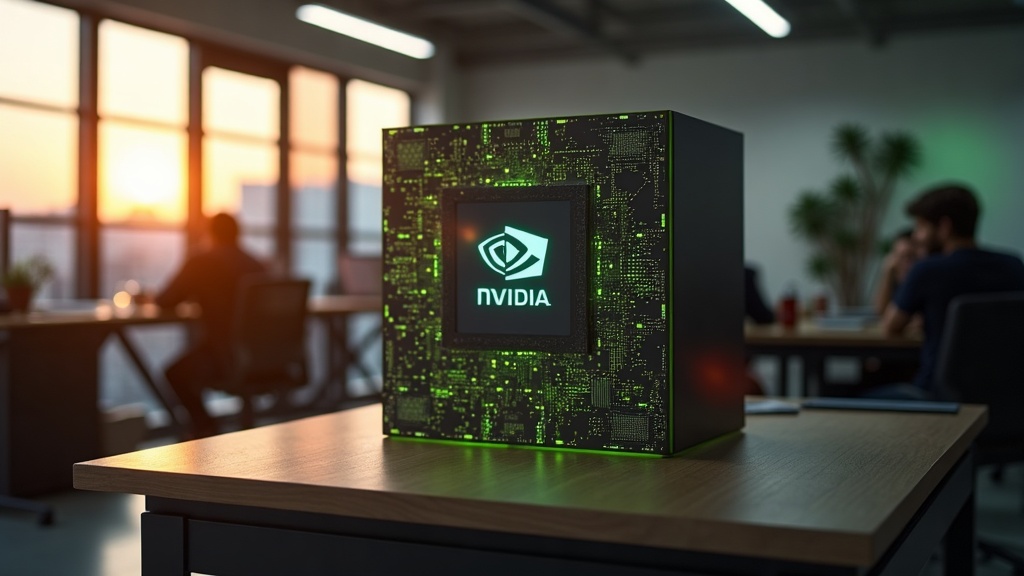
Jensen Huang did not announce a new GPU at Computex this year. He announced a CPU. That single fact tells you more about where the AI buildout is heading than any benchmark chart, because Nvidia spent two decades insisting the CPU was a commodity it was happy to leave to others.
What Actually Happened
Nvidia confirmed that Anthropic, OpenAI, SpaceX, and Oracle Cloud Infrastructure are among the first organizations to receive its new Vera central processing unit. Nvidia's vice president of hyperscale and high-performance computing hand-delivered the first systems to each customer's California facilities, a deliberately theatrical gesture for a product that normally ships on a pallet. Huang named the four customers from the stage in Taipei, framing Vera not as a side project but as a strategic pillar of the company's roadmap through 2027. The choreography mattered as much as the chip: Nvidia wanted the industry to see that the most demanding buyers of compute on the planet had already said yes before the product even reached full production.
Vera is the successor to Grace, the data-center processor Nvidia launched to pair with its Hopper and Blackwell accelerators. The architectural break is the headline. Grace leaned on off-the-shelf Arm Neoverse cores. Vera is built around 88 custom "Olympus" cores that Nvidia designed itself, the company's first fully in-house CPU effort. Full production is scheduled for the third quarter of 2026, with the hand-delivered units functioning as early validation hardware for the labs that consume the most compute on earth. Designing its own core means Nvidia controls the instruction pipeline, the cache hierarchy, and the memory controllers, the levers that decide how fast a CPU can keep a rack of GPUs from sitting idle.
Vera does not ship alone. It is the CPU half of the Vera Rubin platform, Nvidia's named successor to the Grace Blackwell generation, where the Vera processor and Rubin accelerators are designed to operate as one coordinated unit over the company's NVLink fabric. That pairing is the point: Nvidia is no longer selling chips to be assembled by someone else, it is selling a matched CPU-and-GPU complex tuned end to end. The hand-delivery to four named customers, rather than a quiet sampling program, signals that Nvidia wants the market to treat Vera Rubin as the default reference design for frontier data centers, the way Grace Blackwell became the default for the current generation of training clusters. The chip is explicitly positioned for the age of agentic AI: software that plans, calls tools, and executes multi-step tasks rather than returning a single answer.
Why This Matters More Than People Think
For most of its history Nvidia let Intel and AMD fight over the CPU socket while it captured the accelerator. Designing a custom core changes the company's relationship with every hyperscaler at once. When a single vendor supplies the GPU, the CPU, the networking, and the rack design, the customer is no longer assembling components, they are buying a system. That is far stickier revenue, and it is far harder to displace. Vera is less a chip than a moat extension, and the four launch customers represent roughly the largest concentration of frontier compute demand in existence. Nvidia is converting one-time hardware sales into platform relationships that renew for years.
The timing is pointed. Anthropic just locked in a reported $65 billion equity round and a 10-gigawatt compute reservation split across Amazon Trainium and Google TPU, while OpenAI continues to raise tens of billions for infrastructure. Both labs are simultaneously diversifying away from Nvidia GPUs through custom and rival silicon. Nvidia selling them a CPU is a way to keep a foot inside data centers that are actively trying to reduce their Nvidia exposure. Owning the host processor means owning the part of the stack that even a TPU or Trainium cluster still needs, because every accelerator, no matter who makes it, still answers to a general-purpose host that schedules its work and feeds it data.
There is a second-order effect for the rest of the market. Every watt and every dollar a hyperscaler spends on a Vera CPU is a watt and a dollar not spent on an AMD EPYC or Intel Xeon part. Nvidia is not entering a small market. The data-center CPU segment is worth tens of billions annually, and Nvidia just told its biggest customers that the reference design now includes its own processor. That reframes the competitive question from "which accelerator" to "whose entire system," and Nvidia wrote the answer into the blueprint. For AMD and Intel, the danger is not losing a head-to-head benchmark, it is being designed out of the rack before the comparison is ever made.
Consider what this does to Nvidia's own revenue mix. Today the GPU carries the gross margin and the CPU is a pass-through cost Nvidia hands to Intel or AMD. By bringing the host in-house, Nvidia captures margin on a component it previously gave away, and it does so inside deals it has already won. That is the cleanest kind of growth: more dollars per rack from customers who are not going anywhere, with no new sales motion required. A data center that buys 100,000 Rubin GPUs is now a candidate to buy 100,000 Vera CPUs in the same purchase order, and Nvidia booked the relationship years ago.
The Competitive Landscape
The incumbents Vera targets are obvious and formidable. AMD's EPYC line has clawed back serious data-center share on raw core counts and memory bandwidth, and Intel's Xeon 6 generation is pushing core density hard to defend its installed base. But the more revealing competitors are the hyperscalers' own Arm-based chips: Amazon's Graviton, Google's Axion, and Microsoft's Cobalt. Those parts exist precisely so the cloud giants can escape paying margin to a third party for general-purpose compute. Vera asks those same companies to pay Nvidia for a CPU they have been trying to build themselves, which is either a hard sell or a quiet admission that integration beats independence.
That tension is the whole game. Ampere Computing pioneered the high-core-count Arm server CPU and found a market with cloud providers who wanted an alternative to x86. Nvidia is now arriving with deeper pockets, a captive GPU customer base, and the ability to bundle the CPU into a rack the customer already wants. The pitch is integration: a Vera CPU talking to Rubin GPUs over Nvidia's own NVLink fabric should move data faster than any mix-and-match alternative. Performance-per-rack, not performance-per-chip, is the metric Nvidia wants buyers to judge on, because that is the metric where vertical integration wins and where a standalone CPU vendor cannot compete no matter how good its silicon is.
The historical parallel is Apple leaving Intel for its own M-series silicon. Apple controlled the whole device, so a custom CPU let it optimize across the stack in ways a merchant-chip vendor never could, and the performance-per-watt gap that opened was decisive. Nvidia is attempting the same vertical integration one layer up, at rack and data-center scale. If it works, the lesson of the last computing era repeats: the company that owns the system, not the component, captures the durable margin. The difference is that Nvidia's customers are sophisticated enough to build their own chips, which Apple's never were, so the integration advantage has to be large enough to overcome a buyer's instinct to insource.
Hidden Insight: The CPU Is the New Battleground for Agent Economics
The non-obvious story is not that Nvidia built a CPU. It is why agents made the CPU suddenly matter again. A chatbot turn is a short burst of GPU math. An agent doing real work is a long-running process: it holds context across dozens of tool calls, manages memory, parses structured outputs, retries failures, and coordinates sub-tasks. Most of that is serial, branchy, general-purpose code, exactly what a CPU does and a GPU does badly. As the industry pivots from chat to agents, the ratio of CPU work to GPU work in a typical request is climbing, and the host processor stops being a passive feeder and becomes a co-equal partner in the work.
This reframes a cost debate the whole industry is having. Enterprises are alarmed at how token billing balloons when agents re-send context on every step. Part of that bill is GPU inference, but a growing part is the orchestration overhead that runs on the host. A CPU purpose-built to keep GPUs fed and to handle agent control flow efficiently is, in effect, a margin lever on the single fastest-growing line item in enterprise software. Nvidia is selling not just speed but a cheaper cost-per-completed-task, which is the number that actually matters once agents leave the demo stage and start running thousands of concurrent sessions for real customers paying real money.
It also explains the customer list. SpaceX is not a chatbot company, and Oracle is an infrastructure landlord, not a model lab. What unites all four launch customers is that they run sprawling, long-lived, compute-orchestration workloads where the CPU genuinely gates throughput. Nvidia chose validation partners that stress the exact dimension Vera was designed for, then made sure the world knew their names. The marketing is the architecture: the chip's thesis is that agentic compute is host-bound, and the launch customers were picked to prove it in production rather than in a slide deck full of synthetic benchmarks.
The deepest implication is about lock-in physics. Once a lab tunes its agent runtime to Vera's 88 Olympus cores and the NVLink path to Rubin, migrating to a generic x86 host means re-validating the entire pipeline. Nvidia has spent years making CUDA the switching cost for GPUs. Vera extends that switching cost to the CPU, so the host and the accelerator now lock in together. The company is not just selling another chip into the rack, it is making the rack a single indivisible decision, and indivisible decisions are how durable monopolies are built. The customer who standardizes on Vera Rubin is not buying hardware, they are signing a multi-generation architectural commitment.
What to Watch Next
Over the next 30 days, watch for independent confirmation of Vera's core specifications and any early performance figures from the launch customers, especially memory bandwidth and the GPU-to-CPU interconnect throughput. Nvidia's framing leans on system-level gains, so the number to hunt for is performance-per-rack against an EPYC or Xeon host paired with the same GPUs, not raw single-thread CPU benchmarks. Watch too for whether Anthropic or OpenAI publicly attributes any inference cost reduction to the host change, because that is the claim that would turn Vera from a curiosity into a category.
In the 90-day window, the question is Q3 production volume. Nvidia has promised full production in the third quarter, so supply commitments, TSMC capacity allocation, and whether Vera ships in volume or trickles out to favored customers will reveal how seriously Nvidia is contesting the CPU socket versus simply checking a box. Watch the hyperscalers' reaction: if Amazon, Google, and Microsoft accelerate their own Graviton, Axion, and Cobalt roadmaps in response, that signals they read Vera as a genuine threat rather than a niche accessory. A defensive scramble from three trillion-dollar companies would be the loudest possible endorsement of Nvidia's thesis.
However, the bear case is straightforward and worth stating plainly: the hyperscalers building Graviton, Axion, and Cobalt did so specifically to reduce dependence on outside silicon vendors, and critics argue they will never willingly hand the CPU socket back to Nvidia at scale. The risk is that Vera sells well to labs like Anthropic and OpenAI that lack their own chip programs, but stalls at the cloud giants who view in-house silicon as a strategic necessity. Looking 180 days out, the strategic tell is pricing and bundling. If Nvidia discounts Vera to drive Rubin attach rates, it is treating the CPU as a loss-leading moat extension. If it prices Vera at a premium, it believes the agent-economics thesis is strong enough to charge for, and expect AMD and Intel to answer with agent-tuned host processors of their own within the year.
Nvidia spent twenty years saying the CPU was someone else's problem. The moment AI agents made the host processor a bottleneck, it decided the CPU was its problem after all.
Key Takeaways
- Anthropic, OpenAI, SpaceX, and Oracle received the first hand-delivered Vera CPU systems at their California sites
- 88 custom Olympus cores mark Nvidia's first fully in-house CPU, replacing the off-the-shelf Arm Neoverse cores used in Grace
- Full production lands in Q3 2026, with the early units serving as validation hardware for the largest compute buyers on earth
- Vera targets agentic AI workloads, where long-running orchestration and tool routing make the host CPU a genuine throughput bottleneck
- The chip pits Nvidia against AMD EPYC, Intel Xeon, and the hyperscalers' own Arm parts: Amazon Graviton, Google Axion, and Microsoft Cobalt
Questions Worth Asking
- If the host CPU now gates agent throughput, are your AI cost models still measuring the right thing when they track only GPU and token spend?
- What happens to the hyperscalers' multi-year effort to build their own server CPUs if Nvidia can bundle a better one into a rack they already need?
- When the GPU, CPU, network, and rack all come from one vendor, what leverage does any customer have left at renewal time?