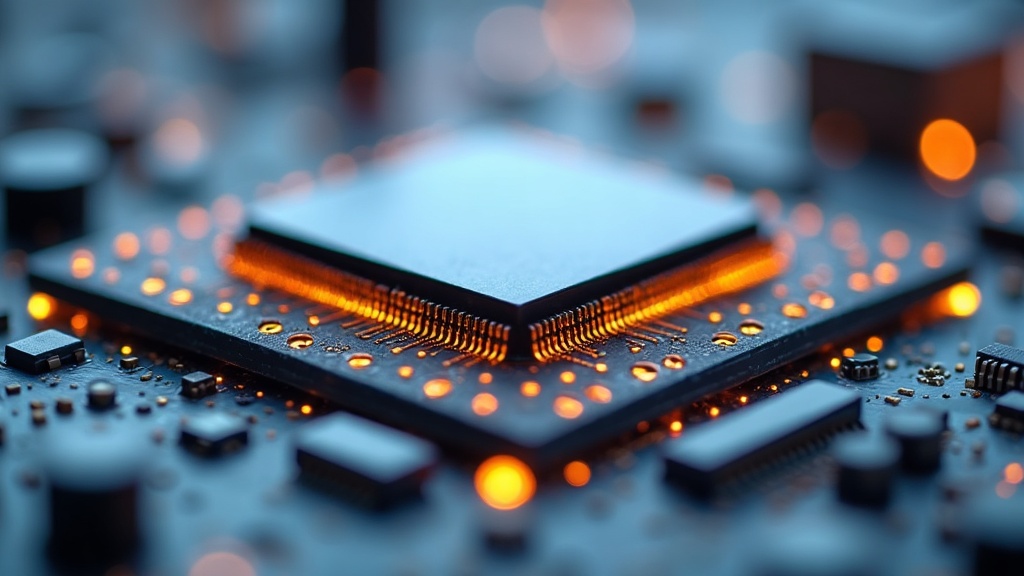
A French startup just raised one of Europe's largest quantum funding rounds, and it did so by betting against almost everyone else in the field. Quobly is not building exotic superconducting loops or trapped ions. It is building qubits out of ordinary silicon transistors, on the same 300mm wafers that already churn out the chips inside laptops and cars. The wager is simple and audacious: the company that industrializes quantum will be the one that refuses to invent a new factory.
What Actually Happened
Quobly closed a 115 million euro Series A on June 3, 2026, one of the largest quantum rounds ever raised by a European company. The round was led by Bpifrance, the French state investment bank, alongside semiconductor security firm SEALSQ and chipmaker STMicroelectronics. Participation came from the European Innovation Council Fund, Blast, ALIAD (Air Liquide Venture Capital), and existing backer Innovacom. The cap table also still includes France's CEA and CNRS research bodies, Quantonation, and Supernova Invest, a roster that reads like a who's who of European deep-tech capital.
The money has a precise destination. Quobly plans to ship its first commercial quantum computer through the cloud by the end of 2026 under a product line it calls Alloy. The debut system, Alloy Pioneer, targets early adopters in high-performance computing and research, accessible over the cloud this year before physical deployment inside HPC infrastructures in 2027. The capital funds three things at once: continued R&D, the industrialization push, and international commercial expansion beyond France. For a field where most players still measure progress in lab milestones, committing to a dated commercial launch is itself a statement of intent.
The technical core is what separates Quobly from the pack. The company builds spin qubits using FD-SOI technology on 300mm wafers, the fully-depleted silicon-on-insulator process that STMicroelectronics already runs at industrial scale. Rather than treating quantum hardware as a laboratory craft, Quobly leans on decades of semiconductor manufacturing maturity to attack the three problems that have strangled every quantum roadmap: scalability, yield, and reproducibility. STMicroelectronics is both an investor and a manufacturing partner, which means the qubits and the production line share a roof. That vertical alignment is rare in quantum, where most startups must beg for foundry time on lines that were never designed for them.
Why This Matters More Than People Think
Quantum computing has a dirty secret: the demos are real, but the manufacturing is not. IBM, Google, and IonQ have all shown working processors with dozens to hundreds of qubits, yet none of them can stamp out chips the way a fab stamps out CPUs. Every superconducting processor is closer to a hand-built prototype than a product. Quobly's bet is that the decisive advantage in quantum will not come from the cleverest physics but from the boring discipline of high-volume semiconductor production, where defect rates are measured in parts per billion and yield curves are a religion.
That framing changes who the real competitors are. If quantum becomes a manufacturing problem, then the companies with fabs win, and France happens to host one of the few European players with a credible 300mm FD-SOI line in STMicroelectronics. The 115 million euros is not just runway. It is a signal that European industrial policy has decided quantum is a sovereignty issue, the same way chips and AI compute became sovereignty issues over the past three years. Bpifrance leading the round is the tell: this is state capital choosing a national champion and willing to underwrite the long, unglamorous work of turning a physics result into a production process.
There is a second-order effect that the headlines miss. Silicon spin qubits are physically tiny, far smaller than superconducting qubits that need macroscopic resonators and dilution refrigerators the size of wardrobes. If Quobly can pack qubits at transistor density, the path to the millions of physical qubits required for fault-tolerant, error-corrected computation looks less like science fiction and more like a die-shrink roadmap. That is the entire argument for silicon: it is the only qubit substrate with a believable story for getting from thousands to millions without rebuilding the universe.
Consider the economics that follow from that density. A superconducting quantum computer today costs millions of dollars per machine, dominated by the cryogenic plumbing and the custom control electronics wired individually to every qubit. A silicon spin processor that rides standard CMOS could, in principle, integrate its control circuitry on the same die, collapsing the wiring bottleneck that makes superconducting systems balloon in cost as they scale. If Quobly delivers on co-integrated control, the marginal cost of adding qubits falls toward the marginal cost of adding transistors, which is effectively nothing. That cost curve, not any single benchmark, is the real prize the 115 million euros is chasing, and it is the one number that incumbents built on bespoke hardware cannot easily match.
The Competitive Landscape
The quantum field is fragmented across modalities, and each camp has a champion. IBM and Google ride superconducting qubits, the most mature approach by qubit count but the hardest to manufacture at density. IonQ and Quantinuum bet on trapped ions, which boast superb coherence but slow gate speeds and brutal scaling challenges. PsiQuantum chases photonic qubits with a billion-dollar war chest. Against all of them, the silicon spin-qubit camp, which includes Intel's quantum group and Australia's Diraq, argues that compatibility with existing CMOS fabs is the only thing that will ever matter at scale.
The historical parallel is the early integrated circuit. In the 1960s, several transistor technologies competed, and the winner was not the one with the best individual device but the one that fit cleanest into planar silicon manufacturing: the process that could be photolithographed, batched, and yielded reliably. Germanium was faster in a lab. Silicon won the planet because it could be made by the billion. Quobly is making the same argument one technological era later, and the involvement of STMicroelectronics gives it a manufacturing partner that most quantum startups can only dream of.
The competitive risk, however, is that silicon spin qubits remain behind on raw qubit count today. Quobly's first commercial system will likely ship with a modest number of qubits compared to the headline figures IBM and Google publish. Critics argue that manufacturability means little if the device is still years from useful scale, and that the superconducting incumbents will have crossed key error-correction thresholds before silicon catches up. The bear case is that Quobly wins the factory and loses the race, arriving with a beautifully manufacturable chip in a market that has already standardized on someone else's physics.
Yet the counterweight to that bear case is the history of the semiconductor industry itself, which has repeatedly punished elegant designs that could not be manufactured cheaply. Bipolar logic was faster than CMOS for years, and CMOS still buried it once power and density mattered at volume. Quobly is wagering that the same dynamic plays out in quantum: the approach that integrates with the existing trillion-dollar fab ecosystem inherits its cost curves, its talent pool, and its supply chain, while exotic modalities must build all three from scratch. STMicroelectronics ships billions of FD-SOI chips a year for automotive and IoT, and every one of those wafers is a rehearsal for the quantum line.
Hidden Insight: Quantum Is Becoming an Industrial Policy, Not a Science Project
The most revealing detail in this round is who is not in it: no Silicon Valley megafund, no US strategic. The lead investors are a French state bank, a French-Italian chipmaker, and a European sovereign innovation fund. This is Europe deciding that it cannot afford to lose quantum the way it lost the consumer internet and very nearly lost frontier AI. The 115 million euros is the financial expression of a political conviction that the continent's semiconductor base, anchored by STMicroelectronics and the CEA-Leti research institute, is a strategic asset to be defended and compounded.
This reframes the timeline question entirely. When a startup is venture-funded, it lives or dies on a 24-month runway and an exit. When a startup is backed by a national champion's strategic capital, it can play a 10-year game, because the patient money behind it cares about industrial capability as much as financial return. Quobly's roadmap, cloud access in 2026 and HPC deployment in 2027, is aggressive precisely because it does not have to satisfy a financial-only investor's impatience. The state wants a working sovereign quantum stack, and it is willing to wait for the yield curves to mature.
The capital structure also tells you something about risk appetite. A 115 million euro Series A is large enough to fund a multi-year industrialization effort but small enough that the investors clearly expect tangible hardware milestones, not an open-ended science grant. Bpifrance and STMicroelectronics are not patient out of charity; they are patient because they believe the manufacturing risk is lower than the market assumes, given that the underlying FD-SOI process is already qualified and shipping. That is a fundamentally different risk profile from a startup inventing both a new qubit and a new fab at the same time.
There is a deeper structural insight here about the convergence of AI and quantum. The AI boom has made compute the world's most contested resource, and every government now treats fabs as critical infrastructure. Quantum rides that same wave: it is fundamentally a compute story, and compute has become geopolitics. Quobly benefits from a tailwind that pure-quantum startups of five years ago never had, because the entire policy apparatus that was built to secure AI chips now extends naturally to quantum chips made on the very same wafers. The continent that learned hard lessons about depending on foreign silicon is determined not to repeat them in the next computing paradigm.
The uncomfortable truth this story exposes is that quantum's winners may be decided by industrial capacity rather than scientific breakthrough, and most of the scientific establishment hates that idea. Physicists want the best qubit to win. Manufacturing reality suggests the most yieldable qubit will win, and those are rarely the same thing. Quobly is a pure expression of the manufacturing thesis, and if it succeeds it will validate a deeply unromantic view: that the quantum era arrives not through a Nobel-worthy discovery but through a yield engineer hitting a target on a 300mm line in Crolles, France. The romance of quantum supremacy gives way to the spreadsheet of quantum manufacturability, and the spreadsheet usually wins in the end.
What to Watch Next
In the next 30 days, watch for Quobly to publish concrete specifications for Alloy Pioneer: how many physical qubits, what coherence times, and which cloud platform hosts the access. Vague roadmaps are cheap in quantum; a dated spec sheet with real numbers is the only signal that matters. Also watch whether STMicroelectronics commits public fab capacity, because a manufacturing partnership that stays on a slide deck is worth far less than allocated wafer starts on an industrial line.
Over the next 90 to 180 days, the leading indicators are benchmark disclosures and customer names. If Quobly can publish a credible two-qubit gate fidelity above 99 percent on a manufactured device, that crosses the threshold where error correction becomes plausible and the silicon thesis gains hard evidence. Watch the HPC centers: a named European supercomputing site committing to a 2027 Alloy deployment would convert the roadmap from aspiration to procurement. Conversely, any slip of the 2026 cloud launch into 2027 would be the first crack in the industrialization narrative.
One more indicator deserves attention over the next year: hiring. Industrializing a quantum process demands process engineers, yield specialists, and packaging experts, the unglamorous semiconductor disciplines that pure-physics labs rarely employ. If Quobly's job listings tilt toward fab operations rather than toward more PhDs, that is the clearest possible evidence the company believes its science is settled and the remaining problem is production. Watch the org chart as closely as the spec sheet, because in this thesis the factory is the product.
The mental model for evaluating Quobly is straightforward. If quantum is ultimately a physics race, the superconducting incumbents probably win and Quobly is a niche player. If quantum is ultimately a manufacturing race, Quobly is positioned better than almost anyone outside Intel. The next 18 months will reveal which race we are actually running, and the 115 million euros just bought Quobly a front-row seat to find out, with a national government holding the ticket and a working fab next door.
The quantum era will not be won by the cleverest physics. It will be won by whoever can make a qubit by the billion, and Quobly just bet 115 million euros that the answer is plain silicon.
Key Takeaways
- 115 million euro Series A makes Quobly one of the largest European quantum rounds, led by Bpifrance, SEALSQ, and STMicroelectronics.
- FD-SOI on 300mm wafers lets Quobly build spin qubits on existing semiconductor lines instead of bespoke quantum fabs.
- Alloy Pioneer ships via cloud by end of 2026, with physical deployment inside HPC infrastructure targeted for 2027.
- State and strategic capital dominate the round, signaling that Europe now treats quantum as a sovereignty issue like AI chips.
- The bet is manufacturing, not physics: silicon spin qubits trail on count today but offer the cleanest path to millions of qubits.
Questions Worth Asking
- If quantum becomes a manufacturing problem rather than a physics problem, do today's superconducting leaders lose their advantage entirely?
- What happens to venture-funded quantum startups when state-backed national champions can play a patient 10-year game they cannot match?
- Are you evaluating quantum companies by their qubit count when you should be evaluating them by their yield curve?