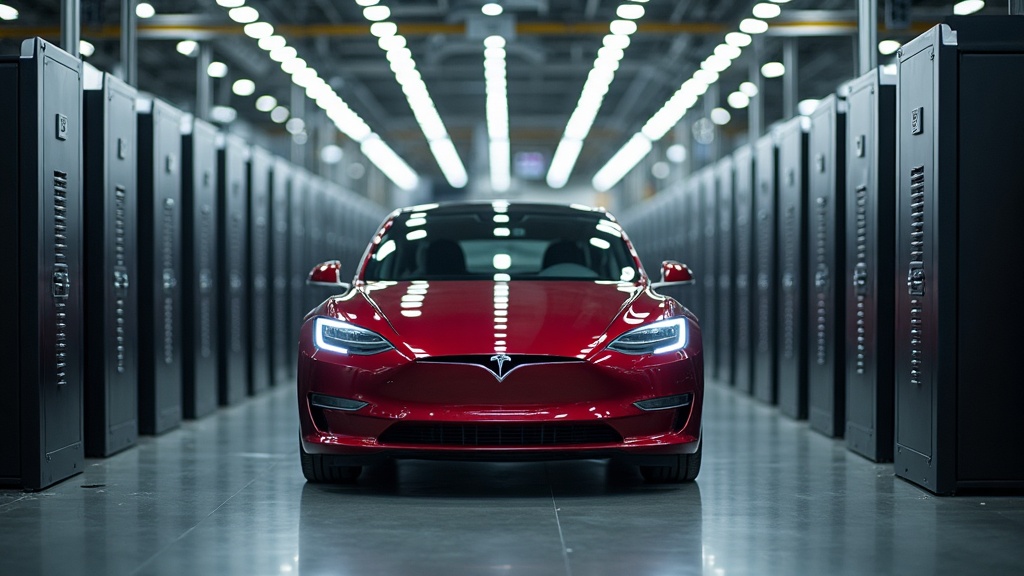
Tesla stopped making the Model S last month at Fremont. The assembly line that built the car which proved electric vehicles could be desirable, not just practical, is now being retooled to produce something the company believes will be more consequential: the Optimus Gen 3 humanoid robot. This conversion, confirmed in June 2026 filings and public statements, isn't just a factory story. It's the moment Tesla formally commits its most important manufacturing asset to the bet that the next decade of growth comes from robots, not cars.
What Actually Happened
According to reporting from TechTimes and a Tesla earnings exhibit filed with the U.S. Securities and Exchange Commission, Tesla ended Model S and Model X production at its Fremont, California facility in early May 2026, completing a transition that had been signaled in executive communications since late 2025. The last Model S rolled off the line after more than a decade of production, closing a chapter in EV history that began when the car won Motor Trend's Car of the Year in 2013. Simultaneously, Tesla began converting the vacated factory floor for Optimus Gen 3 manufacturing. Elon Musk confirmed in a public statement that full Optimus Gen 3 production at Fremont is targeted for late July or August 2026, though he added that the production rate would be "literally impossible to predict" in this initial ramp phase. What is certain is that the world's most celebrated electric vehicle factory is now being reconfigured as a humanoid robot factory.
The scale of what Tesla is attempting is captured in one number: 10,000 unique parts. That is the component count for the Optimus Gen 3, which Musk has described as an entirely new manufacturing challenge compared to any vehicle Tesla has built. A Model 3 contains roughly 10,000 parts that Tesla has spent more than a decade learning to source, manufacture, and assemble at scale with extraordinary efficiency. Optimus Gen 3 presents those same 10,000 parts, but across a production line with new supplier relationships, new mechanical tolerances, and complex integration requirements for the sensors, actuators, force-torque feedback systems, and onboard compute modules that make a humanoid robot function in an unstructured environment. According to Electrek, Tesla's internal communications indicate that initial production volumes through the end of 2026 will focus primarily on internal testing, with units deployed inside Tesla's own factories to continue building the training dataset for the Optimus neural network rather than generating immediate commercial revenue.
Tesla's stated ambition is to reach a manufacturing capacity of up to one million robots per year at Fremont, with the Giga Texas facility eventually scaling toward ten million units annually. Those numbers are long-range aspirational targets, not near-term commitments. For 2026, the realistic expectation based on Musk's own framing is tens to hundreds of units produced at Fremont, with the primary operational goal of validating that the manufacturing process works at all before scaling. Tesla has never produced a consumer product with this degree of integrated electromechanical complexity. A car is designed to be operated by a human seated inside, with fixed joints and a single axis of locomotion. A humanoid robot must balance dynamically, navigate autonomously, perceive its environment in three dimensions, and perform dexterous manipulation, all while managing its own power, thermal output, and compute resources within a body designed to fit human-scale spaces. The manufacturing philosophy differs from automotive production in ways that Tesla is discovering in real time on the Fremont floor.
Why This Matters More Than People Think
The conversion of the Model S line is symbolically and strategically more important than any standard factory news. The Model S was the product that proved Tesla could build a premium automobile that people would pay a premium for, and its sustained production at Fremont was the backbone of Tesla's credibility as a real automaker. Its retirement in favor of a humanoid robot line isn't merely a product discontinuation. It is a declaration of what Tesla believes the next premium product category will be. Elon Musk has said publicly and repeatedly that Optimus will ultimately become Tesla's most valuable product by revenue and market impact. The factory conversion is the first tangible, irreversible physical commitment to that thesis. Every square foot of Fremont that shifts from car production to robot production is a bet that robotics margins will eventually exceed automotive margins, and that bet is now on the factory floor in California.
This also matters for the broader humanoid robot industry in ways that go beyond Tesla's own market position. No manufacturer in the world has previously attempted to scale humanoid robot production using automotive-scale assembly infrastructure. The processes Tesla develops for managing a 10,000-part robotic assembly at Fremont will generate manufacturing knowledge that doesn't yet exist anywhere in the industry. If Tesla achieves consistent production of Optimus Gen 3 at even 10,000 units per quarter by end of 2027, the cost curve for humanoid robots will drop faster than any current analyst projection. Automotive production efficiency, combined with the machine learning feedback loop that Tesla already uses to improve its FSD system, could achieve the same kind of rapid cost compression that made the Model 3 affordable within three years of its initial launch at a premium price. The humanoid robot market doesn't yet have a mass-market cost point. Tesla is attempting to create one.
The bear case, however, is clear and worth confronting directly. Converting an automotive production line for humanoid robots assumes that automotive manufacturing expertise transfers to robotics production, and the assumption is not guaranteed. Automotive production is optimized for low variance at high volume: every Model 3 must be functionally identical to every other, and decades of lean manufacturing have been applied to achieve that repeatability. Humanoid robots, by contrast, require ongoing software calibration after physical assembly, because the product's performance depends on its AI model and firmware as much as its hardware. Critics in the manufacturing industry argue that car factories, however advanced, were designed around different tolerances and different assembly sequences than robotics requires, and that purpose-built facilities like Figure AI's BotQ factory in San Jose are fundamentally better suited to the task. Whether the Fremont conversion produces a world-class robot factory or a compromised hybrid is the central manufacturing question of the next 18 months.
The Competitive Landscape
Tesla enters this production ramp competing against Figure AI, Unitree Robotics, NEURA Robotics, and Boston Dynamics, each approaching the humanoid robot market with different manufacturing philosophies and timelines. Figure AI's BotQ facility in San Jose was designed from the ground up for robot production and is currently producing at a rate of approximately one Figure 03 per hour, translating to roughly 8,700 robots per year at sustained capacity. That gives Figure a meaningful head start on production experience while Tesla is still setting up its Fremont line. Figure has also secured commercial partnerships with BMW and Microsoft, which create early deployment revenue and real-world training data that Tesla will not have in 2026. The competition in 2026 is less about direct sales and more about which company accumulates the most real-world robot-hours, since that data drives model improvements which drive the capability and unit economics of the next generation.
Unitree Robotics shipped 5,500 units in 2025 and is targeting 20,000 units in 2026, nearly four times its prior-year output. Unitree operates at the lower end of the price range, with its consumer-facing G1 robot available at approximately $17,990. Tesla has not disclosed Optimus pricing, but units produced in 2026 are expected either to be retained internally for training or to be sold at a substantial premium well above Unitree's consumer pricing. NEURA Robotics, the German startup that raised $1.4 billion in a Series C in June 2026 backed by Nvidia, Amazon, Tether, and Qualcomm, represents the European challenger with a manufacturing strategy that emphasizes co-designed software stacks for industrial environments. Against this competitive backdrop, Tesla's principal advantage is not capital (Figure, Unitree, and NEURA are all well-funded) but the scale of Tesla's existing manufacturing expertise and the feedback loop between deployed Optimus units and the Tesla AI training infrastructure that already runs FSD at global scale.
A historical parallel worth considering is Ford's conversion of its Rouge River plant from consumer vehicle production to B-24 Liberator bomber manufacturing during World War II. Ford completed a conversion of equivalent complexity in months and ultimately produced bombers that rivaled or exceeded the output of dedicated aircraft facilities. The operational discipline of mass-market automotive production, when fully mobilized around a new manufacturing challenge, can compress timelines that purpose-built competitors assumed were years long. Whether Tesla can replicate that pattern for an era-defining new product class is the central strategic question for the entire humanoid robot industry over the next three years, because a Tesla Fremont that reaches 100,000 units per year would change the cost structure and adoption trajectory of the entire sector, not just Tesla's own market share.
Hidden Insight: The Software Loop No One Is Tracking
The most important aspect of the Optimus Gen 3 production ramp isn't the number of units Tesla will ship in 2026. It's what Tesla learns while shipping them. Every Optimus unit deployed inside Tesla's own Fremont and Austin facilities generates video, sensor, and outcome data that feeds back into the Optimus neural network training process. This closed-loop system is Tesla's genuine competitive advantage over every other humanoid robot company. Figure, Unitree, and NEURA train their robots on collected datasets and simulated environments. Tesla trains its robots on real factory floors where the robots are doing real work, and the scale of that real-world data collection grows with every unit Tesla deploys. By mid-2027, Tesla may have the most capable robot AI not because its research team is larger, but because its deployed robot-hours generate more training signal than any competitor's data collection program.
The software story also gets systematically underreported in coverage of the Optimus production ramp. Tesla's Dojo supercomputer cluster and its full-stack AI training infrastructure represent a multi-billion dollar capital investment originally built to train the Full Self-Driving neural network. That infrastructure is directly applicable to robot intelligence training. When Anthropic, Google, or a startup wants to train a robot foundation model, they need to partner with hardware providers or license training data. Tesla generates its own robot training data from its own deployed robots on its own factory floors, trained on its own silicon. This vertical integration, from factory floor to training cluster to robot deployment, is worth more than any single financing deal because it compounds: more data means better models, which means more capable robots, which means more valuable deployments, which generates more training data.
There is also a non-obvious energy and infrastructure story embedded in the Optimus ramp. Each deployed Optimus Gen 3 unit is a mobile compute and sensing system with meaningful power consumption. For Tesla, which also manufactures Megapack grid-scale batteries and sells solar roof and solar panel systems, there is a coherent path toward selling integrated robotics-plus-energy packages to industrial clients. A facility that deploys 100 Optimus units for warehouse or manufacturing operations could also purchase the Megapack and solar infrastructure to power those robots at lower cost than grid electricity in high-rate markets. Tesla has never explicitly connected these product lines in its public roadmap, but the operational logic is compelling, and the Fremont production ramp will generate the real-world energy consumption data needed to build that package.
The least-discussed constraint on the Optimus commercial ramp is not Tesla's manufacturing capability at all. It's regulatory. Humanoid robots deployed in commercial settings in the United States are subject to OSHA regulations governing collaborative robots in shared workspaces, and humanoid robots operating autonomously around human workers in unstructured environments present novel challenges that OSHA's existing collaborative robot guidance was not written to address. The first commercial deployment of Optimus Gen 3 outside Tesla's own controlled facilities will trigger a level of regulatory scrutiny that Tesla's internal deployments do not face. This regulatory friction delayed autonomous vehicle commercial deployment by years beyond what technical readiness would have supported, and it will impose a similar friction on commercial humanoid robot scaling in 2026 and 2027. The regulatory timeline is the variable that Tesla's manufacturing ramp cannot control.
What to Watch Next
The clearest near-term signal to watch is whether Tesla publicly confirms Fremont production start in late July or early August 2026. If Elon Musk posts footage of an Optimus Gen 3 on the converted Fremont production line in July, the manufacturing timeline is tracking as announced. If that milestone slips to September or beyond, it indicates the factory conversion is running behind the stated schedule. A delay of more than 60 days from the August target should be interpreted as a meaningful operational signal: either the component supply chain for 10,000 unique parts is underperforming, or the manufacturing process validation is taking longer than planned. In either case, investors and analysts will need to revise their expectations for when Tesla might announce commercial Optimus deployments outside its own facilities.
Over the next 90 days, the most important moment will be Tesla's Q2 2026 earnings call in July. This will be the first earnings call where Tesla is operationally compelled to discuss Optimus Gen 3 production as a manufacturing metric rather than a future roadmap item. Analysts will ask for a production number. If Tesla provides even a small number, say 50 or 100 units, it confirms the ramp is real and operational. If Tesla declines to provide a number and cites the "literally impossible to predict" framing, it signals the ramp is still in its validation phase. Compare any production figure Tesla provides against Figure AI's BotQ throughput rate, which Figure reports quarterly and which provides the only published comparable in the commercial humanoid robot category.
At the 180-day horizon, the defining question is whether any Optimus Gen 3 unit has been commercially sold or leased to a customer outside Tesla's own facilities by the end of 2026. Tesla's stated long-term intent is to sell commercial units. No commercial pricing or external delivery commitments have been announced. If a corporate customer in automotive, logistics, or retail announces an Optimus deployment by December 2026, the commercial timeline compresses materially. If by December 2026 all Optimus Gen 3 units remain in Tesla's internal factory deployments, the commercial ramp realistically begins in 2027, giving Figure AI, Unitree, and NEURA Robotics another full year to deepen market presence and accumulate the deployment data that will be the decisive moat in the humanoid robot market.
The factory that built the car that changed transportation is now being converted to build the machine that may change labor itself.
Key Takeaways
- Tesla ended Model S and Model X production at Fremont in May 2026, converting the assembly line to manufacture Optimus Gen 3 humanoid robots with a production start targeting late July or August 2026
- Optimus Gen 3 contains 10,000 unique parts, the same count as a typical Tesla vehicle but with entirely new supplier relationships, tolerances, and assembly requirements for sensors, actuators, and onboard AI compute
- Elon Musk called the production rate "literally impossible to predict" for the initial ramp, with 2026 output expected to focus on internal testing rather than commercial distribution
- Tesla's long-term capacity targets are 1 million robots per year at Fremont and up to 10 million annually at Giga Texas, with those milestones realistically years away from today's initial ramp
- Figure AI currently produces at roughly 1 robot per hour at BotQ, while Unitree targets 20,000 units in 2026, giving both companies a production data head start over Tesla's Fremont ramp
Questions Worth Asking
- If Tesla's automotive manufacturing expertise does not transfer cleanly to humanoid robot production, how long will it take KPMG, logistics firms, and other potential Optimus clients to learn that, and what does that delay cost Tesla in the race against Figure AI and Unitree?
- Tesla's real advantage may be the closed-loop training data from deployed robots feeding back into Dojo. If that loop proves decisive, does Optimus Gen 3 production volume matter less than Optimus deployment diversity across different factory environments?
- At what production cost and unit price does the Optimus Gen 3 become cheaper per labor-hour than a warehouse worker in the United States, and what happens to Tesla's product roadmap and factory staffing when it hits that threshold?