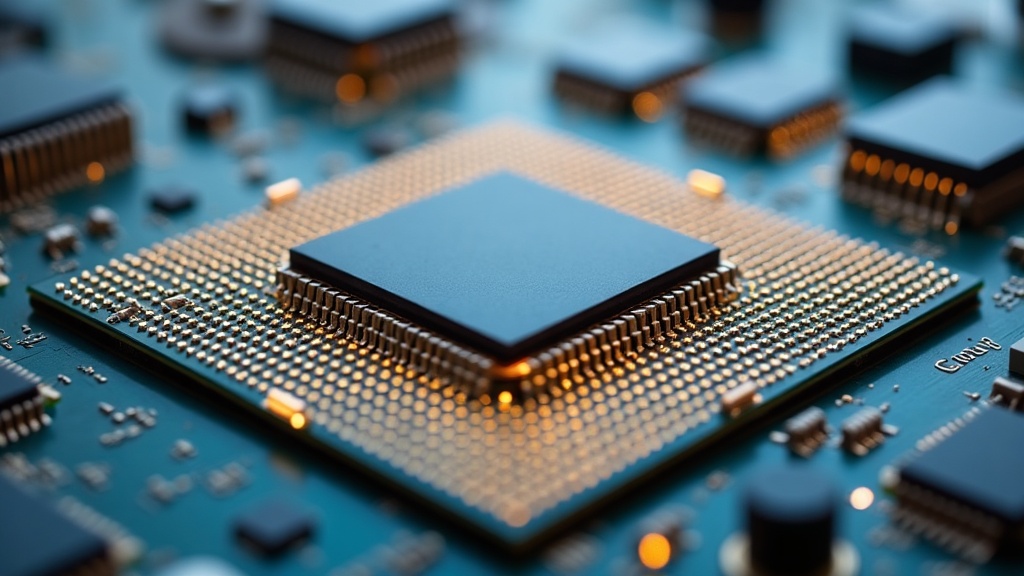
A humanoid robot company most Western investors have never heard of just made a move that Tesla, Figure, and Nvidia have all been circling for a year. UBTECH, the Shenzhen-listed maker of industrial humanoids, quietly registered a chip company in Wuxi with GPU designer MetaX and components supplier Zhejiang Fenglong Electric. The bet is simple and aggressive: own the silicon brain inside the robot, not just the body around it.
What Actually Happened
UBTECH established a joint venture named Xixuan Chuangzhi Technology in Wuxi with an initial registered capital of 100 million yuan, roughly $14 million. Its two partners bring complementary pieces: MetaX is one of China's most advanced domestic graphics-processor developers, and Zhejiang Fenglong Electric supplies the discrete components and power electronics that physical machines depend on. The stated scope of the new company spans integrated circuit design, robotics research, and AI algorithm software, a vertical stack that runs from transistor layout up to the control policies a humanoid uses to walk and grasp.
The technical target is what the industry calls embodied intelligence: edge processors engineered to run heavy AI workloads directly inside a robot rather than streaming them to a data center. Latency is the whole game here. A humanoid catching a falling object or correcting its balance cannot wait 80 milliseconds for a round trip to the cloud, so the compute has to live on the chassis. UBTECH already ships hardware in volume, with FY2025 revenue up 53.3% to 2.01 billion yuan, and its full-size humanoid segment alone jumped from 35.6 million yuan to 821 million yuan on 1,079 units shipped.
The timing is not coincidental. UBTECH has publicly committed to an annual production capacity of 10,000 industrial humanoids by the end of 2026, with an initial 5,000-unit run already earmarked against orders worth more than 800 million yuan. At that scale, buying merchant silicon from an outside vendor for every unit becomes both a cost line and a supply risk. A captive chip venture is how UBTECH proposes to protect its margins and its roadmap at the exact moment it tries to industrialize.
Why This Matters More Than People Think
Most coverage of humanoid robots fixates on the hardware that is easy to photograph: the hands, the gait, the backflips. The real constraint is the compute and the power budget it consumes. A humanoid that has to run perception, planning, and a vision-language-action model on-device is essentially a walking inference server with a 90-minute battery. Whoever controls that edge chip controls the unit economics of the entire category, because the processor dictates how much intelligence you can afford to ship per robot per watt. Get that wrong and every other engineering win is wiped out by the bill of materials.
UBTECH's vertical move signals that the humanoid race is entering its margin phase. The first phase was about whether a robot could stand up and do a useful task at all. The second phase, the one starting now, is about whether you can build 10,000 of them at a price a factory will actually pay. Vertical integration of the chip is a classic playbook for that transition, and it is the same logic that pushed Apple to design its own silicon and Tesla to build the Dojo and FSD chips rather than rent them from someone whose roadmap they could not control.
There is a sovereignty layer too. MetaX exists in large part because US export controls have throttled Chinese access to Nvidia's most capable parts. By pairing a domestic GPU designer with a humanoid maker chasing 10,000 units, Beijing's broader industrial policy gets a flagship demonstration: a Chinese robot, running Chinese edge silicon, built for Chinese factories. That makes Xixuan Chuangzhi less a startup and more a node in a national supply chain that is deliberately designing around American chokepoints, and it gives domestic chip designers a guaranteed first customer at meaningful volume.
Consider the math that rarely makes the headlines. If an edge chip draws even 15 watts less while delivering the same inference throughput, that difference cascades into a smaller battery, a lighter frame, longer uptime between charges, and a cheaper thermal system, each of which lowers the landed cost of the robot. Across 10,000 units a year, single-digit dollar savings per board compound into millions, and the energy profile decides whether a humanoid can work an eight-hour factory shift or taps out after lunch. By designing the chip against its own robots, UBTECH can co-optimize silicon, power, and mechanical design together instead of accepting whatever envelope a merchant vendor happens to ship. It is the unglamorous arithmetic of watts and grams, but it is the arithmetic that decides which humanoid company is still standing in 2028.
The Competitive Landscape
The obvious comparison is Qualcomm, which launched its Dragonwing line of humanoid-specific processors and is working with Figure AI and Neura Robotics to define the next compute architecture, while Infineon, NXP, STMicroelectronics, and Texas Instruments all formalize humanoid product lines. Nvidia sits at the top of the stack with Jetson Thor and its GR00T models, and it recently picked Unitree's H2 humanoid as the reference body for the system it sells to research labs. Against that field, UBTECH is choosing not to be a customer of any of them, which is either bold or reckless depending on how good its chip turns out to be.
That choice splits the market into two philosophies. Figure, Apptronik, and most US players are buying merchant silicon and concentrating their effort on the AI brain and the dexterity. UBTECH, like Tesla, is betting that owning the chip is the durable advantage once volumes climb. The historical parallel is the early electric-vehicle industry, where some makers bought battery cells from Panasonic or CATL while others, eventually, pulled cell design in-house to control the single most expensive and supply-constrained component. The robots that win on cost will likely be the ones that controlled their scarcest input early rather than late.
Domestically, UBTECH's sharpest rival is Unitree, which is racing toward a Shanghai IPO and undercutting everyone on price. Unitree's leverage is cost and speed; UBTECH's answer is depth and integration. By locking in a chip venture now, UBTECH is trying to convert its larger installed base and enterprise relationships into a structural moat before Unitree's public-market war chest lets it buy its way into the same vertical. The next twelve months will test whether integration beats raw price in a market that has almost no repeat buyers yet and almost no agreed standards for what a humanoid should even cost.
History suggests the integrated approach wins only when volume is real and the component is both scarce and improving fast, which is exactly the bet here. When Tesla pulled its FSD chip in-house in 2019, critics called it hubris; within three years it was a structural cost and performance edge that legacy automakers buying from suppliers could not match. The opposite cautionary tale is the long graveyard of phone makers who tried to design their own chips, failed, and reverted to Qualcomm at a humbling premium. UBTECH is wagering that humanoid silicon in 2026 looks more like Tesla's moment than like those failures, because the category is young enough that a focused team can still matter and the parts are nowhere near commoditized.
Hidden Insight: The Robot Is Just a Distribution Channel for Chips
The non-obvious read is that UBTECH may care as much about the chip as about the robot. An embodied edge processor that works inside a humanoid is, with modest changes, the same class of part that drones, autonomous forklifts, surgical robots, and smart cameras all need. If Xixuan Chuangzhi produces a competitive low-power inference chip, UBTECH suddenly has a silicon product line whose addressable market dwarfs its own robot sales. The humanoid becomes the proving ground and the first customer, but the chip is the asset that could outlast any single product line and any single hype cycle.
This reframes the 100 million yuan registered capital. That figure is small for a fabless chip effort, which tells you the venture is leaning on MetaX's existing GPU IP and tooling rather than starting from a blank wafer. The real investment is the design talent and the validation loop that running silicon inside thousands of shipping robots provides. Field data from 1,079 deployed full-size units, and soon thousands more, is a feedback advantage that a pure chip startup with no robots could never match. UBTECH is buying a data flywheel disguised as a chip JV, and the flywheel is the part that compounds.
There is also a talent dimension that the registered capital understates. China graduates more chip-design engineers than it can employ at leading-edge nodes, because the most advanced fabs remain off-limits under export rules. An embodied edge processor does not need a bleeding-edge node to be competitive, which means UBTECH and MetaX can recruit strong silicon talent into a domain where Chinese teams can actually ship, rather than waiting for fab access they may never get. That makes Xixuan Chuangzhi a magnet for engineers who want to build real products, and a workforce advantage in a sector where the binding constraint is increasingly people, not capital. Over time, that recruiting edge may matter more than the chip's first revision, because the second and third silicon generations are where embodied compute will actually be won.
There is a deeper strategic signal about where embodied AI value will concentrate. In the smartphone era, the platform owners who captured the most value were the ones who controlled the system-on-chip and the operating system together. The emerging humanoid stack has the same shape: a body, an edge chip, and a control model. The companies trying to own at least two of those three layers, UBTECH and Tesla most visibly, are positioning to be platform owners rather than parts assemblers. The ones buying all three from vendors risk becoming the Dell of robots, profitable for a while but commoditized and squeezed the moment volume arrives.
The counter-perspective deserves real weight, however. Vertical integration into custom silicon has killed more companies than it has crowned. Designing a competitive edge AI chip is brutally hard, and a 100 million yuan venture is a rounding error next to the billions Nvidia and Qualcomm pour into their robotics roadmaps each year. The risk is that UBTECH ends up with a mediocre in-house chip that is worse than what it could have bought, dragging down its robots precisely when it needs them to be excellent. Skeptics point out that UBTECH is still loss-making at the corporate level, and a moonshot silicon bet during an industrialization crunch can starve the core business of capital. Owning your worst component is not an advantage, it is a liability with a logo on it.
What to Watch Next
In the next 30 days, watch for the formal product scope of Xixuan Chuangzhi and any disclosed tape-out timeline. A venture that names a target process node and a sample date is serious; one that stays vague is a hedge. Also watch whether MetaX commits engineers and IP versus simply lending its name, because the difference determines whether this is a real chip program or a press release dressed as one. The registered-capital number will likely grow if the partners are serious.
Over 90 days, the number that matters is UBTECH's progress against its 10,000-unit 2026 capacity goal and whether early industrial robots ship with third-party silicon while the JV chip is still in development. A staged transition, merchant chips now and captive chips later, would be the rational path and a sign of discipline rather than ideology. Watch the gross-margin line in UBTECH's interim results for any evidence that vertical integration is starting to bend the cost curve in the right direction.
On a 180-day horizon, the real test is whether any robot maker outside UBTECH adopts the Xixuan Chuangzhi chip, because external design wins would prove the silicon has standalone value rather than being a captive part propping up one customer. Track Unitree's post-IPO capital allocation for a competing vertical move, and watch US export-control headlines, since any tightening that further restricts Nvidia in China will hand domestic edge-AI silicon a larger captive market overnight and validate UBTECH's timing in hindsight.
The company that owns the chip inside the humanoid will own the economics of the humanoid, and UBTECH just decided it would rather build that chip than buy it.
Key Takeaways
- 100 million yuan JV UBTECH formed Xixuan Chuangzhi in Wuxi with MetaX and Zhejiang Fenglong to design embodied edge chips.
- 10,000 units by end of 2026 the chip venture is timed to UBTECH's industrialization target, with 5,000 units against 800M yuan in orders.
- FY2025 revenue up 53.3% to 2.01B yuan full-size humanoid sales alone hit 821M yuan on 1,079 units shipped.
- Latency drives the design embodied edge silicon runs perception and control on-device because cloud round trips are too slow for balance and grasping.
- Sovereignty angle pairing domestic GPU maker MetaX with a humanoid leader is a direct response to US curbs on Nvidia chips in China.
Questions Worth Asking
- If the edge chip becomes UBTECH's most valuable asset, is UBTECH still a robot company or a fabless silicon company in disguise?
- Does vertical integration into custom chips actually lower cost at 10,000 units, or does it starve the core business of capital during the hardest scaling year?
- When you evaluate any humanoid maker, are you pricing in who controls the edge chip, or only looking at the hardware you can see in the demo video?