For a decade, the self-driving industry believed the road to autonomy was paved with high-definition maps, one painstakingly hand-built city at a time. A British startup just raised $1.2 billion on the opposite bet: that a single AI model, trained like a language model and carrying no map at all, can drive anywhere it has never been. If Wayve is right, almost everything Waymo built is the expensive way to lose.
What Actually Happened
Wayve closed a $1.2 billion Series D round at an $8.6 billion post-money valuation, led by Eclipse, Balderton, and SoftBank Vision Fund 2. The round pulled in a striking roster of new institutional backers, including Ontario Teachers' Pension Plan, Baillie Gifford, the British Business Bank, and Schroders Capital, and strategic participation from Microsoft, Nvidia, and Uber. Wayve later extended the round with a further $60 million from AMD, Arm, and Qualcomm Ventures, pulling nearly the entire compute-hardware industry onto its cap table at once.
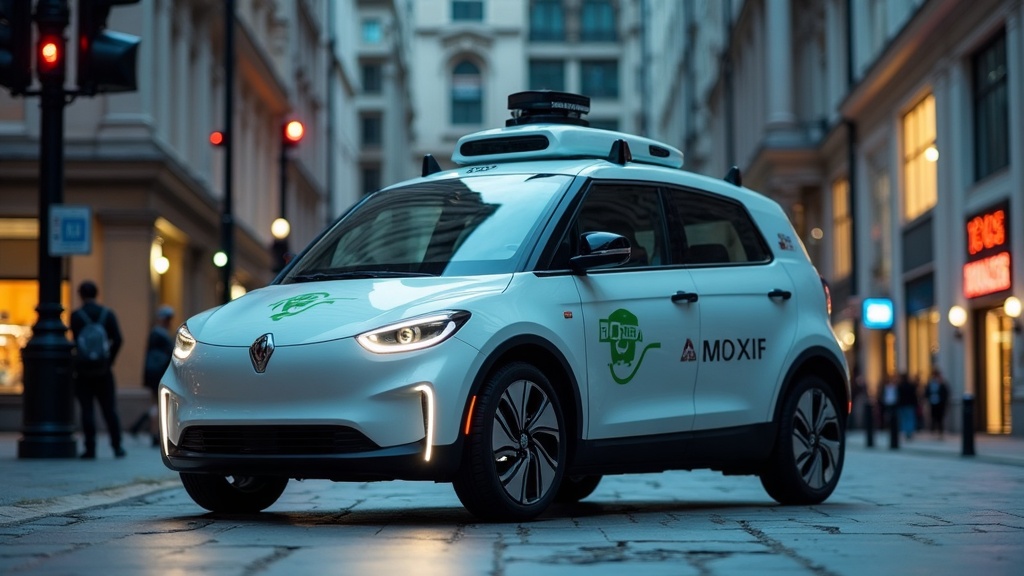
The capital is aimed at a specific, dated milestone: robotaxi trials with Uber on the streets of London in 2026. That makes Wayve the standard-bearer for British autonomy at a moment when the UK has positioned self-driving as a strategic industry, and it gives Uber a second major autonomy partner to complement its existing deals. Under the structure the companies described, Wayve supplies its AI Driver software inside L4-capable vehicles from participating automakers, while Uber owns and operates the fleet, a division of labor designed to scale ride-hailing on mass-produced cars rather than bespoke robotaxi hardware.
What makes the technical claim audacious is the architecture. Wayve's system is an end-to-end embodied AI model that runs entirely on onboard vehicle compute and standard sensors, with no high-definition maps and no location-specific engineering. The company says it became the first and only autonomous-vehicle developer to drive "zero-shot" in more than 500 cities across Europe, North America, and Japan within a single year, meaning the same model handled roads it had never seen without per-city tuning. That generalization is the entire pitch, and it is what separates Wayve from every map-dependent rival.
Why This Matters More Than People Think
The autonomous-vehicle industry has spent more than $100 billion over fifteen years and produced, so far, a handful of geofenced robotaxi services operating in a few sunny cities. The dominant approach, exemplified by Waymo, relies on centimeter-accurate HD maps, heavy sensor suites, and extensive per-city validation. It works, but it scales linearly: every new city is a new engineering project. Wayve is arguing that this is a dead end, and that the only way to cover the world is a model that learns to drive the way humans do, from generalizable experience rather than memorized maps. Waymo took roughly a decade and well over $30 billion to reach paid driverless service in a handful of metros, and each expansion still demands months of mapping and validation before the first rider climbs in. Wayve is wagering that this city-by-city grind is not a moat but a liability that a generalizing model eventually renders obsolete.
If that bet pays off, the economics of autonomy invert. A map-based system's cost grows with every city it enters; a foundation-model system's capability grows with every mile of data it ingests, and the marginal cost of a new city approaches zero. That is the same dynamic that let large language models leap from narrow tools to general assistants, and it is why Nvidia, Microsoft, AMD, Arm, and Qualcomm all wanted a seat at this table. They are not betting on a robotaxi operator. They are betting on the possibility that driving becomes a foundation-model problem, and that the winner sells the brain that every carmaker eventually licenses.
There is also a sovereignty dimension that the British state clearly understands. The presence of the British Business Bank, Ontario Teachers', and Baillie Gifford signals that Wayve has become a national-champion bet for UK technology, one of the few frontier-AI companies of genuine global scale headquartered outside the United States and China. London robotaxi trials in 2026 are as much an industrial-policy statement as a product launch, a demonstration that Britain intends to own a piece of the autonomy stack rather than import it wholesale from Silicon Valley or Shenzhen. The UK passed its Automated Vehicles Act to create a legal framework for self-driving, and ministers have repeatedly cited autonomy as a sector where Britain can lead rather than follow. A homegrown Wayve scaling to global relevance is exactly the outcome that policy was written to produce, which is why patient domestic capital lined up behind the round.
The Competitive Landscape
Wayve's most direct philosophical rival is not Waymo but Tesla. Both have abandoned HD maps in favor of end-to-end neural networks that learn driving from data, and both argue that generalization, not geofencing, is the path to true autonomy. The difference is distribution: Tesla owns millions of cars generating training data and can ship updates to its own fleet, while Wayve owns no cars and must license its AI Driver to automakers and operators like Uber. Wayve is, in effect, trying to be the independent, carmaker-agnostic version of Tesla's autonomy stack, the Android to Tesla's iOS. That positioning is strategically shrewd: Tesla will never license its autonomy to a competitor, leaving every other automaker on earth, from Volkswagen to Toyota to the Chinese EV giants, in need of a driving brain they cannot easily build themselves. Wayve is racing to be the supplier that fills that gap before the incumbents either build it internally or buy a rival.
Waymo remains the incumbent to beat on raw deployment. It has logged tens of millions of paid, fully driverless miles and operates commercial robotaxis in multiple US cities, a lead measured in years of real-world operation. But its map-heavy approach is exactly the cost structure Wayve is built to undercut, and the historical parallel is instructive. In the broader history of AI, hand-engineered, knowledge-rich systems repeatedly lost to simpler approaches that scaled with data and compute, the lesson Richard Sutton called "the bitter lesson." Wayve is betting that driving is the next domain where the general learner beats the hand-built specialist.
The rest of the field is crowded and well-funded. Amazon's Zoox is building purpose-made robotaxis, Mobileye sells a map-and-camera stack to legacy automakers, Aurora and Kodiak are chasing autonomous trucking, and a wave of Chinese players led by Baidu's Apollo Go and Pony.ai are scaling robotaxis at home. Against that backdrop, Wayve's differentiator is capital efficiency and partnerships: rather than build cars or pour billions into mapping fleets, it has assembled the entire chip industry, a hyperscaler, and the world's largest ride-hailing network as backers and customers, a coalition no pure-hardware AV company can match. The Uber relationship is especially telling: the ride-hailing giant has spent years searching for autonomy partners after abandoning its own costly self-driving unit, and committing to deploy with Wayve across more than ten markets is a vote that the mapless model can scale internationally in a way geofenced rivals have struggled to.
Hidden Insight: Wayve Is a Foundation-Model Company That Happens to Drive
The robotaxi headline obscures what Wayve actually is. Strip away the London trials and the Uber partnership, and the company is building a foundation model for physical movement, an "embodied AI" system whose real product is generalizable driving intelligence that can be licensed across vehicles, geographies, and eventually other robots. The robotaxi is a proof point, not the business. The business is owning the model layer that every automaker without a credible in-house autonomy program will need to buy, the same way every software company without a foundation model now rents one from OpenAI or Anthropic. That analogy is not loose marketing. The same scaling laws that made language models general also appear to govern driving models: more diverse data and more compute produce broader competence, which is precisely why Wayve frames its system as embodied AI rather than as a conventional autonomous-driving stack. The endgame is a model that transfers not just across cities but eventually across vehicle types and even other robots.
This reframes the $8.6 billion valuation. It is not a bet on Wayve operating a profitable taxi fleet in London; Uber operates the fleet. It is a bet that Wayve's driving model becomes infrastructure, a layer that carmakers integrate the way phone makers integrate Qualcomm modems or Arm cores. That explains why Arm, Qualcomm, AMD, and Nvidia are all invested: a carmaker-agnostic driving model that runs on standard automotive silicon expands the market for everyone who sells that silicon. Wayve's backers are positioning it to be the default brain that ships inside other companies' cars, which is a far larger and more durable prize than running a regional robotaxi service.
The bear case, however, is sobering and specific. Wayve has effectively zero commercial robotaxi revenue today, and the AV industry's graveyard is full of companies whose timelines slipped by years and whose demos never converged into unsupervised, liability-grade reliability. Cruise raised and spent more than $10 billion before GM effectively shut it down after a safety incident. Critics argue that "zero-shot in 500 cities" is a supervised-driving achievement that says little about the far harder problem of removing the safety driver and accepting full liability, the step where most AV programs stall for half a decade. End-to-end neural networks also raise a verification problem regulators have not solved: it is genuinely difficult to certify the safety of a black-box model that cannot fully explain why it brakes.
There is a second risk hiding in the business model itself. A licensing strategy only works if automakers are willing to outsource the single most strategic capability of a future car to a third party, and many are not. Several carmakers are spending heavily to build autonomy in-house precisely because they fear becoming commoditized hardware shells beneath someone else's brain, the exact fate Wayve's pitch implies for them. Skeptics point out that Wayve may win the technology argument and still lose the commercial one if its would-be customers decide that depending on an external driving model is too dangerous to their long-term margins, leaving Wayve with a brilliant model and too few buyers.
What to Watch Next
In the next 30 to 90 days, the milestone that matters is whether the London robotaxi trials with Uber actually launch on schedule in 2026 and, more importantly, with what level of human oversight. A trial with safety drivers is a demo; a trial moving toward genuine driverless operation is a signal. Watch the UK regulatory process closely, since the country's autonomous-vehicle framework is still maturing and approval timelines could either accelerate Wayve's lead or quietly push the headline date into 2027.
Over the next 180 days, track licensing announcements. The single most important proof point for the foundation-model thesis is a named automaker committing to ship Wayve's AI Driver in a production vehicle, not a research partnership but a real program with a launch year attached. Wayve has guided toward consumers being able to buy AI Driver-equipped cars starting in 2027 with L2+ capability; any concrete OEM deal that backs that promise would validate the entire licensing strategy and justify the valuation. Silence on that front would keep the bear case alive.
The longer-horizon question is whether end-to-end embodied AI can cross the chasm from impressive generalization to certified, unsupervised, liability-grade autonomy at scale. If Wayve's model continues to improve with data and compute the way the bitter-lesson thesis predicts, it could leapfrog the map-based incumbents and become the licensing layer for global autonomy. If the last few percent of reliability proves as stubborn as it has for every predecessor, the company joins a long line of AV pioneers who were technically right and commercially early. The next $1.2 billion buys Wayve the runway to find out which story it is living. Either way, the size of this round and the identity of its backers have already settled one question: the mapless, end-to-end approach is no longer the industry underdog, it is now a fully funded contender for the autonomy crown.
Wayve isn't trying to run a taxi company. It's trying to become the brain that every other carmaker eventually licenses, and the whole chip industry just bet a billion dollars that it can.
Key Takeaways
- $1.2 billion Series D at an $8.6 billion valuation, led by Eclipse, Balderton, and SoftBank Vision Fund 2.
- Microsoft, Nvidia, Uber, plus AMD, Arm, and Qualcomm all invested, pulling the chip industry onto one cap table.
- London robotaxi trials with Uber in 2026, with Wayve supplying AI Driver software and Uber operating the fleet.
- Zero-shot driving in 500-plus cities across Europe, North America, and Japan with no HD maps and no per-city tuning.
- Consumer AI Driver vehicles targeted for 2027, starting with supervised L2+ capability.
Questions Worth Asking
- If driving becomes a foundation-model problem, does the map-heavy approach that built Waymo's lead turn into the reason it gets undercut?
- Will automakers actually license their car's most strategic capability from a third party, or build autonomy in-house to avoid becoming commoditized hardware?
- How much does "zero-shot in 500 cities" really tell us about the far harder problem of removing the safety driver and accepting full legal liability?