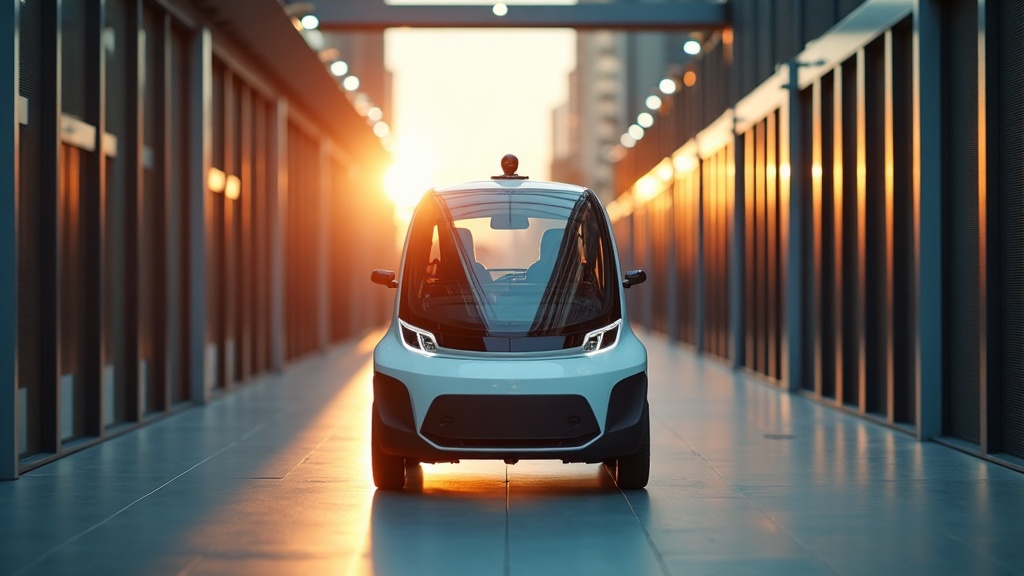
Spain was not supposed to be the first. The robotaxi narrative for the past three years has been a purely American story, told in the specific geography of San Francisco's fog, Phoenix's suburbs, and Austin's gridded boulevards. The country that launched the first commercial driverless taxi service in Continental Europe was expected to be Germany, with its engineering culture and legacy of precision manufacturing, or the Netherlands, whose regulators have led European autonomous vehicle policy for years. Instead, on June 2, 2026, WeRide and Uber filed papers with Madrid's regional government to begin commercial robotaxi operations in the Spanish capital, a city of 3.3 million people and a metropolitan area of 6.7 million, making it one of the largest urban markets where autonomous vehicles will operate commercially anywhere in the world.
The autonomous vehicle industry's center of gravity just shifted, and the vector points south.
What Actually Happened
On June 2, 2026, WeRide Inc. (Nasdaq: WRD), the California-founded, Guangzhou-headquartered autonomous driving company, announced a three-party agreement with Uber Technologies and AVOMO, a fleet operations subsidiary of the Moove Cars Group, to launch Spain's first commercial robotaxi pilot in the Region of Madrid (Comunidad de Madrid). The service will be available to passengers via the standard Uber app, with no separate download or membership required. Riders in Madrid will hail a WeRide-branded autonomous vehicle the same way they would book a conventional Uber, with the app handling routing, dispatch, and payment. This is the fourth city entry under the WeRide and Uber 15-city global expansion agreement, with the remaining 11 cities scheduled to launch by 2030. AVOMO's role mirrors exactly what it does in Atlanta and Austin: managing the autonomous vehicle fleet on the ground while WeRide provides the self-driving software stack and Uber provides the consumer-facing demand network that no AV startup has been able to build independently.
The Madrid service will launch in phases consistent with standard industry practice for new market entries. The initial deployment will include trained human safety operators seated in the driver's seat. This phased approach allows regulators, operators, and the public to accumulate data on WeRide's performance in Madrid's specific urban environment before permitting fully unsupervised operation. WeRide and Uber have committed publicly to progressing toward fully driverless commercial service as key performance milestones are met, following precisely the same playbook they executed in the Middle East. In Abu Dhabi and Dubai, WeRide and Uber currently operate the only fully driverless, fare-charging robotaxi service outside the United States. The Madrid Regional Government has signed on as an active partner, providing regulatory coordination, permitting support, and access to the city's traffic management infrastructure. Spain's autonomous vehicle law, updated in 2024 and aligned with EU harmonization requirements, creates a clear legal pathway from supervised to fully driverless commercial operation, subject to verifiable safety benchmarks rather than arbitrary bureaucratic timelines.
WeRide's global footprint has expanded rapidly over the past 18 months. The company, which conducted its first commercial robotaxi trials in Guangzhou in 2019, now operates in five European markets and has delivered over 800,000 paid autonomous rides globally as of early 2026, across China, the UAE, and the United States. In Abu Dhabi, WeRide and Uber have operated fully driverless commercial robotaxi service since 2024, charging standard Uber fares with no safety driver present in the vehicle at any point. A similar fully driverless service launched in Dubai in mid-2025. The Madrid entry makes WeRide the first autonomous vehicle operator to bring commercial robotaxi service to Continental Europe's car-centric capitals. Unlike Gulf city-states, where purpose-built road infrastructure and a single regulatory authority simplified initial deployment, Spain is a fully democratic EU member state with multiple overlapping jurisdictions, powerful transport unions, and a deeply embedded culture of human-operated taxis. Winning in Madrid requires more than engineering competence: it requires political navigation that WeRide has not previously been required to master at commercial scale.
Why This Matters More Than People Think
The surface headline is that Spain gets its first robotaxi. The deeper story is that Uber has demonstrated, for the second time in six months, that its global autonomous vehicle strategy does not require building a single technology or owning a single vehicle. Uber's playbook is aggregation: it provides the demand network, the app, the payment rails, and the consumer brand, while autonomous vehicle partners provide the hardware and software stack. In Madrid, that partner is WeRide. In Phoenix, San Francisco, and Austin, Uber has equivalent agreements with Waymo and Aurora. This asset-light model is structurally different from every major competitor. General Motors spent over $10 billion on Cruise before its October 2023 accident and near-shutdown of that program. Waymo has consumed an estimated $5 to $7 billion in development capital since 2009. Uber, by contrast, sold its own self-driving unit to Aurora in 2020 and now captures value from technology it never had to fund at the research stage, paying only for rides actually delivered rather than for years of R&D burn.
For Spain and Continental Europe broadly, the announcement represents a regulatory maturation that industry observers have been waiting years to see. Unlike the United States, where autonomous vehicle regulation happens at the state level and creates a patchwork of different rules across California, Texas, and Arizona, the European Union has moved toward harmonized frameworks for Level 4 autonomous vehicles under the EU General Safety Regulation and Vehicle Type Approval rules. Spain's 2024 autonomous vehicle law aligned national rules with these EU requirements, making Madrid a legally clear operating environment for commercial AV service with defined liability frameworks. This matters enormously for the broader European timeline. Waymo, which has discussed European expansion repeatedly in investor calls, has not yet submitted a commercial deployment application in any EU country. WeRide and Uber's Madrid launch establishes the operational precedent, the regulatory relationship with the Comunidad de Madrid, and the safety data that every other European city government will study when evaluating future AV applications from any operator worldwide.
The commercial implications for Uber's economics are worth examining directly. Uber currently generates revenue primarily through the driver-supply side of its marketplace. Every trip booked via the Uber app involves a human driver who takes approximately 72 to 75 percent of the fare as net earnings. When that driver is replaced by an autonomous vehicle under an arrangement where Uber pays per ride rather than per hour, Uber's gross take rate on the same ride increases materially, potentially from the current 25 to 28 percent toward 35 to 45 percent depending on fleet ownership structure and vehicle amortization schedules. Uber CEO Dara Khosrowshahi has been explicit about this arithmetic in investor presentations, describing AV partnerships as a structural improvement to Uber's long-term unit economics. The Madrid pilot is not yet large enough to move Uber's consolidated margins, but it is a live proof-of-concept for the higher-margin, AV-powered version of Uber's core business that the company has been building toward since its Aurora divestiture in 2020.
The Competitive Landscape
Waymo remains the global benchmark for autonomous vehicle commercial operations. As of June 2026, Waymo operates fully driverless robotaxi services in San Francisco, Los Angeles, Phoenix, and Austin, having completed over 25 million fully autonomous miles. The company has announced plans to expand to Miami, Atlanta, and several international cities but has not yet received commercial operating permits in any European jurisdiction. Waymo's technology is widely considered the most mature in the Western market, having successfully navigated the regulatory frameworks of California's DMV and federal NHTSA oversight. However, Waymo's deliberate pace of international expansion reflects a real difficulty: replicating its carefully cultivated US regulatory relationships in new jurisdictions requires not only technical validation but also new insurance underwriting frameworks, accident liability protocols, and government partnerships that take years to negotiate and even longer to trust. WeRide's Middle East track record provides a different kind of credibility: operational experience in high-heat, high-traffic conditions that European regulators explicitly find analogous to Mediterranean urban driving environments.
The risk is real, however, and critics argue that the Madrid pilot faces legitimately tougher conditions than WeRide's successful Gulf deployments. Dubai and Abu Dhabi are governed by single-authority city-states where government backing can accelerate regulatory approvals that would take years in democratic, multi-stakeholder European systems. Spain's framework may be EU-aligned, but it still requires insurance underwriting by European insurers who have historically been more cautious than their UAE counterparts on autonomous vehicle liability exposure, and formal coordination with Madrid's powerful transport unions that have already raised public objections in regulatory consultations. WeRide's AVOMO partner has deep experience in US fleet operations but not in the specific contractual, labor, and operational culture of the Spanish transport sector. Bridging the operational gap between running robotaxis in Dubai, where road infrastructure is newer, traffic patterns are more predictable, and labor opposition is essentially absent, and running them in central Madrid's narrow medieval streets with its deeply embedded taxi culture, is a challenge the company has not yet faced at commercial scale on any continent.
The closest historical parallel is Uber's own international expansion. When Uber launched in London in 2012, it faced protests from Black Cab drivers, regulatory challenges from Transport for London, and sustained accusations of regulatory arbitrage. It took Uber approximately five years of legal battles and multiple operational adjustments before securing a stable long-term operating license in the UK. For autonomous vehicles, the political opposition will look similar (European transport unions), but the regulatory stakes are higher because the safety argument cannot be settled through lobbying and legal fees alone: it requires independently verifiable operational data. WeRide's Abu Dhabi and Dubai deployments provide the company with over 2 million fully driverless operational miles to present to Spanish regulators as direct evidence of real-world performance. That accumulated mileage is WeRide's most important competitive asset in Madrid, because in AV regulation, the company with the most credible safety data wins the permit, and the company that wins the permit first writes the rules that every subsequent operator must follow.
The WeRide-Uber-AVOMO structure in Madrid is a blueprint for how the autonomous vehicle industry will actually scale globally, and almost no mainstream coverage is analyzing it at the architectural level that matters. WeRide builds and owns the autonomous driving software stack. AVOMO owns and physically operates the vehicles on a day-to-day basis. Uber provides consumer demand aggregation, payment infrastructure, and global brand recognition. None of these three parties could have launched this service independently. WeRide cannot build a consumer-facing mobility app with millions of daily active users and negotiate a city-level partnership with Madrid's regional government simultaneously. Uber cannot develop world-class Level 4 autonomous driving software from scratch on a competitive timeline without the kind of capital that only a company whose primary business is autonomous driving can sustain. AVOMO cannot aggregate global demand at scale or negotiate multinational city entry deals without a brand like Uber providing commercial credibility. The three-party structure solves precisely the integration problem that consumed tens of billions of dollars at companies that tried to build everything in-house.
The 15-city pipeline carries more strategic weight than any single city announcement suggests. Each new city added to the operating roster gives WeRide's equity story substantially more credibility to institutional investors who currently value WeRide at approximately $4.6 billion on Nasdaq, despite the company not yet being profitable at the consolidated level. Every city with paying passengers reduces the risk premium that investors assign to WeRide's forward revenue projections. For Uber, the cities in the 15-city pipeline represent essentially cost-free options on future high-margin AV revenue, exercisable without capital outlay for technology research and development. Uber pays per completed ride rather than per year of R&D burn rate. This structural asymmetry is why Uber's stock re-rates consistently upward on AV partnership announcements: the market understands that Uber benefits from autonomous vehicle technology without bearing any of the fundamental development risk that has destroyed shareholder value at GM, Ford, and virtually every other company that tried to build AV technology from the ground up over the past decade.
Spain's selection as the European entry point is not coincidental geography. Portugal, France, and Germany all have autonomous vehicle regulatory frameworks, but Spain's 2024 law is the most operationally permissive of any EU member state for commercial Level 4 deployments in urban zones. Spain also has a regulatory history of pragmatic accommodation to platform economy disruption: while France and Germany initially banned Uber's UberPop service outright, Spain found accommodation through regulation. The Comunidad de Madrid's active co-sponsorship of the WeRide pilot is particularly revealing. Regional governments in Spain hold autonomous authority over traffic and transportation policy within their territory, independent of national legislation in many operational respects. Madrid's government made a deliberate choice to be the launch partner, meaning it also captures the operational data, the safety record, and the economic development benefits of hosting the first European commercial robotaxi. Cities that host the first commercial AV operations tend to retain them, because the regulatory frameworks, operational relationships, and infrastructure integrations created in the first years become real switching costs for any operator contemplating a future city change.
The most consequential question that the Madrid launch raises, and that no coverage is yet asking publicly, concerns what happens to Uber's approximately 180,000 active driver-partners in Spain as autonomous vehicles reach economic scale in the market. Uber has framed the Madrid service carefully as a pilot in which supervised operation keeps human operators employed initially. But the long-term trajectory is not ambiguous to anyone reading the partnership agreement. WeRide, Uber, and AVOMO have committed to expanding to fully driverless commercial service across core urban areas as performance milestones are met, on a timeline driven by safety data rather than labor or political considerations. Spain's transport unions have raised concerns in public consultations, but their leverage over Uber is structurally limited: Uber's driver-partners are classified as independent contractors in most Spanish jurisdictions, which structurally limits the collective bargaining power available in Germany or France, where gig economy labor protections are far stronger. The driver displacement question is not a 2026 issue. But it is a 2029 issue that nobody in the current regulatory conversation is pricing in.
What to Watch Next
The next 30 days will establish whether Madrid's regional government can issue WeRide the specific urban driving permits required to begin supervised operations. The regulatory process involves vehicle type approval under Spain's 2024 autonomous vehicle law, route-specific authorization for the initial operating zone, insurance underwriting with an EU-licensed insurer, and formal coordination with Madrid's EMT traffic control center. The speed of this permitting process will serve as a live benchmark for every other European city currently evaluating its own robotaxi application pipeline. If Madrid clears WeRide in under 60 days from the announcement date, it signals that Spain's 2024 regulatory framework is genuinely operational-grade and creates competitive urgency for Barcelona, Valencia, and Seville, none of which will want to cede the regulatory learning advantage and the technology cluster investment that Madrid is about to capture. If permitting takes six months or longer, it will confirm that even the most permissive European AV regulations are still operating on a political-bureaucratic timeline incompatible with US-speed commercial deployment.
The 90-day marker to track is the date of WeRide's first fare-paying passenger ride on Madrid streets. WeRide has committed to launching operations during 2026, implying a window between now and December 31. The initial route corridor, operating hours, and fare pricing will all signal how aggressively WeRide is pursuing market share versus how cautiously it is managing its regulatory relationship with the Comunidad de Madrid. In Abu Dhabi, WeRide initially restricted operations to designated corridors before expanding to broader city coverage over approximately 18 months. A similarly conservative launch in Madrid would be technically rational but commercially underwhelming, particularly for Uber's investors who have been waiting years for the company's AV strategy to produce tangible European revenue. The per-mile unit economics on autonomous Uber rides in Madrid will be closely watched: if WeRide's China-manufactured vehicle cost structure permits profitable economics in a Western European market from the first year of operation, it compresses the break-even horizon for the broader industry and forces every major competitor to reassess their cost assumptions.
The 180-day and longer horizon to monitor is Waymo's formal European response. Waymo CEO Tekedra Mawakana and Alphabet CEO Sundar Pichai have both acknowledged European expansion as part of Waymo's long-term roadmap in recent earnings calls. WeRide's Madrid operational launch will not directly force Waymo's hand on timing, but it creates a concrete competitive reference point that Waymo's potential European fleet and automotive partners will use as their primary comparison benchmark in commercial negotiations. If WeRide reaches 1,000 daily paid rides in Madrid by the end of 2026, that milestone transforms the European regulatory risk narrative from the paralyzing abstraction of "no commercial AV has ever operated here" to the manageable operational reality of "one already has, and here is its verified safety record." The three European cities to watch for 2027 commercial AV applications are Amsterdam, Barcelona, and Munich, each with distinct regulatory frameworks but similarly forward-leaning municipal governments. Whoever secures commercial operating permits in those three cities in 2027 will have written the European AV playbook for the following decade.
The company that accumulates the most global AV safety miles does not just win the technology race: it wins the regulatory argument in every new market it enters next, because regulators follow data, and the data follows the miles.
Key Takeaways
- Spain's first commercial robotaxi launches via WeRide and Uber in Madrid under a three-party structure with fleet operator AVOMO, available through the standard Uber app with no separate download required
- 15-city global pipeline means Madrid is the fourth of fifteen cities WeRide and Uber have committed to, with eleven more markets to open by 2030 spanning Europe, Asia, and the Middle East
- 800,000-plus paid autonomous rides globally gives WeRide the safety data record European regulators require before granting commercial permits, an asset competitors without international deployments cannot match
- Uber's asset-light AV model means the company captures the margin benefit of autonomous rides without funding technology development, paying only per completed ride rather than bearing the R&D costs that have cost competitors billions
- 180,000 Uber driver-partners in Spain face a long-term structural displacement risk as milestone-based progression to fully driverless service creates a clear trajectory, even if exact dates remain publicly undefined for now
Questions Worth Asking
- If WeRide's China-manufactured vehicle cost structure allows profitable unit economics in Western Europe from the first year, how quickly does that force Waymo to rethink a strategy built around far more expensive American-built hardware?
- The EU AI Act classifies autonomous vehicles as high-risk AI systems subject to mandatory conformity assessments: at what point does compliance burden become a structural barrier to European AV expansion that neither WeRide nor Waymo has fully priced into their city expansion timelines?
- When fully driverless Uber rides in Madrid achieve economic scale, what prevents European competition regulators from scrutinizing Uber's dramatically improved per-ride take rate the same way they scrutinized its driver classification practices, and what does that regulatory scenario do to the business model's long-term stability?