A small Korean chip startup just convinced investors that the most expensive bottleneck in artificial intelligence is not the thing everyone is fighting over. While the industry pours hundreds of billions into Nvidia GPUs, XCENA raised $135 million on the opposite premise: the wall AI keeps hitting is memory, and the company that tears it down captures a market the GPU vendors have quietly ignored. The round closed at a $570 million valuation, and the people writing the checks include some of Asia's largest financial institutions.
What Actually Happened
XCENA closed a $135 million Series B co-led by Atinum Investment and IMM Investment, with a broad syndicate of new and existing strategic backers across Asia's venture and financial sector. The round values the company at $570 million and brings its total capital raised to $185 million since it was founded in 2022. For a company with no shipping product and first revenue not expected until 2027, that is an aggressive mark, and it reflects how badly investors want exposure to the inference cost problem.
The founders are not outsiders to memory. Jin Kim, Dohun Kim, and Harry Juhyun Kim are all veterans of Samsung and SK Hynix, the two companies that together control most of the world's high bandwidth memory supply. They left the incumbents to attack a gap their former employers were structurally slow to address: the data orchestration work that still runs on CPUs even in GPU-dominated AI systems. Their pitch is that the people who built HBM know exactly where its limits are and how to route around them.
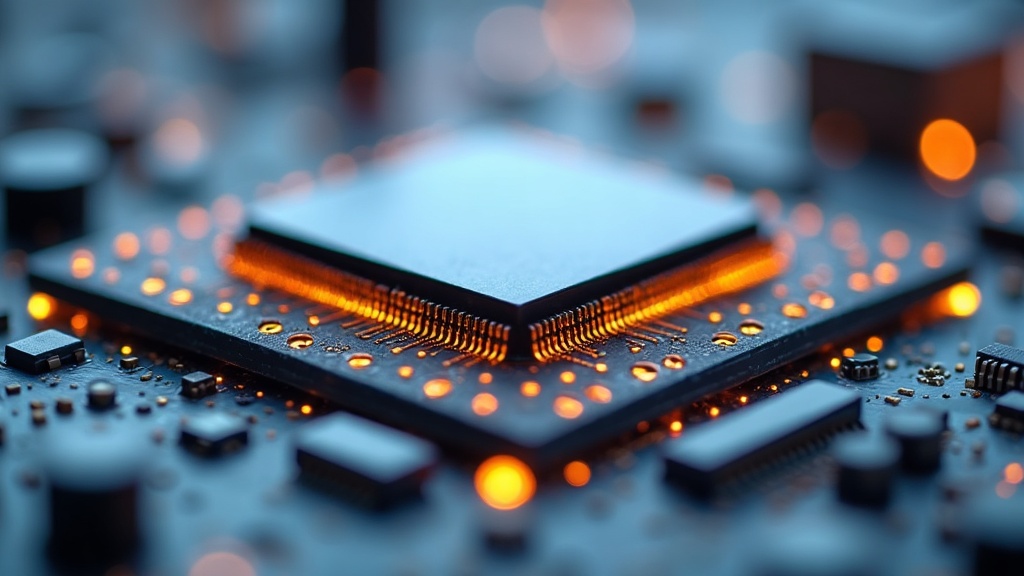
The product is a chip called the MX1. It connects to the host CPU through CXL, the Compute Express Link standard that creates a coherent, high-speed lane between processors and pooled memory. Instead of shuttling data across the bus to be processed and shuttled back, the MX1 runs computation inside the memory module itself. XCENA expects mass-production silicon to come off Samsung's foundry lines by the end of 2026, with commercial revenue beginning in 2027 as the first design wins move into deployment.
Why This Matters More Than People Think
The dominant story of the AI buildout has been compute. Nvidia's market capitalization, the GPU shortage, the export controls, the gigawatt data centers: all of it frames raw matrix multiplication as the scarce resource. XCENA's bet is that this framing is already out of date. Training a model is compute-bound, but running one, especially a long-context or agentic model, is increasingly bound by how fast and how cheaply you can move and store data. GPUs are brilliant at the math and wasteful at everything around it.
Consider what actually consumes resources during inference. Preprocessing, data caching, and above all key-value cache management, the system that stores prior conversation context so a model does not reprocess every token, all lean heavily on memory bandwidth and capacity. As context windows stretch to a million tokens and agents run for hours, the KV cache balloons and the memory subsystem, not the GPU core, becomes the choke point. XCENA wants to absorb that work into the memory module, freeing the expensive GPU to do only what it is uniquely good at.
If the thesis holds, the economic consequences are large. Inference, not training, is where the recurring cost of AI lives, and inference margins are what determine whether the current generation of AI products can ever be profitable. A chip that cuts the memory tax on every query changes the unit economics for everyone running models at scale, from hyperscalers to enterprises self-hosting open-weight models. That is a different and arguably larger prize than selling another accelerator into an already saturated GPU market.
The scale of that prize is easy to underestimate. Every enterprise now wiring agents into its workflows is discovering that the bill scales with context, not with cleverness, because each step replays a growing history through the model. Token costs that looked trivial in a demo turn into line items that double quarter over quarter once an agent runs across thousands of employees. A memory device that lets a server hold more context closer to the processor and recompute less of it attacks the part of the bill that grows fastest. That is why XCENA frames the MX1 not as a faster chip but as a cheaper one, measured in dollars per served request rather than raw throughput, which is the metric finance teams actually scrutinize when they approve an AI budget.
The Competitive Landscape
XCENA is not alone in noticing the memory wall, and its rivals are formidable. SK Hynix, Samsung, and Micron dominate high bandwidth memory and are racing to ship HBM4, which widens the pipe between memory and GPU. Nvidia keeps enlarging on-package memory and tightening its NVLink fabric to keep data close to compute. Samsung itself has shipped processing-in-memory prototypes that blur the line between storage and computation. XCENA is effectively betting it can out-execute the very giants that trained its founders.
The strategic wedge is the CXL standard, which lets third parties insert smart memory devices into a system without owning the GPU or the CPU. That is the same playbook that let networking and storage startups thrive in the cloud era: standardize an interface, then build a better box behind it. The historical parallel is the rise of dedicated offload hardware like data processing units, where companies such as Mellanox, later bought by Nvidia for $6.9 billion, proved that moving work off the main processor could become a category in its own right.
The difference this time is timing and concentration. The DPU market matured over a decade; the AI inference cost crisis is acute right now, with companies burning cash on every generated token. That urgency is what let a pre-revenue startup raise at $570 million. It also means the window is narrow. If the hyperscalers decide memory orchestration is strategic, they have the silicon teams and the balance sheets to build it in-house, the way Google built the TPU and Amazon built Graviton and Trainium rather than waiting for a vendor.
There is a national dimension that sharpens the bet. South Korea, through Samsung and SK Hynix, supplies the majority of the world's advanced memory, and the government has treated that lead as strategic infrastructure on par with TSMC's role in logic chips. A homegrown fabless startup that turns memory from passive storage into active computation extends that advantage up the value chain, from selling capacity to selling intelligence. The CXL Consortium, which counts Intel, AMD, Samsung, and the major cloud providers as members, sets the interface XCENA depends on, so the company's fate is partly tied to how aggressively that standards body pushes adoption against Nvidia's preference for its own proprietary interconnects.
Hidden Insight: The Inference Era Rewrites the Hardware Map
The non-obvious read on XCENA is that it is a wager on a regime change most of the market has not priced. For three years the binding constraint on AI was training compute, because the race was to build ever larger frontier models. That race is now sharing the stage with a quieter, larger one: making inference cheap enough that AI products stop losing money on every user. When the constraint shifts from training to serving, the hardware that matters shifts with it, and memory moves from a supporting role to the main event.
This is why the KV cache detail is the whole story rather than a footnote. Agentic workloads, the ones every enterprise vendor is now selling, do not run a single short prompt. They run long, stateful sessions that accumulate enormous context, and that context has to live in memory and be read back constantly. The cost of an agent is dominated by how efficiently you can manage that state. A chip that handles KV cache inside the memory module is attacking the exact line item that makes agents expensive, which is why investors who have seen the agent token bills are paying attention.
There is a deeper structural point about who profits from each phase of a technology wave. In the training phase, value concentrated in the company selling the scarcest compute, which is why Nvidia captured the bulk of the gains. In the deployment phase, value tends to spread to whoever removes the next bottleneck in the stack. The memory layer has been a commodity for decades, sold by capacity and speed. XCENA is betting that intelligence moving into memory turns a commodity into a differentiated, high-margin product, the same transition that turned plain network cards into smart ones.
The intellectual roots of this bet are older than the AI boom. Computer architects named the memory wall in 1994, warning that processor speed would outrun memory speed until the gap dominated performance. For decades clever caching hid the problem. Large language models tore the cover off, because they stream enormous tensors and cached context that no on-chip cache can hold, exposing exactly the wall the architects predicted. XCENA's approach, often called near-memory or in-memory computing, is the textbook answer to that wall: stop moving the data to the compute and move modest compute to the data. The idea is decades old, but only now, with CXL providing a standard door into the memory pool, does it have a commercial path.
The reason the incumbents may not simply crush this is the classic innovator's dilemma. Samsung and SK Hynix earn their margins selling memory by capacity in massive volume, and their organizations, sales motions, and fabs are tuned for that commodity. Adding programmable logic to a memory module is a different business with different software, support, and customer engagement, and it threatens to cannibalize the simple, high-volume product. That is precisely the gap a focused startup founded by their own alumni is built to exploit, the same way specialized challengers have repeatedly out-maneuvered larger rivals on a feature the incumbent saw as a distraction rather than a category.
The bear case, however, is straightforward and deserves a clear hearing. CXL has been promised for years and adopted slowly, the incumbents can fold memory-centric tricks into their next HBM generation, and software teams keep finding ways to shrink the KV cache through paged attention and compression that reduce the need for new silicon. Skeptics point out that a $570 million pre-revenue valuation assumes flawless execution against Samsung, SK Hynix, and Nvidia at once, and that the gap between a working prototype and a yielding, deployed product has buried better-funded chip startups.
What to Watch Next
The first hard checkpoint is the end of 2026, when XCENA expects MX1 mass production from Samsung's foundry. Tape-out slips and yield problems are the default failure mode for fabless startups, so any delay past that window is the earliest signal the thesis is in trouble. Watch also for the first named design wins. A pre-revenue company living on a memory thesis needs a marquee hyperscaler or enterprise pilot to validate that the offload actually lowers total cost of ownership in production, not just in a benchmark.
Over the next 90 to 180 days, track the broader CXL ecosystem. The standard has been promised for years and adopted slowly, so independent evidence that CXL 3.x devices are shipping at volume in real data centers would lift every memory-centric startup at once. Watch the HBM4 roadmaps from SK Hynix and Samsung too, because if conventional memory closes the bandwidth gap faster than expected, the case for a separate offload chip weakens. The race is partly XCENA versus its rivals and partly XCENA versus the relentless improvement of commodity memory.
The financial tell will be the next round. If XCENA raises a Series C in 2027 on the back of real revenue and design wins, the memory-as-bottleneck thesis graduates from pitch to category. If instead the company raises a flat or down round to bridge to production, that will say the market got ahead of the product. Either way, the signal to track is simple: does any chip that moves compute into memory demonstrably cut the cost of serving a long-context model, and can it do so before the incumbents close the door.
The AI race has been a fight over who can compute the fastest, but the next one is a fight over who can remember the cheapest.
Key Takeaways
- $135M Series B at a $570M valuation funds a pre-revenue memory startup, signaling how hard investors want exposure to AI inference costs.
- The MX1 chip uses CXL to run computation inside the memory module, offloading preprocessing, caching, and KV cache work from CPUs and GPUs.
- Founders are Samsung and SK Hynix veterans, attacking a memory-orchestration gap their former employers were structurally slow to fill.
- Mass production is targeted for end of 2026 at Samsung's foundry, with first commercial revenue not expected until 2027.
- The bet is a regime change: as AI shifts from training to inference, memory bandwidth and capacity, not raw GPU compute, become the binding cost.
Questions Worth Asking
- If inference economics decide which AI businesses survive, is the market overvaluing compute and underpricing the memory layer that serves every query?
- Can a pre-revenue startup out-execute Samsung, SK Hynix, and Nvidia on their home turf, or will the incumbents simply absorb memory-centric computing once it proves out?
- How much of your own AI cost is actually compute, and how much is the data movement and context management that never shows up in a GPU spec sheet?