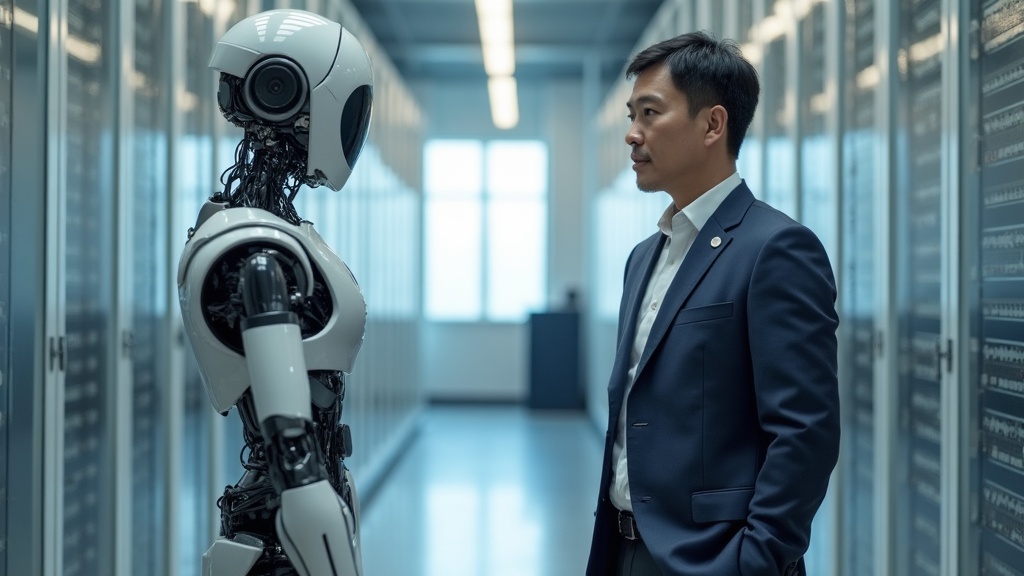
He Xiaopeng, the founder and CEO of XPeng, did something unusual on June 10, 2026: he personally took the title of CEO of his own company's humanoid robotics division. That is not a symbolic gesture. When the founder of a $6 billion electric vehicle company removes the previous head of a division and installs himself in that seat, he is making a resource commitment that board approvals and press releases cannot match. XPeng has spent the last two years building its IRON humanoid robot. He Xiaopeng's message to the market, and to every rival working toward year-end production targets, is that this is no longer a side project.
What Actually Happened
On June 10, 2026, He Xiaopeng announced via internal letter that he was personally assuming the CEO role of XPeng's robotics division, effective immediately. The announcement cited intensifying competition: "The industry is becoming increasingly hot and competitive, and we have clearly seen the direction and timing of victory, but it still requires more arduous implementation and extremely high decision-making ability." The framing is explicit, XPeng sees a specific window, and the CEO believes only his direct involvement will ensure they hit it.
The production target He Xiaopeng is racing toward is mass production of the IRON humanoid robot by end of 2026. XPeng broke ground earlier this year on a dedicated robotics manufacturing facility in Guangzhou's Tianhe District: 110,000 square meters, roughly equivalent to 20 football fields, purpose-built for humanoid robot assembly. The factory represents a capital commitment that goes well beyond prototype production. IRON robots are expected to begin trial use in XPeng's own retail stores before commercial delivery to external customers in China and internationally begins in 2027.
The technical specifications of the IRON robot position it at the high end of the current generation. IRON carries approximately 200 degrees of freedom, close to the human body's 244, which places it ahead of most competitors on articulation. The design targets industrial and commercial applications rather than consumer household use, which aligns with where the first wave of humanoid robot revenue is actually materializing: factory lines, retail operations, and logistics facilities that can quantify productivity improvements and cost per robot-operating-hour. XPeng's EV manufacturing background gives it supply chain relationships and manufacturing process expertise that pure-play robotics startups cannot match on day one.
Why This Matters More Than People Think
The humanoid robot race in 2026 is not just about which company can build the best robot. It is about which company can build robots fast enough to establish the data advantage that will define the next generation of robot AI. Every hour a humanoid robot spends in a real factory, retail floor, or logistics center generates training data for the motion models and decision models that make the next robot iteration better. The companies that get to production scale first, Figure AI at 1 robot per hour from its BotQ factory, Boston Dynamics shipping its entire 2026 production to Hyundai and Google DeepMind, are not just generating revenue. They are building a data moat that latecomers will struggle to cross.
XPeng's entry into this race with a CEO-led commitment stands out precisely because XPeng is not a pure-play robotics startup. He Xiaopeng built XPeng from a design studio into one of China's top three electric vehicle makers, navigating supply chain crises, price wars with BYD, and technology licensing disputes. His track record in manufacturing at scale is more relevant to building humanoid robots than almost anyone else now running a robotics division. The institutional knowledge required to go from 10 robots per month to 10,000 robots per month is not the same knowledge required to build a robot that can walk convincingly in a demo video. XPeng has the first kind of knowledge. The question is whether it has developed the second.
The broader Chinese robotics competitive context raises the pressure on every entrant. AgiBot rolled out its 10,000th humanoid robot in March 2026 and declared 2026 "Deployment Year One" at its April partner conference. Unitree received IPO clearance from the Shanghai Stock Exchange in June 2026, signaling that the Chinese capital markets are ready to provide growth funding for humanoid robot manufacturers. BYD has announced plans to build 20,000 humanoid robots for its own factories. Li Auto has formed three dedicated embodied AI departments. The Chinese government has identified humanoid robots as a strategic national priority. XPeng is not competing in a vacuum, it is competing in the most intense humanoid robot race in the world, in the market that will likely produce the most units over the next five years.
The Competitive Landscape
The global humanoid robot competition in mid-2026 has two distinct theaters. Analysis of the competitive dynamics confirms that the window to establish a durable position in humanoid robot manufacturing is narrowing fast as capital flows and production scales across all major players. The Western theater is led by Figure AI, Boston Dynamics, and Tesla Optimus. Figure AI's BotQ factory is producing Figure 03 at 1 robot per hour, with 40 units commercially deployed at BMW's Spartanburg facility billing at roughly $25 per robot-operating-hour. Boston Dynamics Atlas has committed its entire 2026 production to Hyundai's Robotics Metaplant Application Center and Google DeepMind, at an estimated $420,000 per unit. Tesla continues scaling Optimus inside its own Gigafactory Texas operation, with over 1,000 units working in parts handling and quality inspection, targeting 50,000 by year-end. These are real deployments generating real revenue and real training data.
The Chinese theater is simultaneously the faster-growing and the less internationally visible market. Unitree has shipped over 5,500 units and has its G1 humanoid listed on Amazon for $17,990, a consumer price point that none of the Western competitors have approached. AgiBot has achieved 99.9% success rates on production line tasks with cycle times of 19-20 seconds per operation. EngineAI, Galbot, and Pudu have all announced production-ready models. The Chinese humanoid robot market benefits from a supply chain that produces the servo motors, actuators, and sensors required for mass production at costs that Western manufacturers cannot match. XPeng's entry, backed by CEO commitment and a dedicated factory, gives it manufacturing credibility that most of its Chinese competitors built over 3-5 years of iteration.
The historical parallel worth drawing is the early electric vehicle market. In 2012, Tesla was the only company manufacturing electric vehicles at anything approaching commercial scale. By 2018, nearly every major automaker had announced an EV program. By 2024, BYD had overtaken Tesla in global EV sales. The humanoid robot market in 2026 resembles 2018 EVs more than 2012 EVs: the technology has been proven by early movers, capital is flowing, and the race is now about manufacturing efficiency and cost reduction rather than proof of concept. XPeng's He Xiaopeng watched the EV consolidation happen in real time. He knows that the window for establishing a durable position is narrow, and that waiting to see if the market materializes is not a strategy that survives contact with BYD, Unitree, and AgiBot simultaneously scaling up.
Hidden Insight: The Automotive-to-Robotics Transfer
The most underanalyzed advantage that automotive OEMs bring to humanoid robotics is not their manufacturing scale, it is their supply chain integration. Building a car requires sourcing and assembling thousands of components from hundreds of suppliers, managing tolerances measured in fractions of a millimeter, and running quality control processes that must catch defects before they create safety failures. Building a humanoid robot is architecturally similar. It requires precision actuators, multi-axis joints, sensor arrays, compute modules, structural materials, and electrical systems, all assembled to specifications that must hold up under real-world operating conditions. The companies that have been doing this for EVs, XPeng, BYD, Li Auto, and Xpeng's peers, have a direct manufacturing competence transfer that pure-play robotics startups had to build from scratch.
XPeng's specific advantage is its experience manufacturing high-specification EVs in Guangzhou, the same city where its new robot factory sits. The supply chain relationships, the logistics infrastructure, the quality management processes, and the manufacturing talent pool are geographically co-located. The 110,000-square-meter dedicated facility is not being built in an industrial vacuum, it is being built adjacent to an automotive manufacturing ecosystem that has already optimized for the kind of precision assembly IRON requires. That is a startup cost advantage that a robotics company founded in 2021 cannot replicate quickly.
The risk, however, is real and worth stating directly. XPeng's EV business faces intense pressure from BYD's relentless price competition, and the company is not yet profitable on its core automotive operations. Critics argue that He Xiaopeng's personal takeover of the robotics division may reflect a strategic pivot away from EVs rather than a genuine expansion, that XPeng may be betting on humanoid robots as a growth narrative at a moment when its EV market position is under threat. The bear case is that the CEO's attention is a finite resource, and dividing it between a capital-intensive EV price war and a first-generation humanoid robot production ramp simultaneously may result in executing neither well. The mid-2026 EV sales numbers and Q3 2026 IRON production milestone will be the first test of whether this bet is additive or diversionary.
The data network effect embedded in physical AI deployment adds a dimension that makes the entry timing crucial. Every IRON robot deployed in XPeng's retail stores generates motion capture data, task completion data, and environmental interaction data that feeds back into the IRON foundation model. The companies that get to 100 deployed units first are not just ahead on revenue, they are ahead on data generation. At 100 units, the data flywheel starts spinning in a way that creates compounding advantages. AgiBot's 99.9% success rate on production tasks came after months of deployed operation data, not from lab testing. XPeng's 2026 mass production target is not just about revenue, it is about getting into the data generation phase before the window to do so competitively closes.
What to Watch Next
The 30-day signal is whether He Xiaopeng's takeover translates into accelerated hiring at the robotics division. CEO-level attention to a product team typically precedes a resource allocation: engineering headcount, procurement commitments, and partnership announcements. If XPeng announces a major robotics partnership (with an automaker, a logistics firm, or a government entity) within 30 days, it validates that the CEO takeover was about acceleration rather than rescue. If the announcement is followed by silence, the market should treat it as a morale and restructuring signal rather than a growth signal.
The 90-day marker is the first credible update on IRON production volume. XPeng's year-end mass production target is aggressive by any standard, the company went from announced humanoid program to dedicated 110,000-square-meter factory in approximately 18 months. If the company publishes a production update at or above 50 units per month by September 2026, it confirms the industrial capability is real and the year-end target is achievable. If the update shows single-digit monthly output, the target is in serious jeopardy. Unitree's IPO prospectus disclosing 11,000 cumulative units sets the competitive benchmark for what Chinese humanoid robot production actually looks like at the current frontier.
The 180-day question is whether any external customer commits to IRON before year-end. XPeng's stated plan is to trial IRON in its own retail stores first, a careful approach that generates proprietary data without the customer service complexity of external deployment. But by Q4 2026, the company will need at least a letter of intent or pilot agreement with an external customer to validate commercial demand. The companies watching most carefully will be XPeng's supply chain partners and investors. A signed pilot with a logistics company, an automaker, or a retail chain by December 2026 would represent a genuine inflection point. The absence of any such announcement by year-end would call the entire humanoid robot bet into question for XPeng.
When a founder steps down from the CEO title of his main business to run a product division, he's not managing a side project, he's betting the house on a new market before anyone has proven the market exists.
Key Takeaways
- He Xiaopeng takes direct control of IRON robotics, XPeng's founder and CEO personally assumed CEO role of the company's humanoid robot division on June 10, 2026, citing intense competition and a narrow window for victory
- 200 degrees of freedom in the IRON humanoid, close to the human body's 244, placing IRON at the high end of current-generation commercial humanoid robots on articulation capability
- 110,000-square-meter dedicated factory in Guangzhou, purpose-built for IRON robot assembly, leveraging XPeng's EV manufacturing supply chain and talent in the same city
- Mass production target: end of 2026, with trial deployment in XPeng retail stores first, then commercial customer delivery targeting 2027 in China and internationally
- Chinese humanoid duopoly taking shape, AgiBot at 10,000 units and Unitree with IPO clearance set the production benchmarks XPeng must meet to compete in the world's largest humanoid robot market
Questions Worth Asking
- Is a CEO personally running a product division a sign of strategic confidence or a sign that the division was struggling under its previous leadership?
- Can XPeng simultaneously fight a price war against BYD in EVs and race AgiBot and Unitree in humanoid robots without spreading its manufacturing and management resources too thin?
- If automotive OEMs prove to be the best humanoid robot manufacturers, because of supply chain expertise, not robotics research, what does that mean for the venture-backed pure-play robotics startups that have spent three years building their foundations?