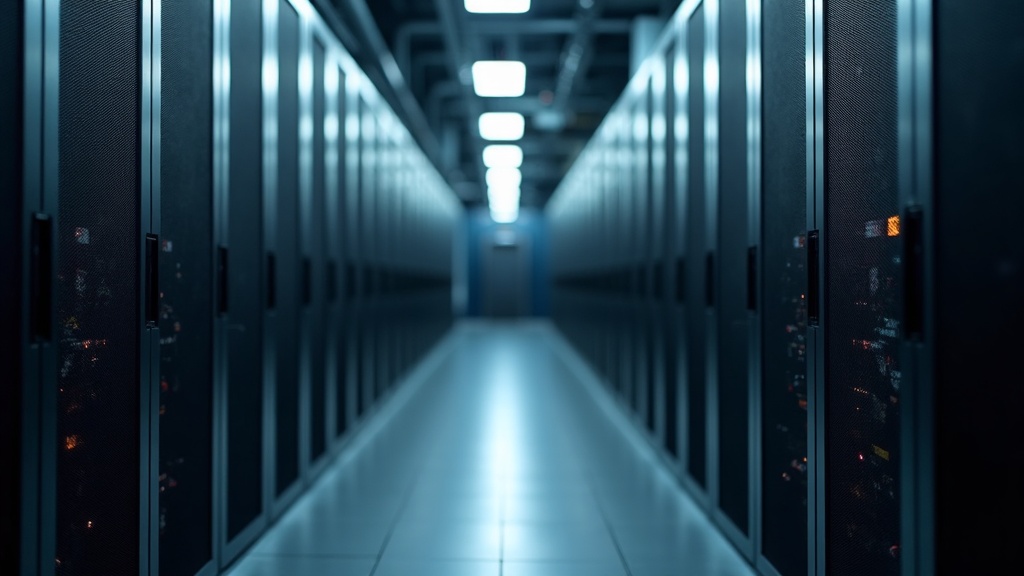
A single rack of next-generation AI chips now draws nearly one megawatt of power, enough electricity to run approximately 750 American homes. Multiply that by the thousands of racks going into data centers across the United States, and the arithmetic becomes uncomfortable. Tech companies have spent the past 18 months arguing that the AI buildout is a supply chain problem, a chip problem, a talent problem. Analysis published this week by DIGITIMES at COMPUTEX 2026 and OilPrice.com makes the case that the actual binding constraint is none of those things. It is electricity, and it cannot be fixed with a product launch.
What Actually Happened
DIGITIMES published its industry analysis on June 10 based on conversations with chip designers, data center operators, and infrastructure planners at COMPUTEX 2026 in Taipei. The headline finding: power availability, not chip supply, has become the primary limiting factor for AI data center expansion. During keynote sessions at COMPUTEX and Nvidia's GTC Taipei event, the conversation among major industry participants shifted from chip performance benchmarks to whether sufficient grid power can arrive on time, arrive clean, and sustain 24/7 carbon-free operations. The AI rack power density numbers driving this concern are unambiguous. Traditional server racks consume 5 to 10 kilowatts. AI-optimized racks running the current generation of Nvidia Blackwell and Rubin GPUs require 50 to 100 kilowatts, a tenfold increase that makes every electrical infrastructure assumption from the prior decade obsolete.
A separate analysis published June 11 by OilPrice.com documented the response strategy being adopted by hyperscalers facing utility grid constraints: building private power plants alongside their data center campuses. Data centers permitted through 2025, if operated at capacity, could consume between 224 and 358 terawatt-hours annually, roughly equivalent to the total electricity consumption of Mexico, a 50% increase over the previous year. Rather than waiting for public utilities to upgrade transmission infrastructure, which historically takes five to ten years to plan and build, companies are installing natural gas generators, co-located solar and battery storage, and in some cases negotiating direct power purchase agreements that bypass the regulated utility system entirely. The Trump administration's March 2026 Ratepayer Protection Pledge Proclamation urged companies to pursue independent power generation. Experts now warn the policy is producing the opposite of its stated intent.
The scale of the infrastructure investment required to sustain AI compute at the trajectory currently planned by the major hyperscalers is without precedent in the history of the technology industry. Bloomberg's 2026 AI data center redesign analysis reported that AI's real electricity constraint is visible in U.S. data center demand projections: 134 gigawatts by 2030, up from approximately 17 GW in 2022. PJM Interconnection, the grid operator that manages electricity for over 65 million people across 13 states, projects it will be a full 6 gigawatts short of its reliability requirements in 2027. The combined capital expenditure plans announced by Amazon, Alphabet, Meta, and Microsoft for 2026 total $725 billion, much of it directed at data center infrastructure. Powering those facilities is an unsolved problem at that scale.
Why This Matters More Than People Think
The "shadow grid" that is emerging from private tech power plants is not simply an infrastructure story. It is a pricing story. When major tech companies lock in bulk contracts for natural gas directly from producers rather than through regulated utilities, they drive up the spot price of natural gas for residential heating and electricity customers. The mechanism is straightforward: tech companies become large enough buyers to move commodity markets. A residential customer in Pennsylvania or Texas does not see a data center in their utility bill. They see a rate increase with a generic explanation about supply and demand. The Ratepayer Protection Pledge was supposed to prevent this dynamic. But the economics of private generation, where a hyperscaler builds its own plant to guarantee power at a fixed cost, actually removes the largest consumers from the regulated grid, concentrating the fixed infrastructure costs on remaining customers who have no alternative to utility service.
The urgency of this moment comes from a specific infrastructure gap. Data centers can be built in under three years. Natural gas power plants, from permitting to operation, take four to six years. Grid transmission upgrades take five to ten years or more. The result is a three-way mismatch between the timelines of AI compute demand, the lead times for power generation, and the planning horizons of regulated utilities. Companies building data centers today are making 10-to-15-year infrastructure bets, but the power infrastructure to support those bets will not exist when they need it under conventional utility planning models. Private power plants fill that gap at a speed that regulated infrastructure cannot match, but they do so by externalizing costs onto the broader electricity system.
The AI compute build is also revealing a structural vulnerability in the U.S. electrical grid that predates AI but is being accelerated by it. U.S. electricity customers experienced an average of 5.5 hours of power interruption in 2022, up from 3.5 hours in 2013. Rates have increased more than 30% since 2020. One in five American households already struggles to pay their electricity bills. Adding Mexico-scale industrial demand without proportionate grid investment to a system that is already showing reliability stress creates a compounding risk. Tech companies solving their own power problem by going around the utility system does not make the system stronger. It makes it more fragile for everyone who remains in it.
The Competitive Landscape
Every major hyperscaler has now adopted some version of a private or semi-private power strategy. SMR Intelligence's nuclear data center deal tracker shows 13 announced projects committing over 9.8 gigawatts of nuclear capacity across Microsoft, Google, Amazon, and Meta. Microsoft secured a 20-year, $1.6 billion agreement to restart Three Mile Island's 835 MW reactor. Google committed to 500 MW from Kairos Power's small modular reactors. Amazon invested $700 million in X-energy for up to 12 next-generation reactors. Meta leads with up to 6.6 GW across four nuclear partners: TerraPower, Oklo, Vistra, and Constellation. None of these nuclear reactors will deliver electrons before 2027, and most are targeted for 2030 or later. In the interim, natural gas is filling the gap.
The historical parallel that best captures this dynamic is the electrification of American industry in the early 20th century, when large manufacturers built private power plants rather than waiting for nascent utility companies to reach them. Carnegie Steel and Standard Oil both operated their own electrical generation before the regulated utility model matured. The difference today is that the regulated utility model is already mature and serves hundreds of millions of customers who depend on its pricing stability and infrastructure investment obligations. What looked like innovation in 1910, building your own power plant to avoid an immature grid, looks like a different kind of decision in 2026, when it means extracting yourself from a system that everyone else depends on.
The bear case for the private power plant strategy, however, cuts in multiple directions. Critics including utility regulators and environmental groups argue that natural gas co-generation at data center campuses locks in carbon emissions for decades at precisely the moment the grid is transitioning toward renewables. The carbon math for AI is already unfavorable: data centers that drove a 50% energy surge in 2025 are growing at five times the rate of overall global electricity demand. If private natural gas plants extend AI's reliance on fossil fuels while the regulated grid is simultaneously adding renewable capacity, the aggregate decarbonization timeline gets worse, not better, even as individual tech companies report improved sustainability metrics for their own campuses.
Hidden Insight: The Compute Bottleneck Has Moved, and It Will Move Again
The shift from "chips are the bottleneck" to "power is the bottleneck" is not just a supply chain observation. It is a signal about where the AI arms race is being fought. For the past three years, the strategic advantage in AI compute was held by whoever could access Nvidia GPUs fastest. Anthropic, OpenAI, and the hyperscalers competed for allocation windows and paid above-market rates for early Blackwell and H100 access. That competition is not over, but it is no longer the only game. The next competition is for reliable, cost-effective electricity at scale, and that competition is governed by fundamentally different rules. Chip access is a global market. Power grids are local infrastructure subject to state and federal utility regulation, environmental permitting, transmission rights-of-way, and multi-year construction timelines.
This means the geography of AI compute is about to become significantly more constrained. The optimal locations for AI data centers are no longer just where fiber connectivity and real estate are cheap. They are where electrical infrastructure is sufficient, where grid reliability is high, where water for cooling is available, and where utility regulators will permit large industrial loads without lengthy proceedings. That set of locations is smaller than the set of places with cheap real estate and good internet. States and countries that have invested in grid infrastructure over the past decade, Texas, the Pacific Northwest, parts of the Mountain West, and internationally the Nordic countries with their hydroelectric surplus, will attract disproportionate shares of new AI data center investment. States that deferred grid modernization will find themselves locked out of the next phase of the technology build.
The nuclear deals being signed today are designed to solve a problem that exists primarily in 2030 and beyond. But the natural gas plants being co-located at data centers today will operate for 20 to 30 years. The infrastructure decisions being made right now under the pressure of immediate AI compute demand will shape the carbon and cost profile of U.S. electricity for a generation. This creates a governance gap that no single federal policy addresses: data center operators are making irreversible long-term energy infrastructure commitments under the regulatory oversight of utility commissions that were not designed to evaluate large industrial private generation at scale. The rules governing these decisions were written for a world where a megawatt-scale industrial customer was an unusual exception, not a standard deployment pattern.
The most underappreciated element of the private power plant trend is its interaction with the AI safety debate that Anthropic and others have opened this week. If AI compute is increasingly powered by unregulated private generation, then energy consumption becomes a hidden governance question inside the larger AI governance debate. A model that requires 1 gigawatt-hour of electricity to train, running on private natural gas generation that bypasses utility regulation, is a model that has externalized a large portion of its real infrastructure cost onto the public grid and onto residential ratepayers. Energy accountability, tracking and disclosing the full grid impact of AI training and inference, is conspicuously absent from current AI safety frameworks, including Amodei's proposal. It may not remain absent for long.
What to Watch Next
The 30-day indicator is state-level regulatory action. Utility commissions in Pennsylvania, Texas, Virginia, and Georgia, the four states with the largest concentrations of announced data center development, are all facing dockets involving large industrial load interconnection requests and data center power agreements. If any state commission issues a formal ruling on how private generation at data center campuses should be treated under existing utility regulatory frameworks, it sets a precedent that other states will follow or react against. Watch specifically for rulings that address whether co-located private generation triggers public utility obligations, since that is the central legal question that will determine whether the shadow grid can be formalized or must be constrained.
The 90-day indicator is whether the Federal Energy Regulatory Commission issues guidance on data center power agreements that bypass traditional grid interconnection. FERC has jurisdiction over wholesale electricity markets and interstate transmission, which gives it authority over the large-scale transactions that tech companies are using to secure dedicated generation capacity. If FERC acts to require data center operators to demonstrate grid reliability impact before completing large private power arrangements, it dramatically changes the economics of the bypass strategy. If FERC signals it will not regulate private generation arrangements, it effectively endorses the shadow grid model and removes the most plausible federal check on the trend.
The 180-day indicator is whether any of the major hyperscalers reports a measurable increase in electricity costs per unit of compute as private generation comes online. The financial disclosures for Amazon Web Services, Google Cloud, and Microsoft Azure all include some form of infrastructure cost reporting. If private power plant costs show up in data center operating expenses at a higher per-kilowatt-hour rate than regulated utility contracts, it signals that the bypass strategy is not delivering cost savings and that the private generation bet was primarily about reliability and speed of availability, not cost optimization. That would change the investment thesis for future energy infrastructure decisions and potentially accelerate the nuclear PPA strategy as a longer-term alternative to natural gas co-generation.
The AI industry solved the chip shortage by building more chips. The power shortage will not yield to the same solution.
Key Takeaways
- Power is now the binding constraint: DIGITIMES analysis from COMPUTEX 2026 finds that electricity availability, not chip supply, is the primary limiter for AI data center expansion in 2026
- 224 to 358 TWh projected demand: data centers permitted through 2025 could use as much electricity as Mexico annually, a 50% increase over the prior year driven by AI rack densities of 50-100 kW each
- 134 GW by 2030: U.S. AI data center power demand is projected to grow from 17 GW in 2022 to 134 GW by decade's end, a nearly eightfold increase over eight years
- 6 GW grid shortfall by 2027: PJM Interconnection, which serves 65 million people across 13 states, projects it will fall 6 GW short of reliability requirements within 12 months
- $725 billion in 2026 CapEx: Amazon, Alphabet, Meta, and Microsoft combined capital expenditure plans total $725 billion for 2026, most of it directed at data center infrastructure that needs power that the grid cannot yet supply
Questions Worth Asking
- If tech companies build private natural gas power plants to solve their immediate electricity needs, and those plants operate for 25 to 30 years, have they locked the AI industry into a carbon footprint that no future efficiency gain can fully offset?
- States that invested in grid infrastructure over the past decade are becoming the default winners in the AI data center location race: does this accelerate economic divergence between U.S. states in a way that current industrial policy does not address?
- Amodei's AI safety framework covers cybersecurity, bioweapons, and autonomous AI risks, but says nothing about energy accountability: should the total grid impact of training a frontier model be part of the mandatory disclosure requirements for large AI systems?